

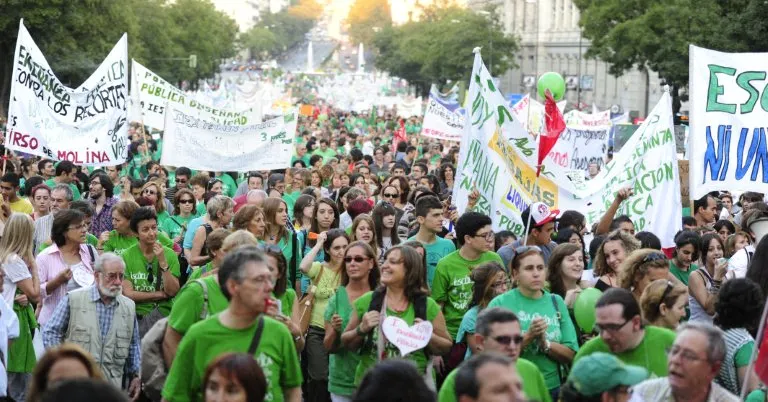
Teachers and other educators in Valencia, Catalonia and Aragón have been staging a series of walkouts in recent days, protesting everything from class sizes to salary and working conditions. Here’s what you need to know about the situation this week.
An indefinite strike in Valencia has been going on since May 11th, while in Catalonia teachers began their stoppage the following day on May 12th.
This is the third stoppage by teachers in Catalonia this year, following the huge mobilisations on February 11th and March 20th.
In Aragón, education unions also announced protests on Tuesday May 19th and Wednesday May 20th.
READ ALSO: What to know about the teachers’ strikes in Valencia and Catalonia
This week, all three regions are facing new calls for teacher protests, amid ongoing conflicts with their respective education authorities, without a unified national call to action.
This comes after weeks, and in some cases months, of negotiations and ongoing calls for change.
Valencia
The situation is most serious in Valencia, where unions have called for an indefinite strike for public school teachers.
They are demanding salary increases, reduced student-teacher ratios, increased staffing, less bureaucracy, and changes in regional education policy.
Last week saw big demonstrations in Valencia, Alicante, Elche, and Castellón, as well as sit-ins and marches. Thousands of teachers, students, and families also took to the streets on Sunday.
The strike continues this Monday as they await further negotiations.
Catalonia
In Catalonia, educators and teachers held walkouts on May 12th, but have more regionwide strikes planned for May 27th and June 5th.
There were also more protests concentrated in Barcelona on Monday May 18th, where disgruntled teachers blocked the entrance to the Sagrada Familia for two hours.
Teachers in the region are demanding better working conditions and better organisation of the education system. They want improvements to teachers’ working conditions, a review of certain organisational decisions, and progress on issues related to staffing, workload, and labour negotiations.
Minimum services have been decreed here. For early childhood, primary and secondary education it will be one teacher for every 3 classrooms.
Aragón
In Aragón, teachers are continuing to protest decisions related to educational agreements, especially for high schools, which is slightly different to the other two regions. They are also demanding better funding of the education sector from the local government.
Teachers at all non-university public education centres across the provinces of Zaragoza, Huesca, and Teruel will be staging protests on May 19th and 20th.
On Monday, many parents and teachers plan to spend the night at the Hispanidad and Soledad Puértolas schools in Zaragoza, and a group of teachers will also camp out early Wednesday morning on the sports fields of the Domingo Miral high school in Jaca.