
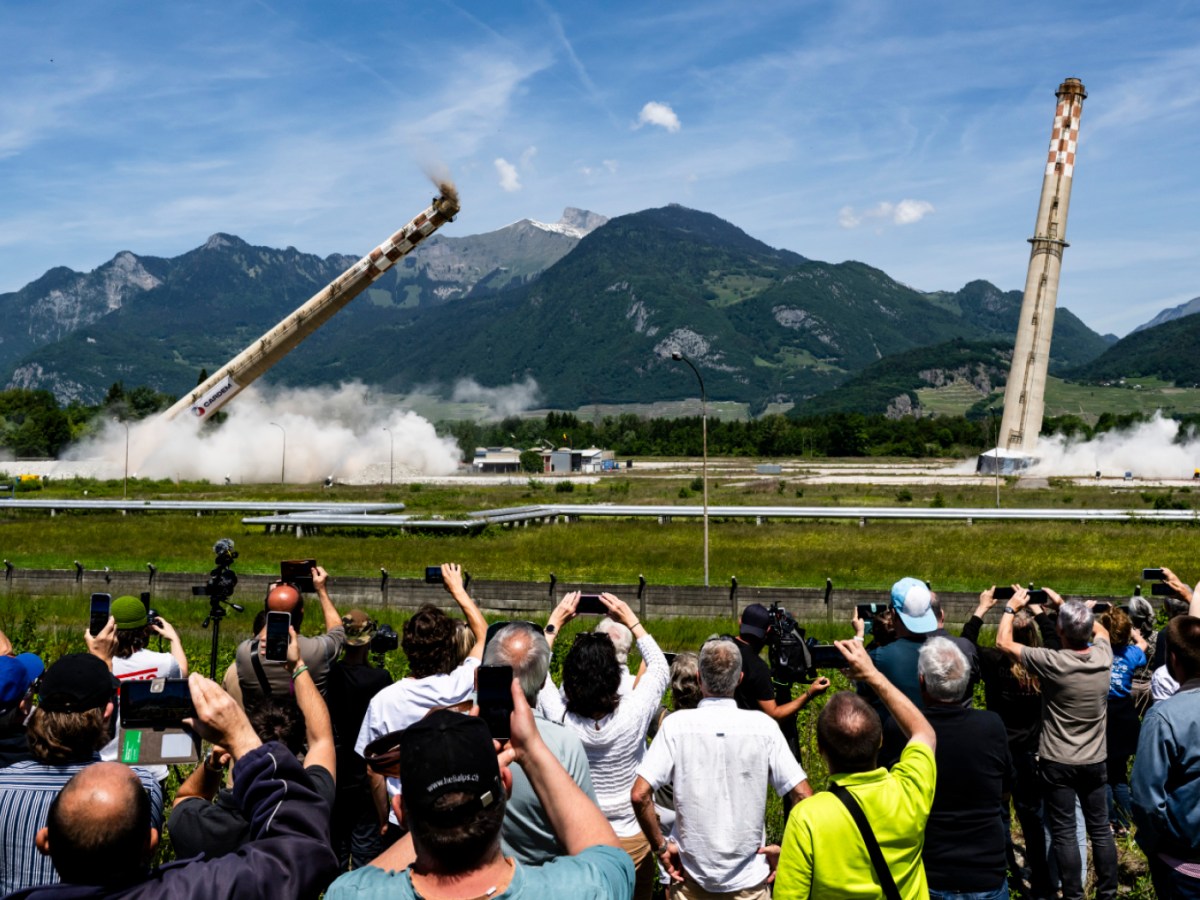
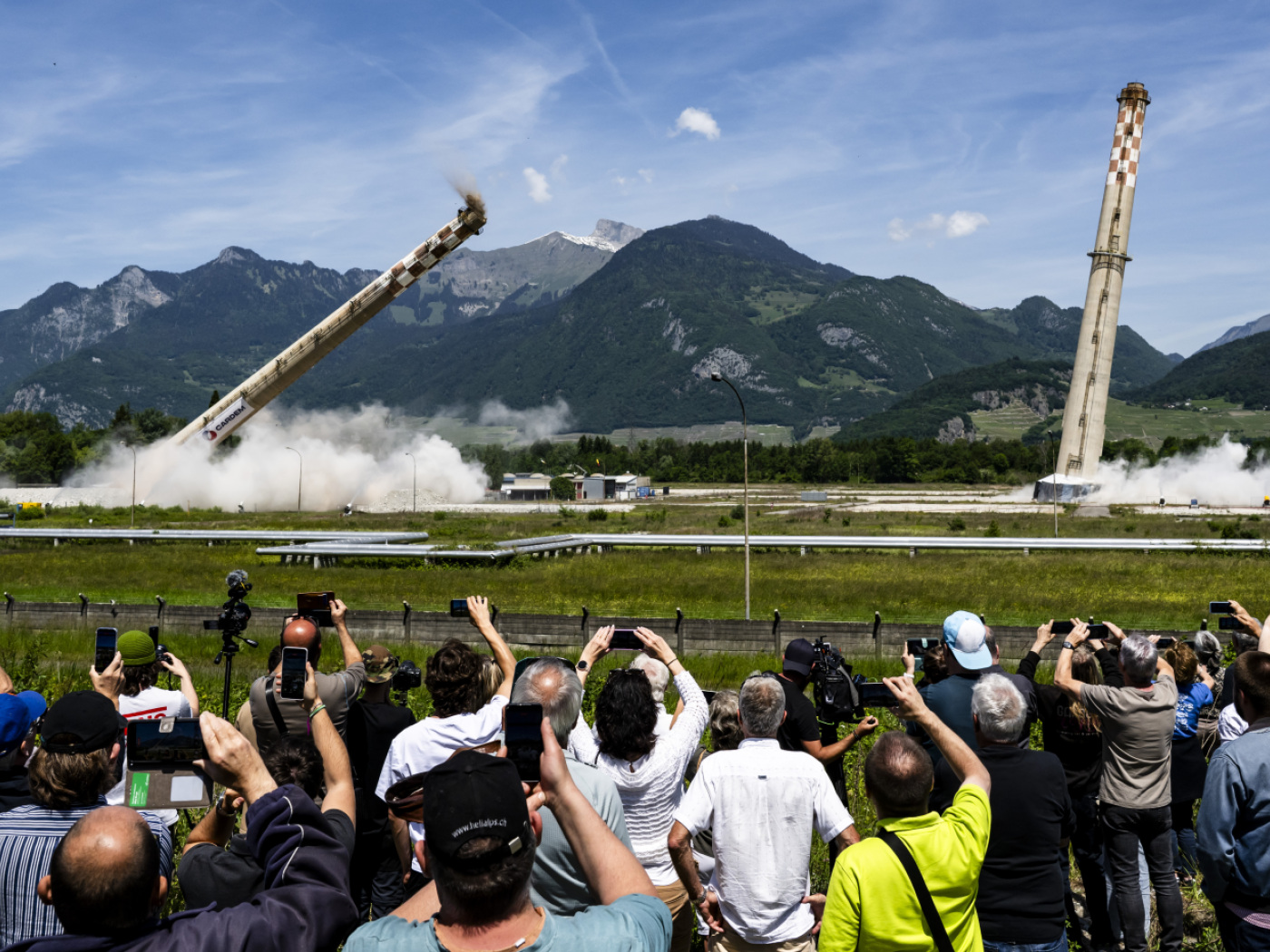
The final two chimneys at the Tamoil Collombey-Muraz refinery were demolished on Thursday.
Keystone-SDA
The final two chimneys of the former Tamoil refinery in Collombey‑Muraz, canton Valais, were demolished on Thursday, as plans continue to redevelop the site into a hub for new technologies.
+Get the most important news from Switzerland in your inbox
The chimneys, about 100 metres high and with a total weight of 4,000 tonnes, collapsed one after the other, like a house of cards, within seconds.
The demolition, which took about three months to prepare, required 50 kilos of explosives. Nearby streets were closed for one hour for safety reasons.
“Extensive environmental, technical and risk analysis studies have been conducted since 2024 and field tests were carried out in 2025 to assess ground vibrations,” Tamoil Switzerland Director Stéphane Trachsler told reporters. The rubble will be reused in construction projects in the region.
More

More
Switzerland’s fossil fuel dependence explained
“It’s a symbolic day,” said Olivier Turin, mayor of Collombey-Muraz. “It closes an industrial chapter, but allows for a new beginning that will transform our local landscape and that of the Chablais region.”
“One cannot witness the disappearance of a site that has been an energy provider for our country and has provided a living for so many families for decades without feeling a certain nostalgia, especially among the people who worked there,” Trachsler said.
More

More
Where Switzerland gets its oil and gas
“This dismantling is both an end and a beginning but which will not be that of heavy industry, but rather oriented towards new technologies.”
The refinery was closed in 2015 and over 230 people lost their jobs. At the time, canton Valais gave Tamoil a five-year deadline to decide on possible re-use of the site, but the company decided in 2019 that it no longer wanted to re-open and announced that it would be decommissioned.
Translated from Italian by AI/sb
We select the most relevant news for an international audience and use automatic translation tools to translate them into English. A journalist then reviews the translation for clarity and accuracy before publication.
Providing you with automatically translated news gives us the time to write more in-depth articles. The news stories we select have been written and carefully fact-checked by an external editorial team from news agencies such as Bloomberg or Keystone.
If you have any questions about how we work, write to us at english@swissinfo.ch
