Blog

  • FanDuel Arkansas Promo Code: Bet , Get 0 Win or Lose as FanDuel Launches in Arkansas

    FanDuel Arkansas Promo Code: Bet $5, Get $300 Win or Lose as FanDuel Launches in Arkansas


    This page may contain affiliate links to legal sports betting partners. If you sign up or place a wager, FOX Sports may be compensated. Read more about Sports Betting on FOX Sports.

    FanDuel has now launched in Arkansas, and if you are looking to sign up for one of these new sportsbooks in the Natural State, then this welcome offer is for you!

    CLICK HERE to claim a cool $300 bonus, when you sign up and bet your first $5 on the platform. That is a huge reward for signing up and placing your first bet on your new online sportsbook, and the best part is, your first bet doesn’t even have to win!

    So whether you are betting on basketball, hockey, or any other sport this weekend, this bet $5, get $300 promises to kick off your FanDuel journey with a bang.

    Read below to learn more:

    How to Claim the FanDuel Arkansas Promo Code:

    1. CLICK HERE to claim the FanDuel Arkansas welcome bonus
    2. Deposit $5+ into your account, so your account is funded and ready to place your first qualifying bet
    3. Bet $5 on your chosen sport
    4. Receive $300 in bonus bets, win or lose!

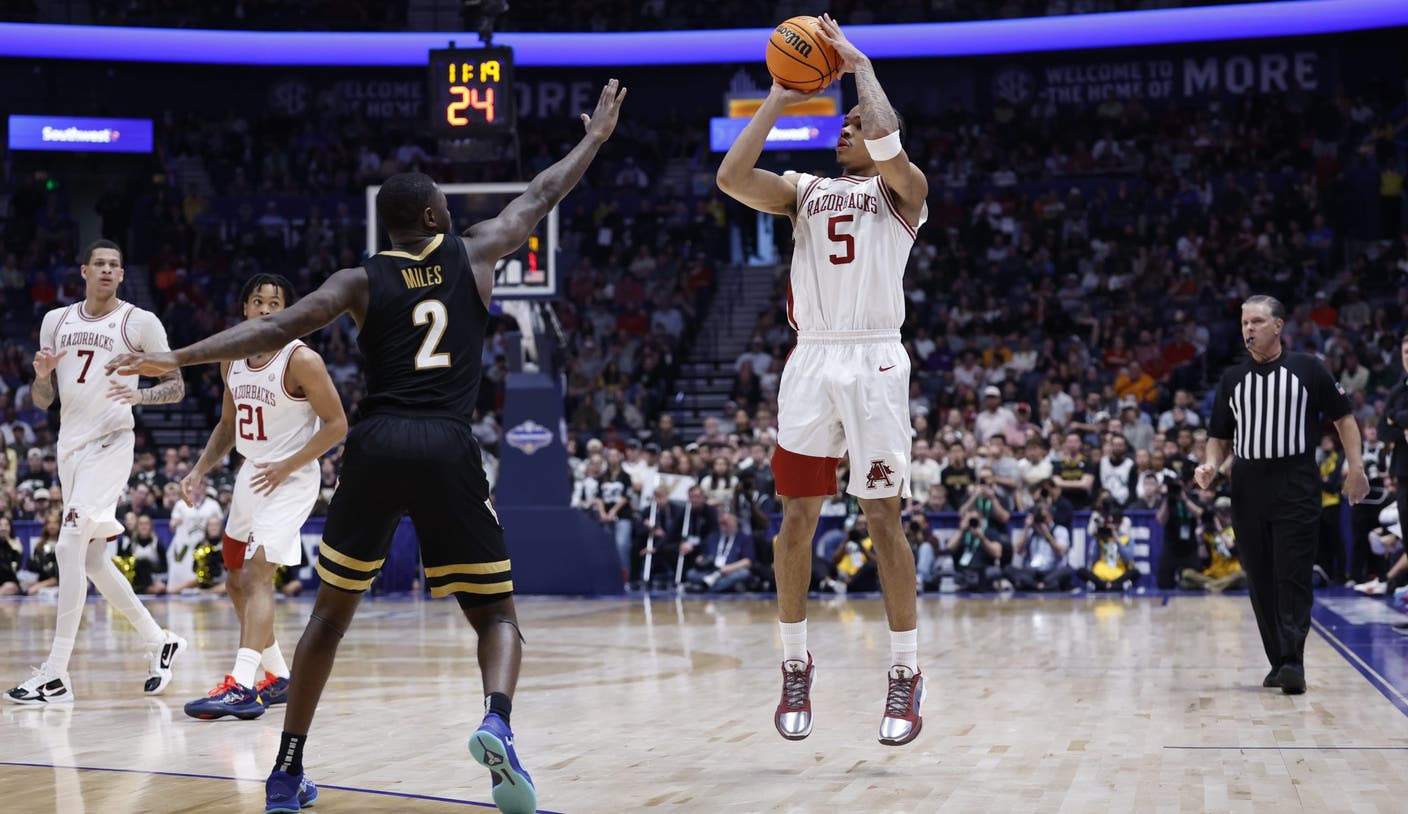
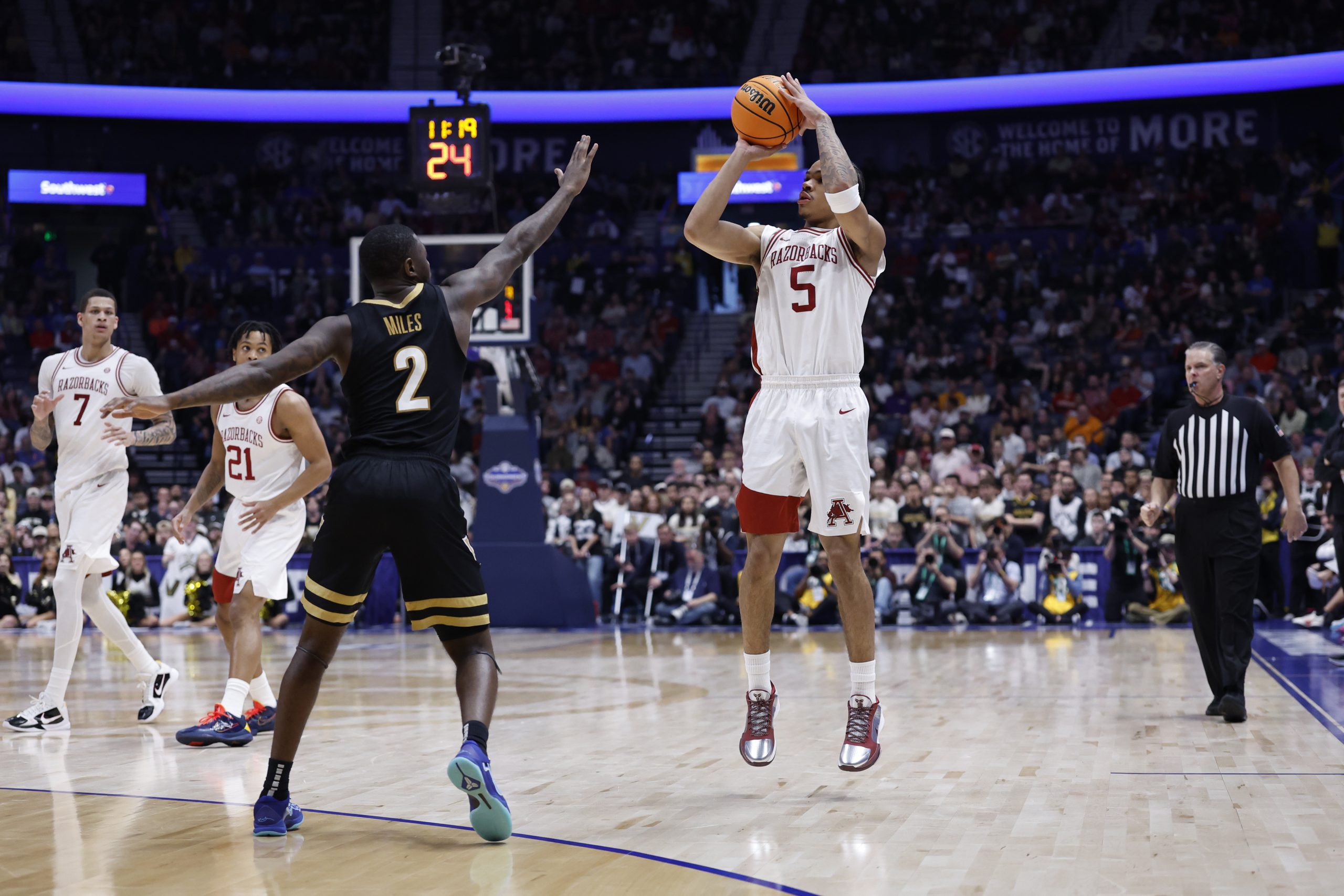
    High Point Panthers vs. Arkansas Razorbacks – Game Preview

    • Matchup: High Point Panthers (31-4, 18-1 Big South) vs. Arkansas Razorbacks (27-8, 16-5 SEC).
    • Location/Time: Portland, Oregon; Today, 9:45 p.m. EDT.
    • Betting Line: Razorbacks -11.5; over/under is 168.5.
    • Tournament Context: No. 14 Arkansas faces High Point in the second round of the NCAA Tournament.
    • Conference Play: Arkansas went 16-5 in SEC play and 11-3 in non-conference games, while High Point dominated the Big South at 18-1.
    • Scoring Margin: Arkansas averages 90.1 PPG and outscores opponents by 10.1 points per game.
    • Offensive Profile: High Point leads the Big South with 89.8 PPG while shooting 48.9% from the field.
    • Scoring Comparison: Arkansas scores 90.1 PPG, 19.5 more than the 70.6 High Point allows. High Point averages 89.8 PPG, 9.8 more than the 80.0 Arkansas allows.

    Top Performers

    • Darius Acuff Jr. (Arkansas): 23.0 PPG, 2.6 made 3-pointers per game (44.4% from three).
    • Meleek Thomas (Arkansas): 16.7 PPG over the last 10 games while shooting 45.3%.
    • Terry Anderson (High Point): 16.0 PPG, 6.1 RPG, 1.5 SPG.
    • Rob Martin (High Point): 18.2 PPG, 4.6 APG, 1.6 SPG over the last 10 games.

    Last 10 Games

    • Razorbacks: 8-2, averaging 93.6 PPG, 33.6 RPG, 17.2 APG while shooting 49.4%. Opponents average 88.9 PPG.
    • Panthers: 10-0, averaging 86.5 PPG, 34.3 RPG, 15.3 APG while shooting 45.1%. Opponents average 73.0 PPG.

    FanDuel Arkansas Promo Code Terms and Conditions

    • First time FanDuel Sportsbook customers only
    • Place a wager of $5+ on any sport between 3/20/2025 at 12:00 a.m. Central Time (CT) and 4/26/2026 at 11:59 p.m. Central Time (CT).
    • Your first placed wager of $5+ will be your qualifying wager
    • You will receive $300 in bonus bets instantly
    • Bonus Bets are single-use, non-transferable, non-withdrawable, and have no cash value. Bonus Bets are valid for seven (7) days (168 hours) from the time they are credited to customers’ accounts. Bonus Bet stake removed from payout
    • Bonus Bet cannot be used as qualifying wager
    • One (1) qualifying wager per customer
    • Must be 21+, unless otherwise stated, and located in AR
    • Customers who participated in any Pre-Launch offer are ineligible for this promotion

    Gamble responsibly. Gambling Problem? Call or text 1-800-522-4700.

    If you or someone you know has a gambling problem, Call 1-800-GAMBLER.

    21+ and present in AR.
    Read More

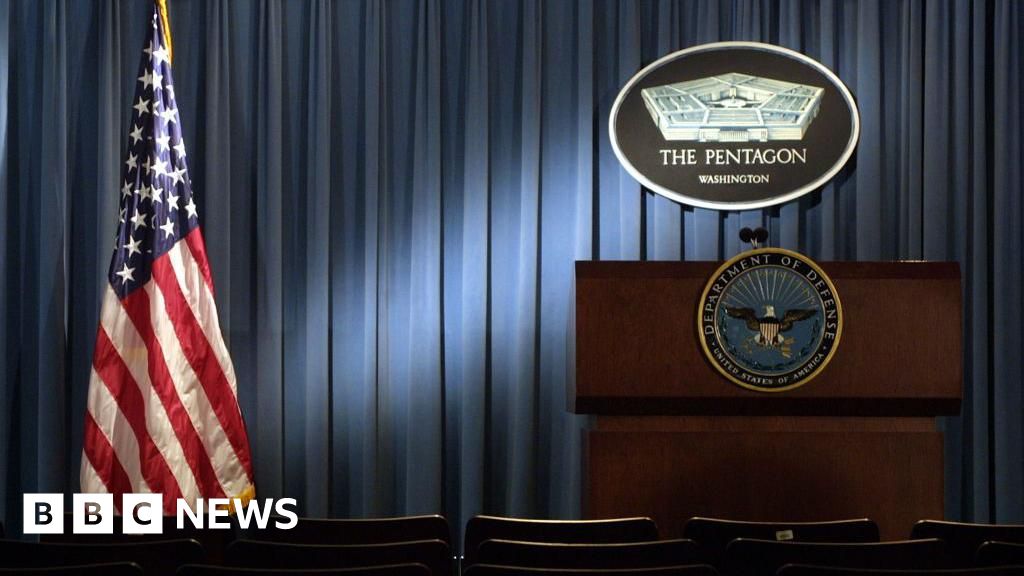
  • Pentagon restrictions on press violate First Amendment, judge rules

    Pentagon restrictions on press violate First Amendment, judge rules


    The Department of Defense had required reporters to agree to certain rules on what information they could gather in order to maintain access to the Pentagon.

    Read More

  • UK polo patrons linked to laundering of Venezuelan oil sale proceeds, says US Treasury

    UK polo patrons linked to laundering of Venezuelan oil sale proceeds, says US Treasury


    Unlock the Editor’s Digest for free

    Two leading figures in English polo have been accused of using their positions at a now-defunct Swiss bank to launder the proceeds of the illegal sale of millions of barrels of oil belonging to Venezuela’s national oil company, according to the US Treasury.

    A notice issued by the Treasury department earlier this month about the activities of Zurich-based MBaer Merchant Bank linked both Siri Evjemo-Nysveen, the bank’s former vice-chair, and her husband Alessandro Bazzoni, an Italian businessman, to allegations of money laundering.

    Both are leading figures in England’s polo scene, with Bazzoni acting as patron of the Monterosso team while Evjemo-Nysveen acted as patron of a team called Vikings. Patrons are wealthy players who bankroll a team and play alongside hired professionals.

    Bazzoni played in a charity polo tournament against Prince William, the Prince of Wales, in 2022 while he was on the US sanctions list for trading with Venezuela. He has since been removed from that list.

    His team Monterosso played an active role in last summer’s English polo season.

    Alessandro Bazzoni, wearing a white helmet and polo shirt, stands beside a brown polo horse during a match.
    Alessandro Bazzoni is patron of the Monterosso polo team © Zuma/Alamy

    Last month, Switzerland’s financial regulator Finma withdrew MBaer’s licence, saying it did not have an adequate structure in place to combat money laundering. The bank subsequently went into liquidation.

    On March 2, the Financial Crimes Enforcement Network (FCEN), a bureau of the US Treasury department, published a notice proposing MBaer be designated an “institution . . . of primary money laundering concern”.

    It said that for years the bank had “directly or indirectly facilitated money laundering for or on behalf of illicit actors”, including Russians and Iranians.

    It added that the bank’s beginnings were “anchored in Venezuela corruption”.

    MBaer was founded in 2018 by Michael Bär, great-grandson of the founder of Switzerland’s Julius Baer private bank, according to a page on its website that has since been removed.

    According to the UK’s Land Registry, Evjemo-Nysveen owns an eight-bedroom house with stables and fields near Windsor that she bought for £8mn in 2021.

    The FCEN notice said that press reports had accused Evjemo-Nysveen of using the bank to launder the proceeds of a corruption scheme at Petróleos de Venezuela (PDVSA), the state oil company.

    Mbaer Swiss Merchant Bank sign

    The Office of Foreign Assets Control (Ofac), which oversees the US sanctions regime, imposed sanctions on PDVSA in January 2019 over its role in shoring up the regime of Venezuela’s then-president Nicolás Maduro.

    The FCEN notice said that PDVSA had allegedly “secretly sold millions of barrels of Venezuelan crude oil in circumvention of US sanctions” and embezzled the proceeds “in a manner that deprived the Venezuelan public of the benefits” of the “illegal sales”.

    It said: “Siri Evjemo-Nysveen, MBaer’s vice-chairperson from September 2020 through May 2023 and board member from 2019 to 2023, reportedly used her position to further payments through MBaer related to a PDVSA corruption scheme.”

    It added: “She reportedly did so on behalf of her husband, Alessandro Bazzoni, a minority shareholder of MBaer at the time, who was sanctioned by Ofac in January 2021 for providing material support to PDVSA in his role as a core facilitator of the sanctions evasion network.”

    The statement said that Evjemo-Nysveen’s activities took place while Bazzoni was still on the US sanctions list, although it acknowledged that he was subsequently removed from it.

    In a response to the notice, Bazzoni, Evjemo-Nysveen and their solicitors said the references to Bazzoni in the Treasury notice referred to “unsubstantiated or debunked sources”.

    They said: “Mr Bazzoni was previously vindicated through his successful sanctions delisting by one arm of the US Treasury and expects to be vindicated once again with this second arm of the same department.”

    They added: “US (and Swiss) authorities have never taken any action, investigative or otherwise, against Ms Evjemo-Nysveen in the context of the allegations referred to in the discredited article, which are denied.”

    The Treasury’s notice also alleged that MBaer maintained an account for Jose Luis Chavez Calva, whom it called “a key figure involved in laundering billions of dollars obtained through PDVSA corruption through European banks”.

    It said Calva was alleged to be a financial facilitator handling “funds derived from corruption” on behalf of both Bazzoni and Alex Saab, a close associate of Bazzoni.

    Calva told the FT he had no criminal convictions in any jurisdiction worldwide and that any account with the bank had been held for legitimate personal and professional purposes.

    He said: “I strongly deny any involvement in money laundering or acting as a financial facilitator.”

    No UK law enforcement agency has publicly acknowledged investigating or taking any action against Bazzoni or Evjemo-Nysveen. In response to an inquiry by the FT on Friday, the National Crime Agency said it routinely refused to confirm or deny the existence of investigations.

    Additional reporting by Mercedes Ruehl in Zurich

    Read More

  • Middle East war risks undermining Syria’s fragile recovery, Security Council hears

    Middle East war risks undermining Syria’s fragile recovery, Security Council hears


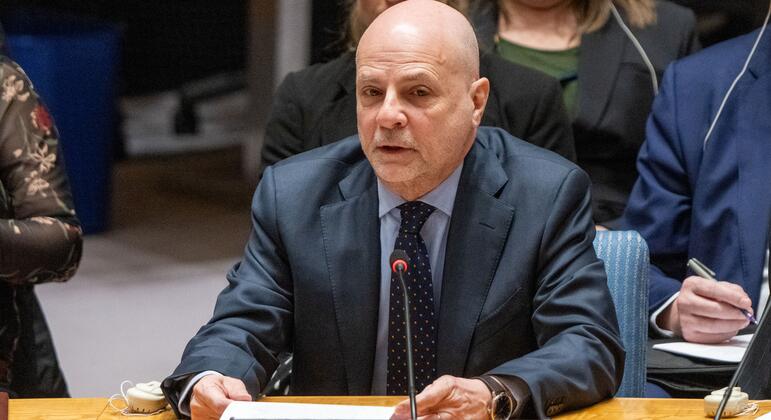
    Claudio Cordone, the Secretary-General’s Deputy Special Envoy for Syria, and Joyce Msuya of the UN humanitarian affairs office, OCHA, briefed ambassadors alongside Syrian Olympic athlete Yusra Mardini, a Goodwill Ambassador with the UN refugee agency, UNHCR

    Mr. Cordone began by addressing how “the alarming regional escalation” is impacting Syria, which continues along the path to political transition more than a year after the overthrow of the Assad regime and 14 years of civil war. 

    Incidents inside Syrian territory have mainly involved the crashing of debris following interception of Iranian missiles and drones in Syrian airspace, causing civilian casualties, and one incident of shelling from Lebanon attributed to Hezbollah,” he said. 

    Israeli helicopter and drone operations in Syrian airspace have also increased, and Israeli forces continued to carry out incursions into Syrian territory. 

    Thousands flee from Lebanon 

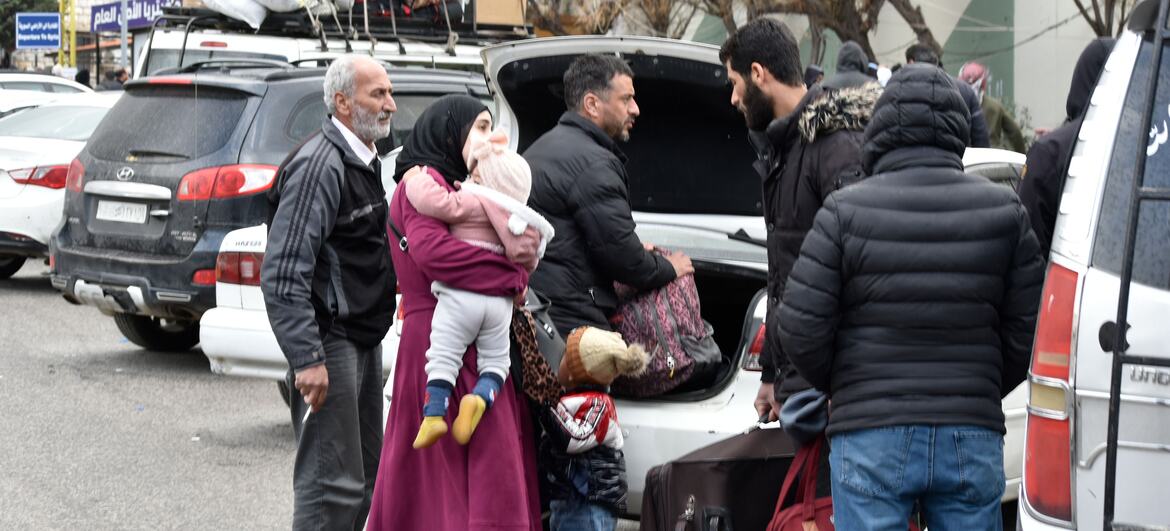
    Furthermore, Israeli airstrikes on Lebanon have killed both Lebanese and Syrian citizens and forced roughly 140,000 people, mostly Syrian nationals, to cross into Syria in search of safety.

    I reiterate our call in this context on Israel to fully respect Syria’s sovereignty and territorial integrity, adhere to the terms of the 1974 Disengagement of Forces Agreement, and refrain from any actions that could undermine Syria’s stability and political transition,” he said. 

    The envoy commended the Syrian Government for its engagement with regional and international stakeholders to insulate the country from further escalation and ensure that its territory is not used in ways that could widen the conflict. 

    “Syria’s steady but fragile recovery –political, institutional and economic – could be undermined by the impact of a prolonged regional conflict,” he warned.

    Let us redouble efforts to support Syria in shielding itself from this conflict, and let us refocus on helping Syria continue, and even accelerate, its path towards recovery, reconstruction and stability.” 

    Refugee family with luggage waits at the Masnaa border crossing in Lebanon to enter Syria, escaping Israeli bombing.

    People gather at the Masnaa border point in Lebanon as they wait to cross into Syria to escape the ongoing conflict.

    ‘New strain at a fragile moment’ 

    Ms. Msuya, the UN Deputy Emergency Relief Coordinator, reported on the humanitarian aspects of the crisis. 

    “For Syria, this escalation adds new strain at a fragile moment – one that still offers a genuine opportunity for progress,” she said.

    She noted that falling debris has killed or injured several people, in addition to damaging property, while the scores of people who fled from Lebanon join some 1.5 million refugees who have returned from neighbouring countries since December 2024. 

    A ‘fragile’ opportunity 

    Yet, humanitarian operations continue in Syria despite airspace restrictions, the closure of the airport in the capital Damascus, and heightened security risks. 

    “As we have consistently told this Council, Syria has an important opportunity to move towards economic recovery, to gradually reduce humanitarian needs, and to lessen reliance on large-scale humanitarian assistance,” she said. 

    “But this opportunity remains fragile and will require sustained international support, particularly in the face of the regional volatility.” 

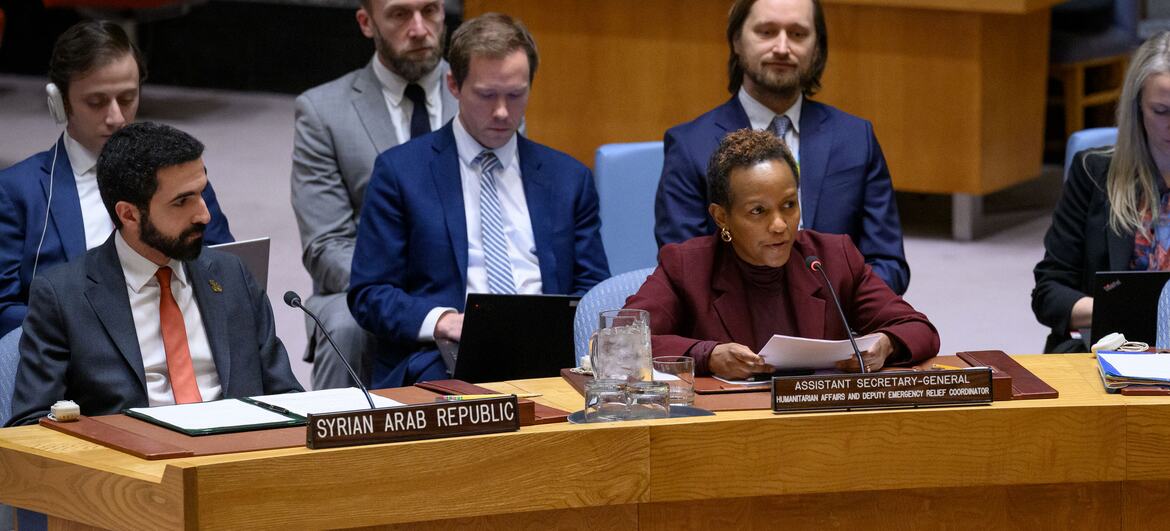
    A woman in a maroon blazer speaking at a conference table with a nameplate reading 'ASSISTANT SECRETARY-GENERAL HUMANITARIAN AFFAIRS AND DEPUTY EMERGENCY RELIEF COORDINATOR'. Behind her, a man sits at a table with a nameplate for the 'SYRIAN ARAB REPUBLIC'.

    Joyce Msuya (right) UN Deputy Emergency Relief Coordinator, briefs the Security Council meeting on the Middle East.

    Diplomacy, aid and investment 

    Ms. Msuya made three requests to ambassadors, first calling for “sustained diplomatic engagement to resolve remaining flashpoints” and ensure stability necessary for people to return home and recovery to begin.

    “This includes consolidating security improvements in areas like northeast Syria, where recent violence has added to existing needs. But it also includes addressing the current regional escalation,” she said. 

    “Beyond the danger of direct military spillover, the prolonged disruption to shipping routes, coupled with the rising prices of fuel, fertilizer and other essential goods, could deal a serious blow to Syria’s already fragile economy – just as it begins to recover and reconnect with the world after years of conflict and isolation.”

    She also stressed the need to sustain critical humanitarian assistance in the near term, as operations remain constrained by funding shortfalls, liquidity challenges and the lack of banking and other services in many parts of the country. 

    “It would be a tragic mistake if our support to the people of Syria lost momentum now,” she said.

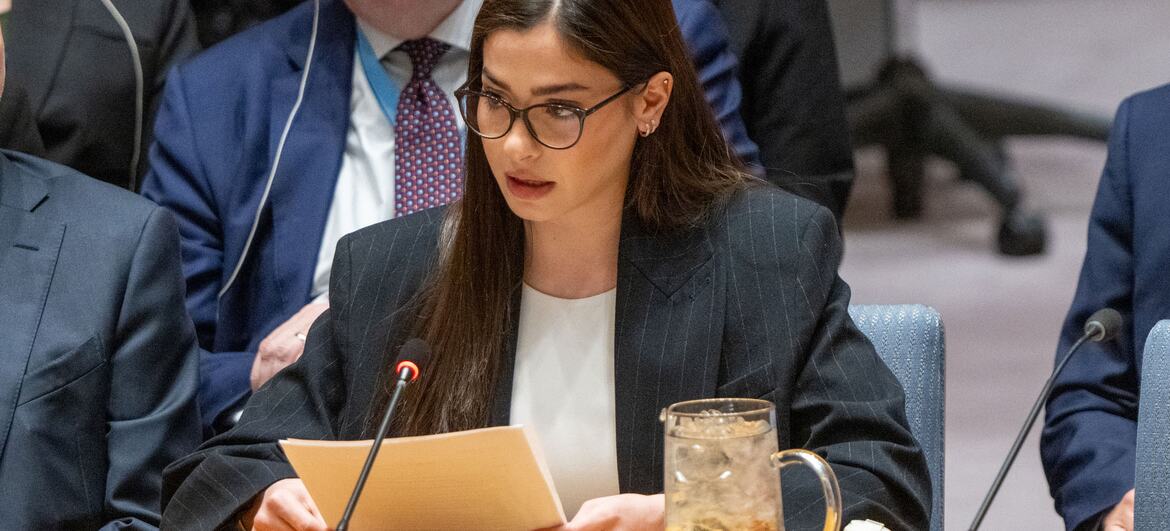
    Yusra Mardini speaking at a formal event, seated at a table with a microphone.

    UNHCR Goodwill Ambassador, Yusra Mardini, speaks at the UN Security Council meeting on the situation in the Middle East.

    Breaking down ‘walls of division’

    Ms. Mardini – a member of the first refugee team to compete at the Olympic Games – described herself as a child of war. She said half of all children in Syria today have never known a single day of peace. 

    She emphasised that her homeland requires years of recovery that is not only physical.

    “Syria also requires reconciliation and societal recovery. A future where no religious sect divides us, and where no one group is favoured over another. We must break down the walls of division, not build new ones,” she said. 

    Ms. Mardini also spoke of the challenges facing young Syrians and urged the international community to provide financial support, investment, and capacity-building so Syria can once again build a world-class education system. 

    Read More

  • EU divisions deepen over Russian sanctions as Commission rejects compromise on oligarch delistings


    The European Union’s internal divisions over Russia sanctions have resurfaced following reports that the European Commission has rejected a compromise proposal to potentially delist two prominent Russian businessmen, Alisher Usmanov and Mikhail Fridman.

    The issue emerged during recent negotiations on the rollover of EU sanctions against Russia, a process that requires unanimous approval from all member states. Hungary and Slovakia reportedly pushed for the immediate removal of Usmanov and Fridman from the sanctions list, arguing that their continued designation was no longer justified.

    However, the proposal met resistance from a majority of EU countries, reflecting ongoing caution within the bloc about easing pressure on individuals linked directly or indirectly to the Kremlin amid the continuing war in Ukraine.

    A compromise rejected

    In an attempt to break the deadlock, Slovakia is understood to have proposed a compromise: the EU would commit to delisting the two businessmen if the Court of Justice of the European Union (CJEU) were to rule in their favour in ongoing legal challenges against their sanctions.

    Such a move would have created a clearer link between judicial outcomes and political decisions on sanctions. But the European Commission reportedly rejected this approach as well, maintaining that sanctions policy must remain within the political discretion of member states.

    The rejection underscores a broader tension within the EU system—between legal processes and political decision-making in sanctions policy.

    Politics versus law

    EU sanctions are adopted under the bloc’s Common Foreign and Security Policy (CFSP), an area where political considerations dominate, and unanimity is required. While individuals and entities have the right to challenge their designation before the EU courts, a favourable ruling does not automatically translate into immediate delisting.

    This disconnect has drawn increasing scrutiny.

    Critics argue that the refusal to tie delisting decisions more closely to judicial rulings highlights the fundamentally political nature of sanctions. In their view, the current system risks undermining legal certainty, as court victories may not guarantee relief from restrictive measures.

    Supporters of the Commission’s position, however, contend that sanctions are a foreign policy tool, not merely a legal instrument. They argue that even if procedural or evidentiary issues arise in court, the broader political rationale for maintaining pressure on Russia—and those associated with its economic and political system—remains valid.

    Rare and selective delistings

    While some sanctioned individuals have successfully challenged their listings before EU courts, such cases remain relatively rare. Those who have been delisted through judicial proceedings have often been lower-profile figures, including family members of sanctioned individuals, rather than major business figures.

    This pattern has reinforced perceptions among some observers that the system operates unevenly, with high-profile cases more likely to remain entangled in political considerations.

    Broader implications

    The dispute comes at a sensitive moment for EU unity. Sanctions against Russia have been one of the bloc’s central responses to Moscow’s invasion of Ukraine, but maintaining consensus among 27 member states has become increasingly complex as economic pressures and political differences grow.

    Hungary, in particular, has repeatedly used its veto power to extract concessions in sanctions negotiations, while Slovakia’s position reflects a more nuanced balancing act between EU alignment and domestic political considerations.

    The latest disagreement over Usmanov and Fridman highlights not only the challenges of sustaining a unified sanctions regime but also the unresolved question at its core: to what extent should EU sanctions be governed by legal rulings versus political judgement?

    As legal challenges continue to make their way through the CJEU, that tension is unlikely to fade—and may yet shape the future of the EU’s sanctions architecture.

    Read More

  • High-Stakes Nuclear Talks Between U.S. and Iran Set to Kick Off

    High-Stakes Nuclear Talks Between U.S. and Iran Set to Kick Off


    new video loaded: High-Stakes Nuclear Talks Between U.S. and Iran Set to Kick Off

    transcript

    transcript

    High-Stakes Nuclear Talks Between U.S. and Iran Set to Kick Off

    The United States and Iran have been flexing their military might as their negotiators resume nuclear talks in Switzerland.

    I’ll be involved in those talks indirectly, and they’ll be very important. We’ll see what can happen. Typically, Iran’s a very tough negotiator. I don’t think they want the consequences of not making a deal. They want to make a deal.

    The United States and Iran have been flexing their military might as their negotiators resume nuclear talks in Switzerland.

    By Shawn Paik

    February 17, 2026

    Read More

  • Things to see and do in the Loire Valley

    Things to see and do in the Loire Valley


    LOIRE FESTIVALS

    The Festival International des Jardins, held at the beautiful Château de Chaumont-sur-Loire, is the leading garden festival in France. Every year, the top international names in garden and landscape design are given carte blanche to let their imagination run wild. Held from May till November, the festival is renowned throughout Europe for the extraordinary quality of its exhibits.

    domaine-chaumont.fr/en/international-garden-festival

    Each year the Domaine de Chaumont-sur-Loire Centre d’Arts et Nature invites internationally acclaimed artists and photographers to create original, site-specific works on the theme of nature. Set within the château and across its 32 hectares, you’ll discover top artistic talent alongside the château’s exceptional permanent collection.

    domaine-chaumont.fr/en/centre-arts-and-nature

    Orléans’s biennial Festival de Loire is Europe’s largest gathering of traditional riverboats, and it magically recreates the bustling 19th-century port life along the Loire, featuring maritime exhibitions, regattas, live performances, rowing races, boat jousts and local gastronomy.

    www.tourisme-orleansmetropole.com/en

    Held each autumn, the AR(t] CHIPEL contemporary art festival, in partnership with Paris’s Centre Pompidou, pairs artworks from the Pompidou collection with works by local artists at historic sites across the Loire Valley, many of which are normally closed to the public.

    www.centrepompidou.fr/en/lieu/artchipel-festival

    CYCLING

    Among the world’s most beautiful cycling paths, Loire à Vélo’s 560 mile (900 km) route runs past storybook châteaux, scenic rivers, and the beautiful UNESCO-designated landscape of the Loire. Along the way, cyclists can enjoy hotels at every comfort level, food, wine tastings, repair stops, parking and a special transport train. Check the website for bike rentals.

    www.loirebybike.co.uk

    Circuit_gravel_et_bickepacking-Copyright-Dorothee_Mouraud___Destination_Angers

    Every year, gravel cycling enthusiasts flock to Angers to participate in the Nature is Bike festival, held in late May. This citywide celebration highlights the 1,000 km of gravel paths that lead from the centre of Angers to the sea and beyond.

    natureisbike.com/en

    VINEYARDS & TASTINGS

    The Loire Valley is one of France’s most diverse wine regions and scores of winemakers offer tastings and wine experiences. The Vins de Loire website is an excellent resource to find a tasting, tour or other wine-themed activity along the Route de Loire or near wherever you plan to be.

    www.vinsdeloire.fr/en

    Château d’Epiré©Portrait Paul Bizard 5th generation winemaker

    Wine tasting in a troglodyte cave is an experience not to be missed while in the Loire.

    tinyurl.com/troglodyte-wine

    GUIDED TOURS

    Bilingual guide Aurzelle da Silva leads tailored tours, spinning bygone times into a riveting story – with a refreshing sense of humour. With a master’s degree in medieval art history, and articles published in French scholarly journals, Da Silva can get as fascinatingly geeky as you like.

    www.loirepassionguide.fr

    BOAT TOURS

    For 80 years, La Bélandre -Chenonceaux en Bateaux has navigated the romantic River Cher. Boats cast off near the village of Chisseaux, 2km from Château de Chenonceau. Join a tour on a sightseeing boat or hire a silent electric boat for four to meander under the château’s arched bridge and view its famous reflection. Parking is plentiful and boats leave frequently.

    www.labelandre.com

    HOT AIR BALLOON RIDES

    Positive Altitude’s balloons take you over Cheverny, Chambord, Chaumont-sur-Loire, or Chenonceau, depending on the wind direction, as well as many other gems. Flights cost from €200 to €680 for a private VIP tour.

    www.positive-altitude.fr

    Mongolfière Loire, Wiki Commons

    From France Today Magazine

    Lead photo credit : Meta-Nature AI, installation de Miguel_Chevalier au Domaine de Chaumont-sur-Loire, 2025 © M. Chevalier

    Your email address will not be published. Required fields are marked *

    Read More

  • 2025-26 Men’s Final Four Odds: Duke, Michigan, Florida and Arizona Favored

    2025-26 Men’s Final Four Odds: Duke, Michigan, Florida and Arizona Favored


    The men’s Final Four isn’t necessarily close, but it’s not far either. 

    Who is favored to be one of the last teams standing?

    Let’s check out the odds for the 2026 Final Four at DraftKings Sportsbook as of March 21. 

    This page may contain affiliate links to legal sports betting partners. If you sign up or place a wager, FOX Sports may be compensated. Read more about Sports Betting on FOX Sports.

    To reach the Final Four 2026

    East Region

    Duke: -120 (bet $10 to win $18.33 total)
    UConn: +650 (bet $10 to win $75 total)
    Michigan State: +750 (bet $10 to win $85 total)
    St. John’s: +800 (bet $10 to win $90 total)
    Kansas: +1500 (bet $10 to win $160 total)
    Louisville: +1700 (bet $10 to win $180 total)
    UCLA: +2200 (bet $10 to win $230 total)
    TCU: +7500 (bet $10 to win $760 total)

    Midwest Region

    Michigan: -135 (bet $10 to win $17.41 total)
    Iowa State: +425 (bet $10 to win $52.50 total)
    Tennessee: +1000 (bet $10 to win $110 total)
    Virginia: +1100 (bet $10 to win $120 total)
    Texas Tech: +1500 (bet $10 to win $160 total)
    Alabama: +2000 (bet $10 to win $210 total)
    Kentucky: +3000 (bet $10 to win $310 total)
    Saint Louis: +6500 (bet $10 to win $660 total)

    South Region

    Florida: +180 (bet $10 to win $28 total)
    Houston: +225 (bet $10 to win $32.50 total)
    Illinois: +350 (bet $10 to win $45 total)
    Nebraska: +1100 (bet $10 to win $120 total)
    Vanderbilt: +1300 (bet $10 to win $140 total)
    Iowa: +4500 (bet $10 to win $460 total)
    VCU: +7500 (bet $10 to win $760 total)
    Texas A&M: +8000 (bet $10 to win $810 total)

    West Region

    Arizona: -120 (bet $10 to win $18.33 total)
    Purdue: +350 (bet $10 to win $45 total)
    Gonzaga: +600 (bet $10 to win $70 total)
    Arkansas: +750 (bet $10 to win $85 total)
    Miami FL: +4500 (bet $10 to win $460 total)
    Texas: +5000 (bet $10 to win $510 total)
    Utah State: +6000 (bet $10 to win $610 total)
    High Point: +40000 (bet $10 to win $4,010 total)

    Here’s what to know about the Final Four oddsboard: 

    The Favorite(s): Duke, Arizona, Michigan and Florida are favored to comprise the Final Four — all four No. 1 seeds. Arizona last made the Final Four way back in 2001, while Michigan last made it in 2018. The Blue Devils last made a Final Four appearance last season, and the Gators are the defending champions. In terms of current form, the Blue Devils did not impress in the first round, while Arizona, Michigan and Florida won in convincing fashion.

    The Contenders: UConn, Iowa State, Houston and Purdue are the four teams expected to challenge the favorites in each region, at least according to the odds. The Huskies have won two of the last three national titles (2023 and 2024) and lost to eventual national champion Florida by two in the second round of last season’s NCAA Tournament. In the first round, UConn eked past Furman, while ISU, Houston and Purdue each pulled off 30-point wins. 

    Read More

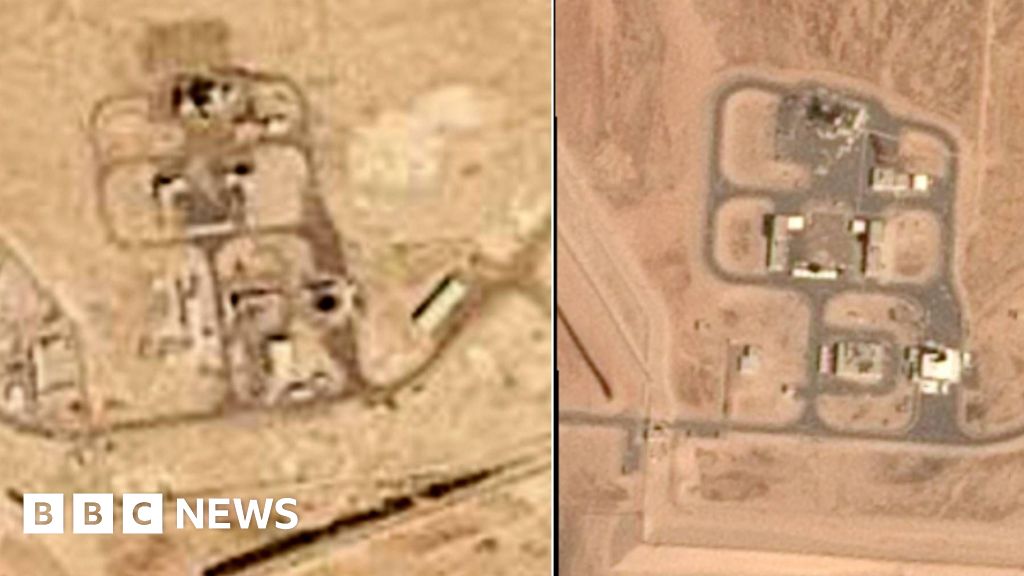
  • Iranian strikes on bases used by US caused 0m in damage, analysis shows

    Iranian strikes on bases used by US caused $800m in damage, analysis shows


    “The damage to US bases in the region has been underreported,” said Mark Cancian, a CSIS senior adviser and co-author of the think tank study. “Although that appears to be extensive, the full amount won’t be known until more information is available.”

    Read More

  • Fuel Shortage Cripples Taxi Services at Bangkok’s Suvarnabhumi Airport

    Fuel Shortage Cripples Taxi Services at Bangkok’s Suvarnabhumi Airport


    A severe fuel shortage is crippling taxi operations at Suvarnabhumi Airport, leaving half the registered fleet out of service and prompting drivers to decline long-distance fares.

    The crisis has led to growing frustration among passengers, many of whom face extended waiting times and limited transportation options. Airport authorities are urging immediate intervention to address the issue, as the shortage threatens to disrupt travel plans and tarnish the airport’s reputation as a key regional hub.

    Key Details:

    • Only about 2,500 of 5,000–6,000 registered taxis are currently operating according to a Bangkok Post report, with SUV taxis — popular with families and travellers with heavy luggage — among the hardest hit.
    • Most airport taxis run on LPG or NGV (natural gas), and the crisis is not about fuel costs but availability, due to distribution bottlenecks and hoarding despite government assurances of adequate oil reserves.
    • Drivers are limiting themselves to short trips or morning-only shifts to avoid running out of fuel mid-journey.
    • The shortage is linked to the ongoing Middle East war, which has disrupted supply chains and caused hundreds of service stations to run dry regularly.
    • The taxi association is preparing proposals to the government, including a shift from traditional meters to app-based fare calculation.

    Why It Matters:
    The disruption poses a significant challenge for travellers at one of Southeast Asia’s busiest airports, and highlights how global fuel supply instability can have direct, localised impacts on everyday transport services.

    SUV Taxis Disappearing at Suvarnabhumi

    SUV taxis are disappearing at Suvarnabhumi Airport primarily due to a severe fuel shortage, not high fuel prices. Large SUV and van-type taxis, which are preferred by families and travelers with bulky luggage, are increasingly suspending services because drivers cannot reliably refuel, especially for long-distance trips like those to Pattaya.

    • Drivers fear running out of fuel mid-journey with no guarantee of finding a refill, prompting them to avoid long trips altogether.
    • The Suvarnabhumi Taxi Coordination Association reports that only about 2,500 of the 5,000–6,000 registered taxis are currently in service, with many drivers halting operations or adjusting schedules to work only in the morning when fuel is more accessible.
    • The issue affects LPG (liquefied petroleum gas) and NGV (natural gas for vehicles) taxis, which are common in Bangkok for cost and environmental reasons.
    • The association has called on the government for intervention, including proposals to shift to app-based fare systems, but action is pending a fully empowered administration.

    As a result, availability of SUV taxis has significantly declined, making it harder for passengers to find suitable vehicles for long-distance travel from the airport.

    File picture : Airport taxi during Covid crisis

    Read More