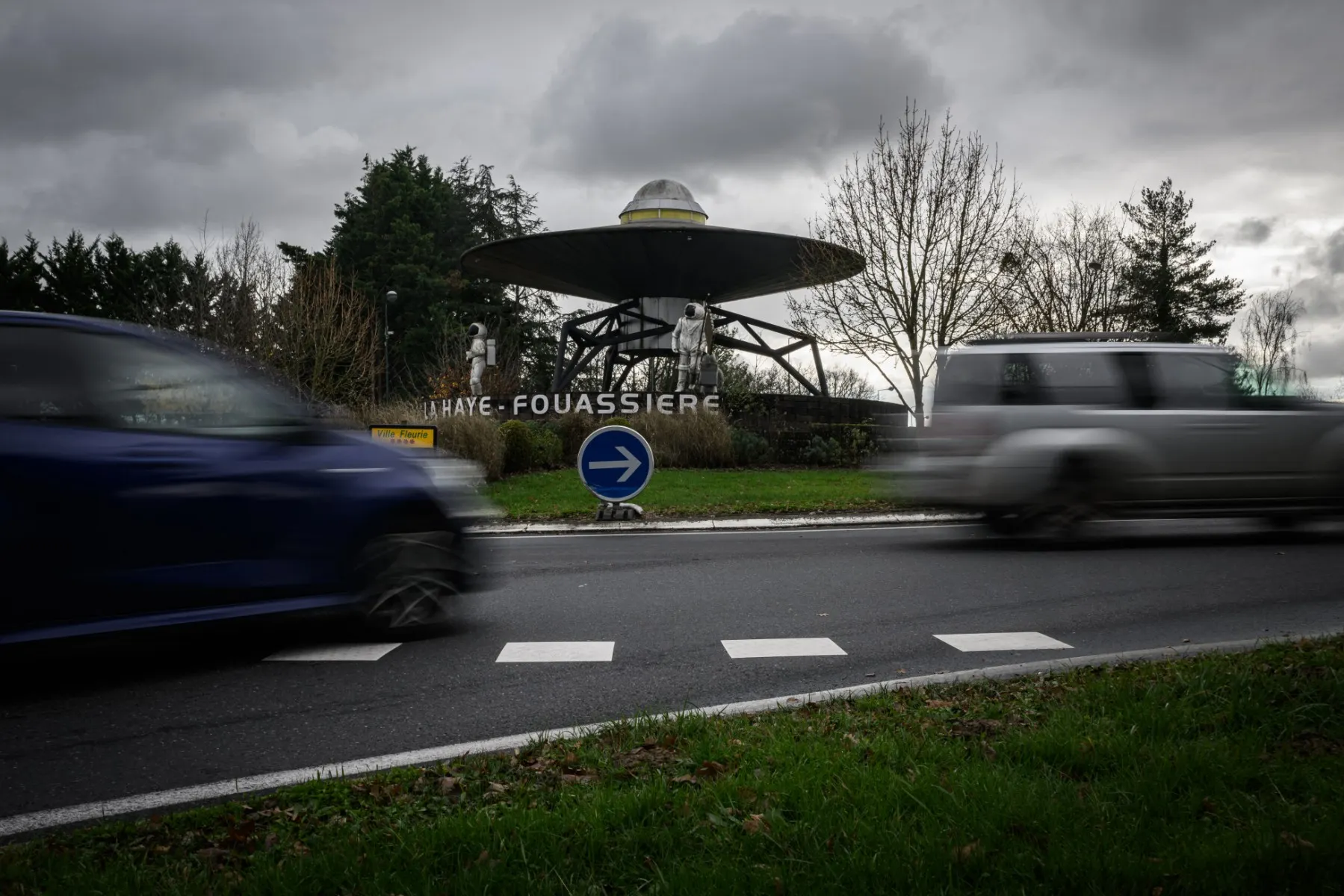
It is a ‘truth’ often recounted that France is a country in possession of ‘half the world’s roundabouts’ – but is it one of those ‘France facts’ that aren’t actually factual?
One thing that you cannot help noticing while driving in France is that road-builders here really, really like roundabouts.
France has somewhere between 30,000 and 62,000 roundabouts, depending on which source you believe.
In a 2024 report on its website, broadcaster TF1 put the figure at 42,986. It didn’t credit where that figure came from, but it was based on an OpenStreetMap data study by car rental platform DiscoverCars.com, and was lower than previous estimates, which had put the number closer to 50,000.
Part of the counting problem is the speed of roundabout construction – earlier this year, Les Echos reported that France has been building, on average, five roundabouts a day for the last 30 years.
It calculated that by the end of 2026 France is on course to have nearly 61,500 roundabouts. In a country of 34,874 communes.
Another aspect of the problem is these counts of the number of round and roundish traffic calming measures (and favoured protest points) make no distinction between standard roundabouts – ronds-points – and traffic circles – carrefours à sens giratoire – which have one crucial difference from one another.
On the former, vehicles already in the intersection and approaching from the left have priority. On the latter, priority is usually given to traffic from the right – the notorious Arc de Triomphe roundabout is, in fact, a traffic circle … with 13 nerve-shredding entry and exit lanes. In all other rules of the road ways, they are the same.
READ ALSO 11 things to know about France’s Arc de Triomphe
Large – and occasionally terrifying – though it is, there are bigger ‘roundabouts’ than the 241m diameter one at Place de l’Étoile, on which the Arc de Triomphe sits.
The Rotonde du Bois de l’Aune, in Aix-en-Provence, is so large it has a roundabout of its own, as well as a residential area – with its own roundabout, a restaurant and a pharmacy – within its 320m diameter. It may be so big you forget you are on one, but it is a roundabout.
Toulouse’s Grand Rond, meanwhile, though smaller than the Place de l’Étoile, is better known for the park, with bandstand and fountain and statuary, contained within the 200m diameter boundary road. In fact, the south-western city is one of the biggest fans of the roundabout, with nearly 500 of them.
But back to the question at the top – does France really boast half of all the world’s roundabouts?
In 2024, when France had just 42,986 roundabouts, it still boasted nearly twice as many as the country that lagged behind in second, with 25,976 – the United Kingdom.
In third place was Italy with 18,172; then Spain with 15,053, while Brazil was fifth with 11,854.
Slightly disappointingly, perhaps, these figures alone disprove the ‘truth’ that France has half the world’s roundabouts. Sorry.
But France does boast more roundabouts than any other nation. And, according to the 2024 study more roundabouts per capita, by some margin.
It had, according to the calculations, 663.8 roundabouts per one million inhabitants. Its nearest rival was Portugal, with 473.4 roundabouts per one million. Norway was third with 427.1/1m; Iceland fourth with 421/1m; and Ireland fifth with 385/1m.
In terms of roundabout density, however, France slips to fourth with 78.5 roundabouts / km2, behind Netherlands (113.4/km2); UK (107.4/km2) and Israel (81.8).
It’s impossible not to notice that European nations are more heavily into roundabouts than elsewhere. And it may not actually boast half the world’s roundabouts, but France does have more than any other nation.
Whether that’s something to be proud of or not, we’ll leave to you.