
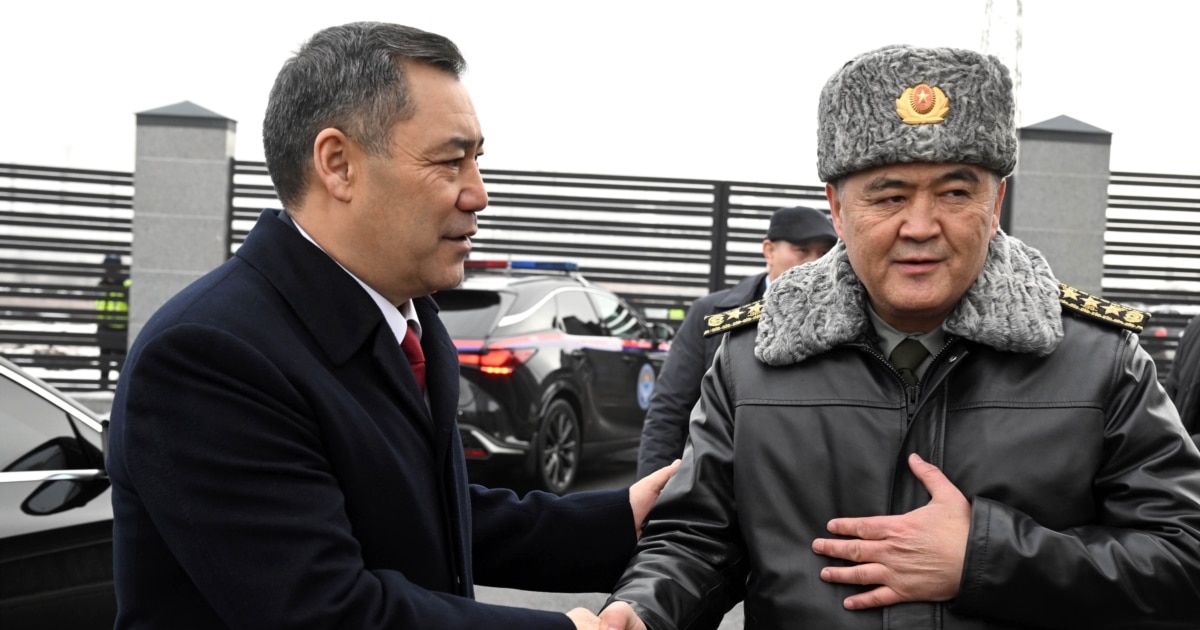
Kamchybek Tashiev was once one of the most powerful men in Kyrgyzstan and played a crucial role in helping the country’s president, Sadyr Japarov, rise to power. Now he’s facing charges of plotting a coup in a stalled trial that some analysts liken to a political purge.
Tashiev was dramatically sacked from his role as head of Kyrgyzstan’s State Committee for National Security (SCNS) on February 10 while undergoing medical treatment in Germany.
When he returned to Kyrgyzstan in March, he was taken straight from the airport for a five-hour interrogation about an alleged coup. After he was formally charged on May 1, the case against him and other alleged conspirators was suspended — but not abandoned — on procedural grounds three weeks later.
“Dismissal alone would leave Tashiev politically alive…a coup charge transforms Tashiev from a dismissed partner into an existential threat to the state. It legitimizes purging his network, frightening his supporters, and closing the case to public scrutiny,” Aksana Ismailbekova, a senior research fellow at the Berlin-based Leibniz-Zentrum Moderner Orient institute, told RFE/RL.
Her assessment was echoed by Temur Umarov of the Carnegie Russia Eurasia Center, who told RFE/RL that Japarov’s objective was not simply to remove a rival from office, but to permanently erase him.
“Japarov doesn’t want to leave this story halfway and wants to completely destroy any potential for Tashiev to come back to politics without killing him,” Umarov said.
Friends Turned Enemies
Japarov’s rise was one of the most abrupt political turnarounds in modern Central Asia: from a prison cell to the presidency in less than two weeks, propelled by mass protests and the collapse of the existing political order.
The trigger came on October 5, 2020, when disputed parliamentary elections sparked nationwide demonstrations. That night, protesters stormed the prison where Japarov was serving an 11-1/2-year sentence for kidnapping a regional official.
At that time, Tashiev was an established opposition figure with a power-base in southern Kyrgyzstan and a background in the security establishment.
After Japarov was released from prison, Tashiev helped organize and coordinate informal security forces in Bishkek, which helped prevent supporters of President Sooronbay Jeenbekov mobilizing.
Just as important, Tashiev’s backing helped bridge Kyrgyzstan’s north–south divide at a moment of political collapse. Without his support in the south, Japarov’s rapid rise would likely have faced serious resistance and a risk of regional division.
So close was their partnership that they were dubbed Eki Dos (Two Friends). And it continued once power was secured, with Japarov the populist front man while Tashiev was appointed to head the SCNS.
But it was not to last.
“That position brought him so much influence over the system that he was able to become a competitor to the president,” Umarov said.
From Democracy To Autocracy?
On this telling, Japarov’s move against Tashiev is part of a broader transformation of Kyrgyz politics.
Following the collapse of the Soviet Union in 1991, Kyrgyzstan took a radically different path to other countries in Central Asia. Against a clear trend to varying degrees of authoritarian rule in its neighborhood, the country was characterized by distinctly higher levels of political pluralism and media freedom.
Under Japarov, this appears to be changing, analysts said.
“The trial is less about proving a coup publicly than about completing the transition from tandem rule to one-man presidential dominance,” Ismailbekova said.
“After 2020, Japarov and Tashiev concentrated power while restricting the media and opposition. Since the split [between them], Japarov has moved against the only internal counterweight inside the ruling bloc. A closed coup trial against a former co-ruler suggests there is no longer room even for opposition within the regime,” she added.
Tashiev was once regarded as the second most powerful figure in the system, but his political base has largely remained silent as he has been recast as a political adversary.
