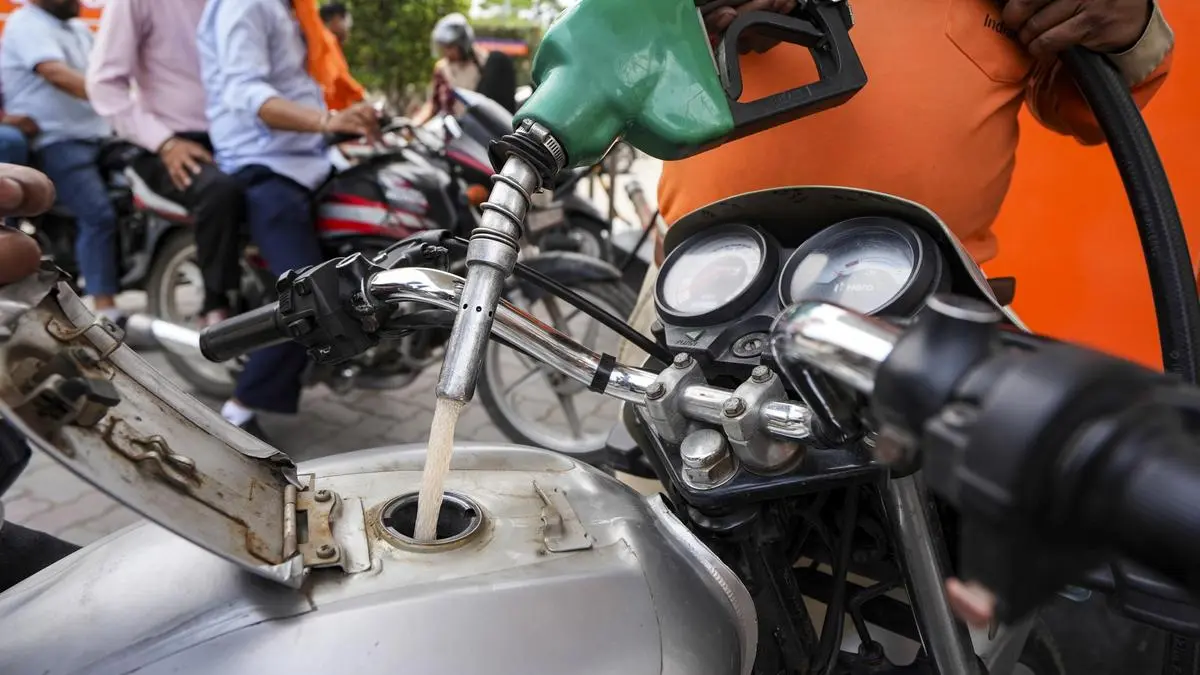
Economists now expect the impact of the fuel price revision to start showing up in the May CPI print, with the full transmission likely from June onwards.
| Photo Credit:
SHIVA SHARMA
The government’s decision to raise petrol and diesel prices by ₹3 per litre is expected to push up retail inflation by 15-25 basis points in the coming months, with economists warning that the combined impact of higher fuel costs, increased import duty on precious metals and revised minimum support prices (MSP) for kharif crops could force a reassessment of inflation projections for the year.
The latest fuel price increase comes at a time when wholesale inflation has already begun reflecting mounting cost pressures. Retail inflation, based on the Consumer Price Index (CPI), stood at 3.5 per cent in April, remaining within the Reserve Bank of India’s comfort range. However, wholesale inflation, measured by the Wholesale Price Index (WPI), surged to a 42-month high of 8.3 per cent in April, driven in large part by a sharp rise in fuel and power inflation.
More hikes likely
Economists now expect the impact of the fuel price revision to start showing up in the May CPI print, with the full transmission likely from June onwards. Several analysts also indicated that the latest increase may not be the last if global crude oil prices remain elevated.
Most economists estimate that the ₹3 per litre increase in petrol and diesel prices alone could add 15-25 basis points to headline inflation, apart from second-round effects through transportation, logistics and other fuel-intensive sectors.
“We estimate the direct impact on CPI inflation at 15bp when fully passed through,” said Aastha Gudwani, India Chief Economist at Barclays, while adding that more consumption curbs could follow. “We expect austerity steps to continue,” she said.
Gudwani said Barclays had already revised its CPI inflation forecast upward in anticipation of higher pump prices. “We recently revised up our CPI inflation forecast to 4.5 per cent for FY26-27, pencilling in a ₹5/litre increase in pump prices of petrol and diesel. We expect the government to top up today’s ₹3/litre increase, if the situation warrants,” she said.
She added that besides the direct impact of higher fuel prices, the recent increase in import duty on gold would also feed into inflation. According to Barclays estimates, the fuel price revision could add around 8 basis points to headline inflation in May, while the gold import duty hike could contribute another 6 basis points.
Long-awaited move
According to Radhika Rao, Senior Economist at DBS, the fuel price revision was a long-awaited move given the sharp rise in global crude prices and the mounting burden on oil marketing companies as well as government finances.
“Higher pump prices are likely to moderate demand and consequently the import burden. Given the weightage of petrol and diesel in the CPI basket, a 3-5 per cent increase likely adds 15-25 basis points to the headline inflation, besides second round impact,” she said.
Economists said the concern is not merely the direct impact of fuel inflation, but also the cascading effect on transport, manufactured goods and services. With fuel costs feeding into freight rates and supply chains, the latest revision could widen inflationary pressures across the economy.
Megha Arora, Director of India Ratings & Research (Ind-Ra), pointed to the additional pressure coming from rising milk prices alongside fuel costs.
“The combined effect of petrol, diesel and milk price is likely to increase the CPI inflation by around 42 bp. The actual impact is likely to be higher via the fuel user industry like transportation and others. However, the impact in the month of May 2026 could be around 20bp,” she said.
The upward pressure on inflation also comes amid the government’s move to revise MSPs for kharif crops, which economists said could further shape food inflation trends over the coming months. Alongside higher import duty on precious metals, the policy measures together are being seen as adding to near-term inflationary risks even as policymakers seek to balance fiscal pressures and external vulnerabilities.
Aditi Nayar, Chief Economist at ICRA Ltd expects the fuel price hike to push up the average CPI inflation print by 25 bps on an annualised basis. Since the hike was effected mid-month, this impact will be spread over the May and June 2026 CPI inflation prints. “We are now revising our forecast for May 2026 to 4.3 per cent from 4.1 per cent,” she said..
Published on May 15, 2026