
MBW Views is a series of op-eds from eminent music industry people… with something to say. The following MBW op/ed comes from Frederic Schindler, a music supervisor and the founder of the music supervision company Too Young Ltd. and the licensing platform Catalog. He was named the 2025 Music Supervisor of the Year by the Association of Independent Music.
“This ‘stuff’ is rapidly becoming our dominant form of music.” – It’s the Music You Hear All Day, Without Ever Noticing, The New York Times Magazine, March 2026
Pick up any food product in a supermarket and turn it over. You will find a full list of ingredients, allergen declarations, GMO status, country of origin, nutrition values, and the name and address of the business legally responsible for what’s inside.
This is not optional; it’s the law. Our societies decided that we have a fundamental right to know what we are consuming.
Now open any music streaming platform. The shelves are infinite. The labels are missing. And nobody is responsible for what’s inside. Play any track: what do you know about it?
You know the title and the artist’s name (or what claims to be one). You might know the label if you look. But you don’t know whether it was created from an artist’s intent, commissioned by a library, or generated by AI.
You do not know if the rights are cleared, contested, or nonexistent. You do not know if the entity behind it invested in artist development, employed session musicians, a producer, or a recording studio, or simply uploaded a synthetic file through a pay-to-play distributor for $9.99.
You know almost nothing. Most of the time, you are not even choosing. The algorithm is. And the algorithm may not be as blind as you are.
The Flood
A staggering number of 150,000 tracks enter the digital music supply chain daily. But only fewer than 1 in 10 uploaded tracks, based on available distributor and aggregator data, come from entities that invest in artists, employ creative professionals, verify rights, and stand accountable for what they release.
Both major and independent labels, as well as curated distributors working with self-released artists and niche imprints, account for only a small single-digit percentage of daily uploads. The other 90-plus percent is unverified self-releases, functional made-for-media library content, and an ever-growing volume of AI-generated material that enters the system alongside everything else.
To put that in perspective, the beacon of culture-defining A&R, the Beggars Group, has built a catalog of roughly 100,000 songs across five decades of curation and artist development. That is less than one day’s worth of unverified uploads.
A Nils Frahm composition released through Erased Tapes, performed on handmade instruments in a Berlin studio, sits in the same undifferentiated stream as a synthetic piano loop instantly generated by an algorithm, uploaded by an anonymous account. The system carries no distinction. The metadata, the file format, the per-stream rate; all identical. To a consumer, to a marketing director planning a global campaign, to a playlist algorithm deciding what 800 million people hear next, they are presented as the same thing, because that is exactly what the supply chain calls them. Music.
“Champagne and adulterated counterfeit sparkling wine, sold at the same price, on the same shelf, with no label.”
Global streaming revenue totaled over $22 billion in 2025, according to IFPI. How much of that went to content with no verified human artistic intent? Nobody knows. And in the current system, a stream is a stream: Nils Frahm and an AI piano loop. Champagne and adulterated counterfeit sparkling wine, sold at the same price, on the same shelf, with no label. If the system cannot identify what enters the pool, it cannot protect the value of what truly belongs there.
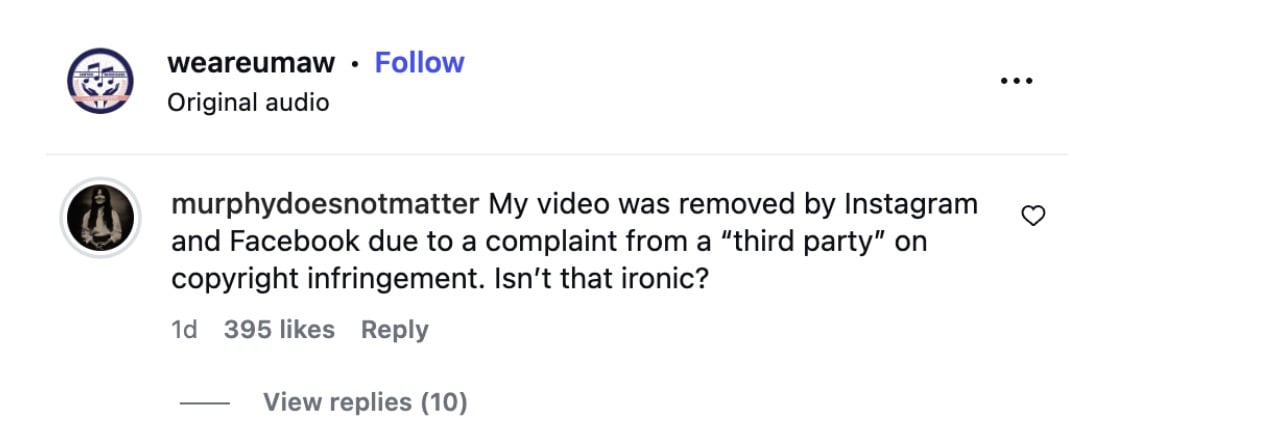
Stories like this now surface weekly: Murphy Campbell, a folk singer from North Carolina, found AI voice clones of herself uploaded to her own Spotify profile, scraped from her YouTube performances. Days later, a troll used a distributor’s Content ID access to claim ownership of her recordings of Darling Corey and In the Pines, songs in the public domain since the 1870s but whose specific performances are her copyright.
In her own words, “it’s unprecedented, it’s the wild west, and it could happen to anyone.”
Then Instagram removed her video due to a copyright complaint from an unnamed third party, and the United Musicians and Allied Workers had to repost it on her behalf. Impersonated on the way in, claimed on the way out, silenced when she spoke up. One independent artist, three system failures, three dangerous precedents.
Every other industry solved this
French wine solved it with Appellation d’Origine Contrôlée (AOC).In the 1930s, when fraud and relabeled wine flooded the market, the response was not to shrug it off. It was to build a certification system that told consumers exactly where a wine came from, who made it, and what standards it met. Nobody banned anything. The label made the difference visible. Consumers could choose, the premium product could prove its value, and the market held.
Fashion solved it with the “Made in” label and supply chain transparency. You know where your shirt was made, what it is made of, and who made it. Fabric composition, country of origin, and care instructions: all mandatory. “Made in Italy” means something different from “Designed in Italy, Made in China.” The label informs you.
Diamonds solved it with the Kimberley Process, a joint government, industry, and civil society initiative. “Conflict-free” is now a standard consumer expectation, and the sector has drastically curtailed financing for bad actors.
Music has not yet found its answer.
We should be celebrating two decades of the digital music age: Spotify was founded in April 2006. Twenty years later, we are the last major consumer industry operating without any form of mandatory product disclosure. None.
There have been promising moves: Deezer pioneered automated AI detection; Apple Music introduced self-reported Transparency Tags; Spotify has deleted over 75 million “spammy” tracks, and recently blocked AI ‘artists’ from being verified on its platform.
These efforts matter, but they are platform-specific, inconsistent, and voluntary. None operates at the supply chain level, where the problem begins.
From the inside
I came to this question as a music supervisor, not a policymaker. Our clients were producing more and more content, and we constantly experienced friction serving the mid- and long-tail of their needs with relevant commercial music, fast and within scope and budget.
Sometimes clients wouldn’t bother calling and ended up in a library – assuming we couldn’t clear something exciting on time for $5k for their short-term campaign. The traditional system could not keep up.
Over two decades of supervision, I have been fortunate to work closely with the leading independents, major publishers and labels, tastemaker imprints, and self-released artists whose talent spoke for itself. So when the friction became impossible to ignore, four years ago, we started building together Catalog, a platform designed to make sync licensing faster and more transparent for professional music supervisors and media producers who champion artistry.
“Once there, you discover something that should alarm everyone who cares about music: there is technically no reliable way to tell what anything is.”
Suddenly, I was no longer curating and licensing songs. I was inside the supply chain, building ingestion systems, defining taxonomies, connecting master and publishing rights, and navigating metadata rabbit holes. I was exactly where the labels, publishers, distributors, and aggregators sit: at the point where music enters the system.
Once there, you discover something that should alarm everyone who cares about music: there is technically no reliable way to tell what anything is. The label name may be in the metadata, but knowing the quality City Slang guarantees, and that an anonymous distributor account does not, requires context that most consumers simply don’t have.
A track arrives: is it a song written by a human being with a career, a publisher that provided A&R guidance, and a live audience? Is it a production library cue commissioned to fill a brief? Is it a synthetic file generated by an algorithm in seconds? The metadata does not answer. You are expected to listen and guess.
I have spent many years training my ear to hear the difference and read the cultural trail of an artist. Most buyers have not. Production libraries understood this first. They invested in technology, built frictionless licensing platforms, and met buyers where the traditional system could not. The problem is not that libraries exist. The problem is that without transparency, their commissioned track is indistinguishable from artistry in the supply chain.
A rare opportunity
Sync is the last major music vertical to be digitized. Streaming transformed consumption. Social media transformed discovery. Publishing administration and collection are being modernized. But licensing, the process that decides which music soundtracks the films, advertisements, games, and content that billions of people experience daily, still runs largely on email, personal relationships, and institutional memory.
That is changing, and as more companies build the digital infrastructure for sync, we have a rare opportunity: to get it right this time. To build transparency into the foundation of the sync digital age, rather than retrofit it later. And because sync sits at the intersection of recorded music, publishing, advertising, gaming, and media, a standard built for this vertical does not remain within it; it also radiates outward.
Most recently, at Act in Sync in Portugal, an EU-funded program that brought together 50 music supervisors and sync professionals for two days of intensive workshops, the scale of the problem became viscerally clear. Two things stayed with me.
As Clement Souchier, Founder of Bridge, noted in his recap of the event, there was unanimous agreement that the industry needs shared guidelines and clear, collective messaging about the difference between artistry, product, and synthetic content, and the compliance risks each carries.
“An A&R colleague at an iconic independent music publisher described how heavily VC-funded production libraries are now approaching his roster of credible, culturally relevant songwriters with juicy flat-fee “remix” deals they can’t ignore.”
Currently, every supervisor fights this battle alone, explaining the differences and risks, client by client, sometimes being perceived as the “bad cops” for raising concerns that should be visible structurally. We compete with carefully blurred messaging from companies whose models depend on the distinction not existing. Moving from individual advocacy to a shared, structured voice is a professional requirement.
Second, a specific tactic that reveals how deliberate the blurring has become. An A&R colleague at an iconic independent music publisher described how heavily VC-funded production libraries are now approaching his roster of credible, culturally relevant songwriters with juicy flat-fee “remix” deals they can’t ignore. These companies are paying artists to lend their names and credibility to functional content that would otherwise be generic stock music.
When you process thousands of tracks and realize that the system cannot flag when a credible artist’s name is being used to launder the reputation of a production library cue, that is not a metadata problem: it’s a market failure.
The conclusion is straightforward: the system lacks the information it needs to function fairly.
Music Facts
It may be time to change that. Not yet with hard regulation but with an enforced standard that borrows directly from the frameworks that already work. The Music Facts protocol simply makes the distinctions visible. What the market does with that clarity is ultimately up to the consumers.
I have recently shared an open draft of Music Facts with industry bodies, CMOs, indie and major labels and publishers, journalists, other sync platform founders, and music-loving tech activists. The response confirmed what I suspected: this is a broadly shared urgent concern.
There may be many differences and conflicting agendas among these groups, but they agree on one thing: music’s cultural resonance is worth defending, and an undifferentiated supply chain is putting it at risk.
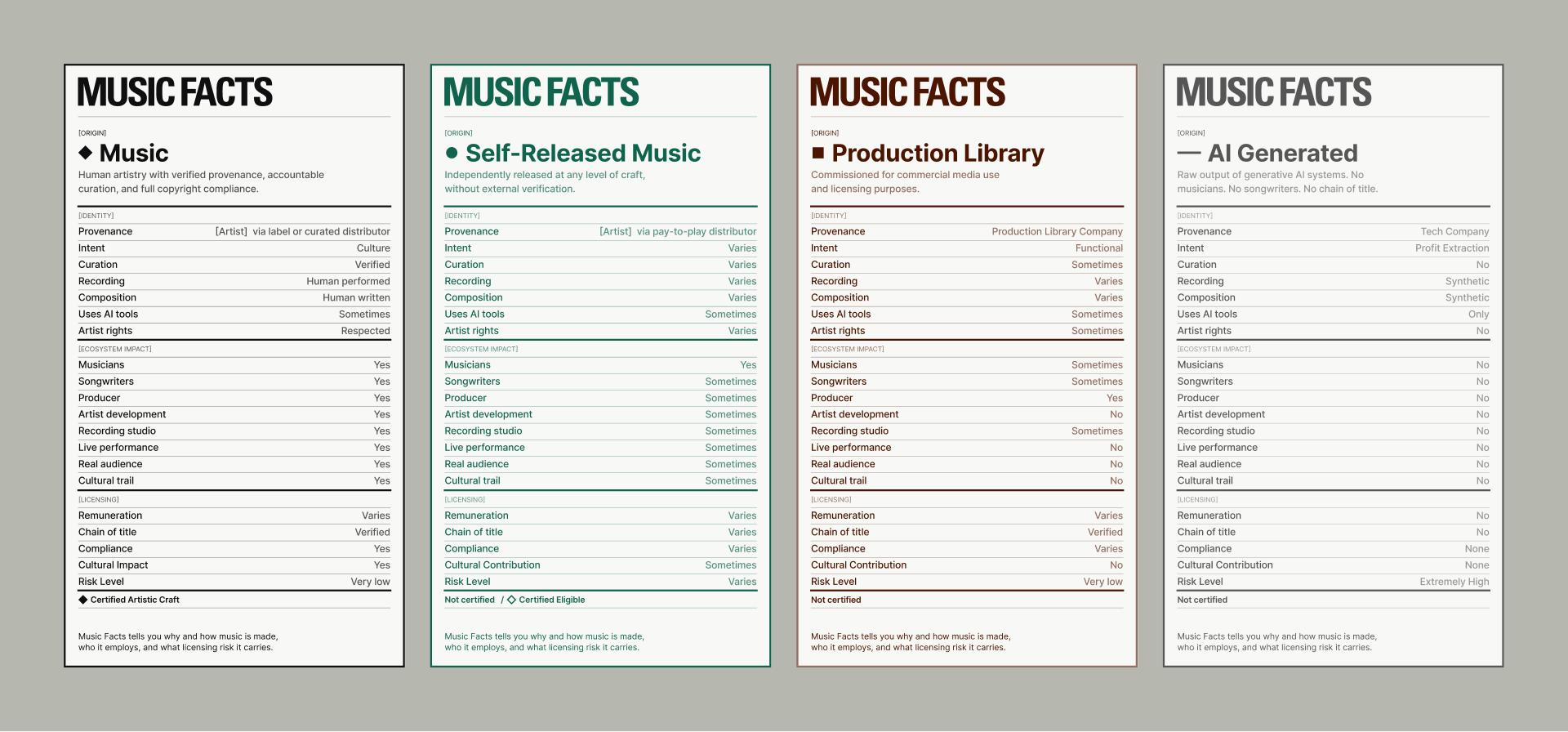
Music Facts is a standardized disclosure label, modeled on the FDA Nutrition Facts panel and grounded in the principles of EU Regulation 1169/2011 for food. It classifies every piece of music in the supply chain by origin, and discloses what is inside: who made it, how it was made, who it employs, and what licensing risks it carries.
The system recognizes four origins:
- Music. Human artistry with verified provenance, accountable curation and full copyright compliance. This is music released by labels and curated distributors that invest in artists and employ musicians, songwriters, producers, and engineers, respecting their rights. If self-published, registered with a CMO. Someone with skin in the game is accountable.
- Self-Released Music. Independently released at any level of craft, without external verification. This category is honest about the spectrum it contains: brilliant artists with real audiences alongside bedroom recordings and hobby projects created for personal reasons. The system does not judge the quality. It states the verification status.
- Production Library. Commissioned for commercial media use, not artistic expression. A legitimate product serving a legitimate need, but a fundamentally different product from artistry based on why it exists in the first place.
- AI Generated. Algorithmically trained raw generative content output with no compliance, accountability and attribution model. No human author. No musicians. No chain of title. No remuneration. No one to call.
In practice
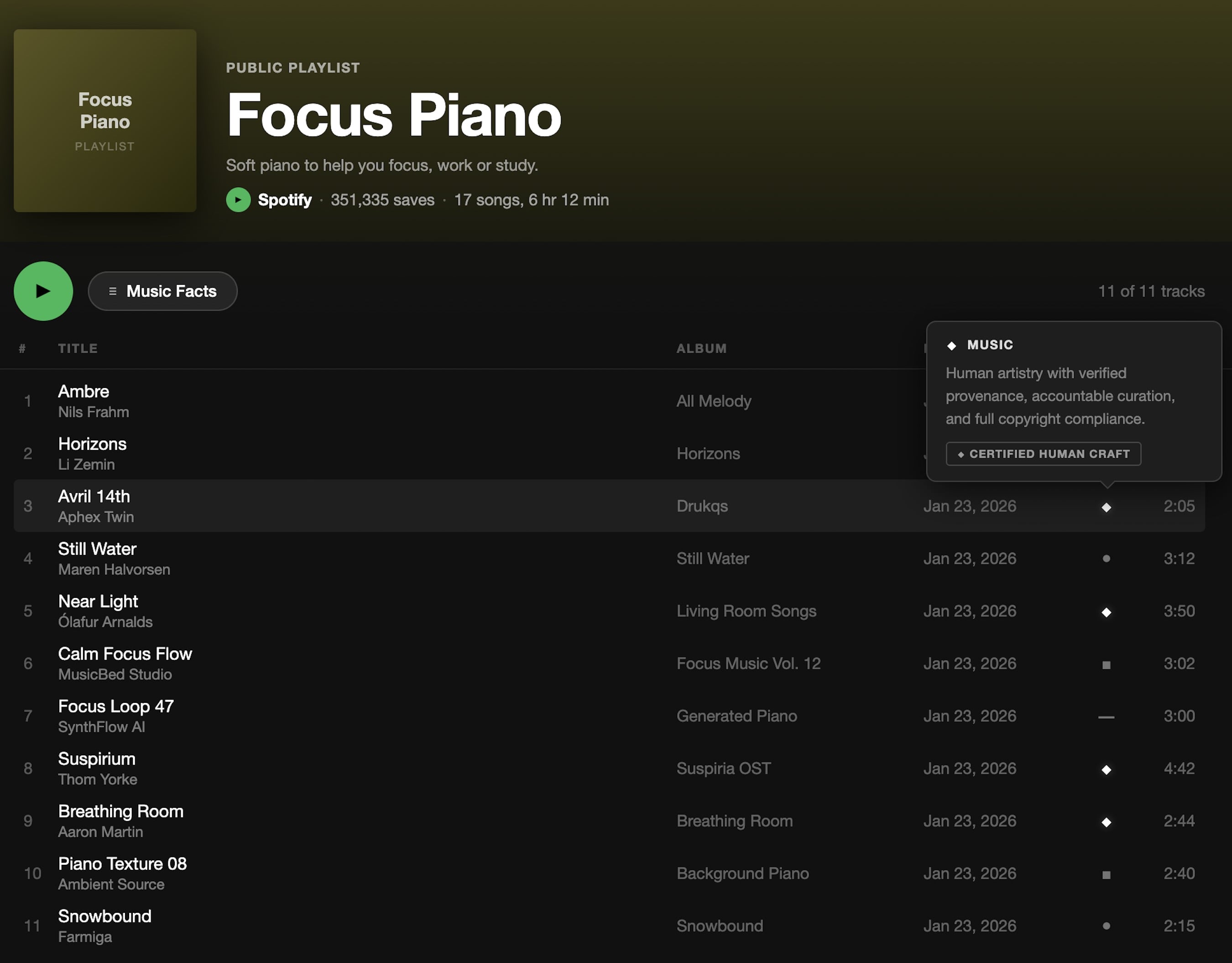
What would this look like in practice across DSPs, sync platforms, and beyond? A single column in a playlist view.
One shape per track.
◆ Diamond for certified artistry.
● Circle for self-released.
■ Square for production library.
— Dash for AI.
The user can filter by origin and avoid specific provenances entirely. Here’s a prototype showing how this system could work at the consumer level.
The first question any person should ask is: Does this create a new gatekeeping system? The answer is no, because the certification pathway is not controlled by a committee or a rigid set of actors.
The ◆ is not awarded by a single authority. It leverages the infrastructure the music industry has already built. Major label imprints earn it through verified credentials administered by IFPI, RIAA, BPI, and their national equivalents.
Independent labels through IMPALA, AIM, A2IM, and WIN member bodies. Publishers through ICMP and IMPF. Curated distributors like IDOL or AWAL through a verified curated distributor status. Artists who own their masters but work with established publishers through their publisher’s verified standing. The credential and human validation process already exists. Music Facts makes it visible to the consumers.
“Some listeners will not care, but many will.”
For the self-released artist without institutional backing, the path is different, but the principle is the same. Live performance history. Real audience engagement. Editorial recognition. A cultural trail that exists in the world.
These are facts, not judgments. The system does not ask whether the music is good. It asks whether the music is real. The facts are the key, not a gatekeeper’s approval. The door remains always open.
The consumer never sees the backend. And critically, clear tagging gives consumers something they have never had during music’s digital age: the ability to choose what they listen to with the same transparency they expect from their food, their wine, their clothes.
Some listeners will not care, but many will. The specialty coffee revolution proved that transparency does not shrink markets. It grows them. It creates a premium category and rewards quality. Music that can prove what it is will be worth more, not less.
Why now?
Generative AI is flooding the supply chain at a scale that makes the production library explosion look quaint. The $1.5 billion stock music industry I wrote about in these pages is about to be cannibalized by its own logical conclusion: music that costs nothing to produce, nothing to license, and employs no one. The endpoint of business, social economy, and culture. Pure profit extraction.
In March, Artlist said it has reached $300 million in annual recurring revenue, driven by a commercial offering that integrates Google’s Lyria 3 Pro directly into its package. That’s almost half of the world’s entire annual recorded sync revenue, according to IFPI: from a single AI-powered platform.
The company’s own terms of use state that these outputs are not guaranteed to be “original, non-infringing, or suitable for any particular purpose,” while granting Artlist a worldwide, royalty-free license to use every input and output generated by its customers.
And Google has never disclosed what Lyria 3 was trained on, only that the training used “materials YouTube and Google have a right to use under our terms of service”. The user carries the legal risk. Artlist collects the data and fees. The artists and rights holders whose work trained the models get neither. If this goes uncategorized, the precedent is set: AI-generated music becomes licensable at scale, and Google may not need companies like Artlist for much longer.
“Artificial streaming, bot farms, and synthetic uploads are draining royalty pools at an industrial scale.”
The fraud problem is accelerating in parallel. Artificial streaming, bot farms, and synthetic uploads are draining royalty pools at an industrial scale. In 2025, Apple Music identified and demonetized two billion fraudulent streams. Deezer reported this week that 44% of all new tracks uploaded are AI-generated, and 85% of their streams were manipulated. Every untagged track that enters the royalty pool dilutes the per-stream value of every tagged one. We dreamt of creative freedom, the end of gatekeeping, and a world in which anyone with genuine talent could become a star overnight, but we invited the mafia to our dining table.
Origin tagging would give rights holders and DSPs the data layer they need to isolate, flag, and act on suspicious content faster: verifiable metadata that declares the creation method, rights chain, and upload provenance. Not just ‘is this track synthetic?’ but ‘who is accountable for this release, and can that be verified?” Origin metadata is transparency, but also revenue protection.
How it’s built
The technical infrastructure is ready: every track delivered to a streaming platform already travels through the DDEX Electronic Release Notification standard. Adding origin, authorship, and provenance as mandatory fields is a schema update, not a rebuild. Labels and distributors already carry DDEX Party IDs. Trust Bodies like IMPALA, WIN, and AIM already maintain membership registries that can validate them. DSP ingestion engines already reject tracks with invalid ISRCs. Adding origin validation follows the same logic.
The implementation could be gradual: start with factual, low-friction objective declarations that no one can object to. Who would argue that a Warp or Parlophone release should carry the diamond mark for verified human artistry?
Then add a layer of dynamic verification, certification criteria, and enforcement as the data builds the case. The detection tools developed by IRCAM, Cyanite, Deezer, and Sony plug in as supplementary verification, requiring no new infrastructure, only integration with what already exists. Because the goal is industry-wide adoption and benefit, Music Facts is designed as an open standard to be refined and upgraded collectively by the industry bodies.
“In food, risks have a name: allergens. In music, no one tells you.”
Every transparency framework that works today started as voluntary. AOC, Kimberley, 1169/2011. Once enough participants adopt the standard, it becomes the baseline that regulators codify. French Wine has a National Institute of Origin and Quality to make sure regulations are enforced.
The initial version of Music Facts has been submitted as a proposal to the DDEX ERN Working Group. What is missing is agreement and the industry moving behind it, in a coordinated way.
As a music lover, I think about this personally. My daughter is now three. She is starting to have favorite songs. She dances to them, requests them by name, and sings fragments of them in the bath. One of them is Bongo Bong by Manu Chao. She knows where he lives, because he is our neighbor in Barcelona, and she points at his house every time we walk past.
To her, the song and the man are connected. The music came from someone who lives in her neighborhood and made something that traveled into her life. These songs were written by people. Performed by people. Produced by people who spent years learning and perfecting their craft. Released by labels that believed in the artists and invested in their development.
Will she know the difference when she is fifteen? Will she be able to tell whether the music in her feed was made by a human being who poured something real into it, or generated by an algorithm trained on the work of artists who were never asked and never got paid? Will anyone tell her?
Not unless we build the system that tells her so she can decide for herself.
In food, risks have a name: allergens. In music, no one tells you.
It is time for clear labels and the ability to choose.
Music Business Worldwide