
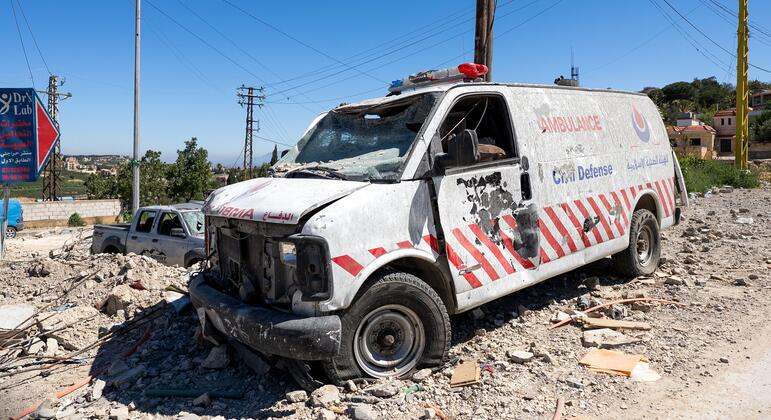
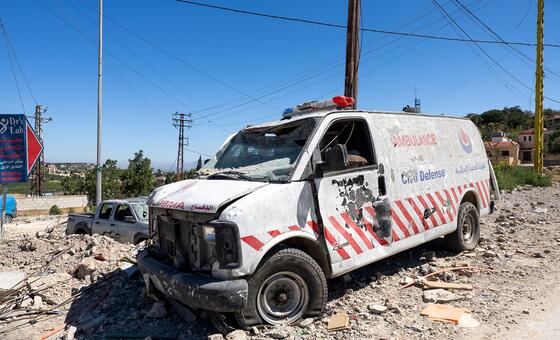
Recent attacks killed two Lebanese Red Cross volunteers: Youssef Assaf, who died during a rescue operation on 9 March, and Hassan Badawi, killed in a drone strike on 12 April.
According to the UN World Health Organization (WHO), there have been 169 confirmed attacks on healthcare workers and facilities in Lebanon, resulting in 116 deaths.
Lebanese authorities say more than 3,000 people have been killed since hostilities escalated in March, with violence continuing despite the ceasefire. Hezbollah fighters based in Lebanon began shelling Israeli communities shortly after the Israeli-US bombing of Iran began; exchanges of fire continue today, with media reports indicating that 21 Israeli soldiers have been killed since 2 March.
UN News spoke with Thameen Al-Kheetan, spokesperson for the UN human rights office, OHCHR; Tommaso Della Longa, spokesperson for the International Federation of Red Cross and Red Crescent Societies (IFRC); and Ali Saad from the Lebanese Red Cross. All of them agree on one thing: that first responders should never be targets.
Aid workers caught in the crossfire
From a human rights perspective, deliberately targeting medical personnel constitutes a war crime. According to OHCHR’s Mr. Al-Kheetan, the international community must do more to ensure the protection of healthcare workers in all conflicts.
The office “has documented cases where Israeli forces launched attacks involving direct strikes on civilians, including medical personnel,” he maintained, stressing that such attacks are not unprecedented, pointing to similar patterns previously documented in Gaza and in other conflicts around the world.
A residential neighbourhood in Beirut, Lebanon shows the signs of missile attacks. (file)
A ‘shocking’ sight
Describing a recent visit to Lebanon, IFRC’s Mr. Della Longa recalled the jarring sight of Red Cross volunteers putting on flak jackets and helmets before heading out to save lives.
“What shocked me most,” he said, “was seeing Lebanon lose people who are committed to humanity and to serving others.”
Mr. Della Longa explained that the details and location of Youssef Assaf and Hassan Badawi’s mission had been shared with the warring parties. They were also travelling in ambulances clearly marked with the Red Cross insignia when they were killed.
‘They are not just numbers’
“Behind every paramedic or volunteer killed, there is a family – they are not just numbers,” he said. “Hassan had a pregnant wife and a son waiting for him at home.”
For Mr. Della Longa, “hitting an ambulance and killing a humanitarian worker means weakening entire communities.”
He renewed the call for the international community to respect and protect civilians, humanitarian workers, and medical transports in accordance with international law.
Rescue workers desal with the aftermath of a missile attack on a neighbourhood in Beirut. (file)
Deconfliction failing on the ground
To help protect rescue teams, the Lebanese Red Cross works with the UN Interim Force in Lebanon (UNIFIL), sharing coordinates and ensuring that all belligerents are informed of the paramedics’ whereabouts. This vital work is known as deconfliction, explained Mr. Saad, a liaison coordinator with the Lebanese Red Cross.
But even with all these measures in place, rescuers have still been targeted.
“This is why the Red Cross volunteers hug each other and say goodbye before every mission,” he explained.
The killing of Youssef Assaf and Hassan Badawi still haunts their volunteer colleagues who have had no explanation why they were targeted. Such attacks – and the killing of Lebanese journalist Amal Khalil on 22 April – are evidence of a “double tap” trend which is increasing, insisted Mr. Saad.
Killed carrying a stretcher
Hassan Badawi was killed in a strike while stepping out of an ambulance with a stretcher during a rescue mission in southern Lebanon, Mr. Saad said, “a drone attacked him directly leaving 300 pieces of shrapnel in his body.”
Given UNIFIL’s key deconfliction role, their impending drawdown and withdrawal from Lebanon next year is unthinkable, the Red Cross worker says: “I don’t know who will support us, but UNIFIL truly, they were international witnesses on what is going on. They might not stop the war or provide a security umbrella, but they were the only true witness to this situation.”
In the meantime, the 5,000 Red Cross volunteers will continue to go on mission and risk their lives. They can access zones located in the so-called “yellow line” – a no-go zone inside southern Lebanon created by the Israeli military last month – but cannot enter battlefield zones near the border, not even to pick up dead bodies.
“They are not military people, their only weapon is a bandage and helping people,” which should be good enough reason to protect them, Mr. Saad insists.