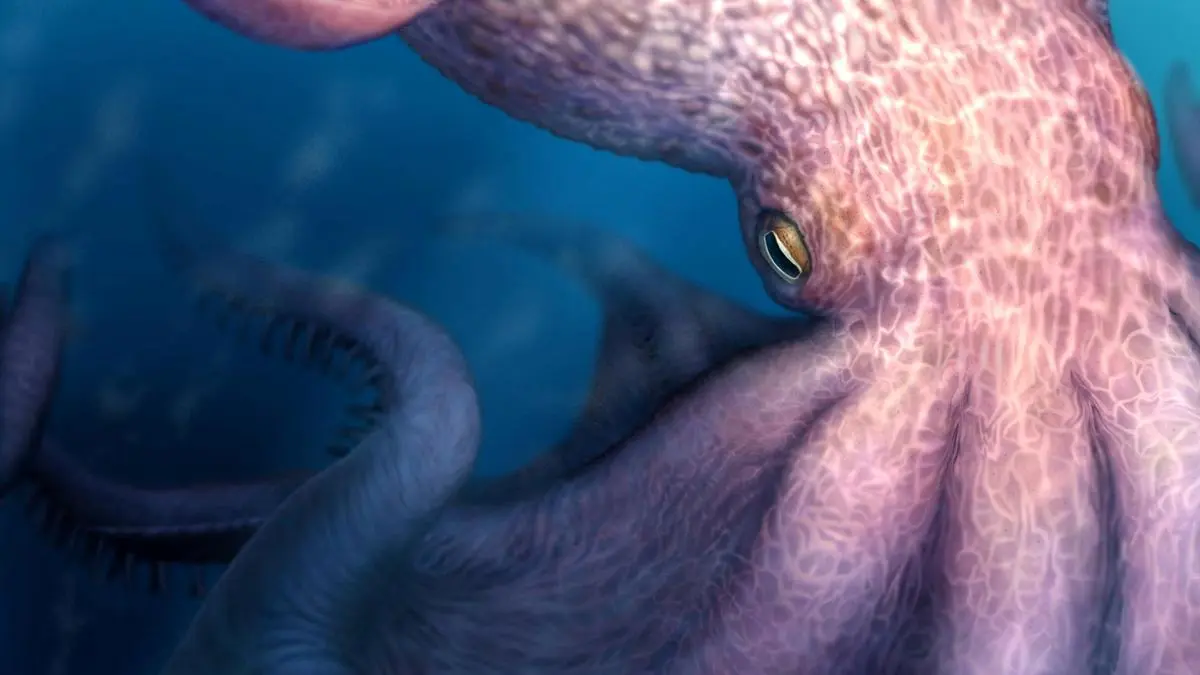

An artist’s reconstruction of a finned octopus of the species Nanaimoteuthis haggarti that reached a length estimated at up to 18.6 metres (61.02 feet) and lived about 86 to 72 million years ago during the Cretaceous Period, released on April 23, 2026.
| Photo Credit:
Yohei Utsuki
The Kraken is a huge tentacled sea monster from Norse folklore that drags ships and sailors down into the deep. During the age of dinosaurs, new research shows, there existed a creature as close to a real-life Kraken as you could possibly get – an enormous octopus that prowled the seas as an apex predator.
Scientists said fossils of beaks – the soft-bodied invertebrate’s hard jaw structure – indicate that an octopus species named Nanaimoteuthis haggarti that lived about 86 to 72 million years ago during the Cretaceous Period ranged from 22 to 61 feet (6.6 to 18.6 meters) long.
“These animals were remarkable. With their large bodies, long arms, powerful jaws and advanced behavior, they represent what could be described as a real ‘Cretaceous Kraken,’” said paleontologist Yasuhiro Iba of Hokkaido University in Japan, lead author of the research published on Thursday in the journal Science.
“For roughly the past 370 million years, marine ecosystems have been thought to be dominated by large vertebrate predators – first fishes and sharks, then marine reptiles and later whales. Our study shows that giant invertebrates, namely octopuses, also functioned as apex predators in the Cretaceous sea,” Iba said.
Size and scale of the ancient octopus
Iba said Nanaimoteuthis haggarti is one of the largest invertebrates on record.
“Until now, the largest-known invertebrate has been the modern giant squid, which can reach about 12 meters (39 feet) in total length,” Iba said.
Predatory behaviour and fossil evidence
The intense wear observed on the beaks is consistent, the researchers said, with repeated crushing of hard structures such as bones and shells, indicative of a predator that hunted large fish, shelled tentacled creatures, clams and other sizable prey.
“In the largest specimens, about 10% of the total jaw length appears to have been lost due to wear. This is more severe than what is typically seen in modern octopuses and cuttlefishes that feed on hard prey,” Iba said.
The beaks were shaped like those of certain deep-sea octopuses alive today that swim with the help of fins, leading the researchers to conclude that these Cretaceous octopuses also bore fins.
Fossil findings across continents
The numerous beak fossils studied in the research came from Japan and Canada’s Vancouver Island. The researchers reexamined previously known specimens and discovered new fossils as well.
The researchers also studied the beaks of a close relative called Nanaimoteuthis jeletzkyi that lived about 100 to 72 million years ago. It was not quite as big, ranging from 9 to 25 feet (2.8 to 7.7 meters) long, but also was an active predator.
Octopus biology and fossil preservation
Because octopuses are soft-bodied animals, they seldom fossilize well. The beak, the only rigid part of the octopus body, is made of a hard and durable material called chitin, also found in the exoskeletons of crabs, lobsters and insects.
Guided by modern-day octopus anatomy, the researchers were able to estimate the size of the Cretaceous octopuses based on the dimensions of the beaks.
Advanced behaviour and intelligence
“Octopuses are not simply biting predators. They use long, flexible arms to capture prey and powerful jaws to process it. As body size increases, their ability to control large prey with their arms and to process it with their jaws also increases,” Iba said.
“In addition, octopuses are among the most intelligent invertebrates. In our fossils, the jaws show asymmetric wear, suggesting lateralized behavior – favoring one side over the other, something like handedness. This indicates not only strength, but also advanced and flexible behavior,” Iba said.
Ancient ocean ecosystem
These octopuses shared the Cretaceous seas with other large predators including marine reptiles called mosasaurs and plesiosaurs that reached up to around 50 feet (15 meters) long as well as sharks rivaling today’s great white in size.
“These giant octopuses likely occupied the same ecological tier and may have competed with marine reptiles and sharks within the same ecosystem,” Iba said. “Their existence changes how we view ancient oceans. Instead of ecosystems dominated solely by vertebrate predators, we now see that giant invertebrates such as octopuses also occupied the very top of the food web.”
Published on April 25, 2026