For another student, Jérémie, dreams are shaped by loss. Displaced by conflict and grieving family members killed in the fighting, he shares a different ambition: “I want to be a general so that I can advocate for peace in the country.”
In eastern DRC, where violence escalated sharply in 2025, such aspirations are fragile.
Jérémie, Shadrac and Esther in front of their school in Ituri Province, Democratic Republic of the Congo.
The region has faced decades of conflict, but with recent attacks, tens of thousands of families have been forced to flee their homes – with an estimated 5.3 million people internally displaced in the country as of September 2025.
Schools have been destroyed or occupied by armed groups, and children are bearing the brunt of the crisis. Exposed to persistent insecurity, hunger, trauma and protection risks, girls and children with disabilities are especially at risk. Nationwide, an estimated 6.4 million children remain out of school.
Without safe, functioning schools, dreams of leadership and peace have little room to grow.
That reality is driving a new US$10 million two-year programme funded by the UN’s Education Cannot Wait (ECW) fund for education in emergencies and protracted crises
The initiative will reach more than 62,000 crisis-affected children in Ituri Province, with priority given to girls, internally displaced children and the most vulnerable.
Kennedy and classmates visit the new classrooms and latrines under construction in North Kivu Province.
While primary school enrolment in DRC increased by almost 70 per cent between 2011 and 2020, renewed conflict in the east now threatens to undo those years of progress.
Schools are not only being damaged or destroyed; insecurity is exposing children to grave protection risks, including recruitment by armed groups, gender-based violence, kidnapping and severe psychological trauma.
Adolescent girls are especially vulnerable when schools are unsafe, closed or located far from home, increasing their exposure to exploitation, abuse and early dropout.
In this context, education is more than a development goal. It is protection and stabilization.
The new initiative builds on other programmes from which over 125,000 children have already benefited.
These have included building or rehabilitating safe classrooms, teacher training, learning materials, school feeding and mental health and psychosocial support
New classrooms are not cosmetic; they are essential for safe, effective learning.
In areas affected by displacement, schools have been forced to run double shifts or squeeze multiple classes into a single room. New and rehabilitated structures reduce overcrowding, create safer and more gender-responsive spaces, and signal stability to communities recovering from violence.
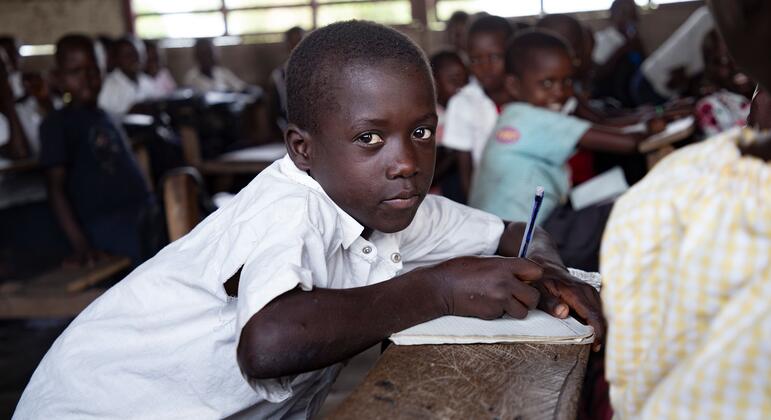
A attends class at a school in South Kivu Province, Democratic Republic of the Congo.
At Mabanga Primary School in Goma, new classrooms are transforming the daily learning experience. “I’m very happy to see the new classrooms being built because now I can study with my friends without being disturbed,” said 8-year-old Kennedy, looking on at the construction underway.
For years, two classes were squeezed into a single space, making it nearly impossible for students to hear or concentrate.
Under the new programme in Ituri, the approach goes further. Alongside infrastructure, the initiative strengthens teacher capacity, expands mental health and psychosocial services, reinforces child protection systems and addresses gender-based violence risks.
Alternative learning pathways, including catch-up programmes, ensure that children who have missed years of schooling are not left behind. Support for children with disabilities is also a priority.
For business and policy leaders concerned about global instability, the implications are clear. Fragile contexts like eastern DRC are home to rapidly growing youth populations. When children are excluded from education, cycles of poverty and conflict deepen, undermining economic growth and regional security.
Educating children delivers long-term dividends: higher lifetime earnings, improved health outcomes, stronger civic participation and the reduced risk of recruitment into armed groups.
In eastern DRC, Shadrac’s presidential dream, Jérémie’s call for peace and Kennedy’s anticipation of learning without distraction are reminders that the future of the country is already sitting in its classrooms, or waiting for them to be rebuilt.