

Weakened ocean currents could have promoted ice ages
Keystone-SDA
A slowdown in ocean currents in the North Atlantic could have been partly responsible for longer and more intense ice ages around a million years ago, a study by the University of Bern reveals.
+Get the most important news from Switzerland in your inbox
Over the past 800,000 years, the Earth’s climate has cycled between warm periods and ice ages roughly every 100,000 years, driven by changes in the planet’s orbit around the Sun. Earlier than about 1.2 million years ago, however, the climate followed a different rhythm, governed mainly by variations in the tilt of the Earth’s axis, with cycles lasting around 41,000 years.
A team of researchers led by Dr. Iván Hernández-Almeida from the Past Global Changes global research network based at the University of Bern has used sediment drilling to investigate the role played by changes in ocean currents in the North Atlantic – and thus also show how they could influence the Earth’s climate in the future. Their study was published today in Nature Communications.
According to a press release, they used sediment cores from the International Ocean Drilling Program (IODP) from the region south of Iceland as the basis for their investigations.
Over hundreds of thousands of years, particles from the seawater, including microfossils such as plankton, are deposited layer by layer in the sediments. These preserve information about the prevailing conditions in the ocean at that time, such as temperature or oxygen content.
More

More
Swiss science seeks answers to climate change in Antarctic ice
With the help of geochemical measurements of oxygen-sensitive elements such as manganese and phosphorus as well as the analysis of fossil microorganisms living on the bottom the researchers reconstructed how well the deep North Atlantic was supplied with oxygen between 1.1 million years to 800,000 years ago.
The researchers showed that during this change in climate cycles, the deep North Atlantic repeatedly went through cold phases in which the oxygen content was greatly reduced.
Melted freshwater from glaciers
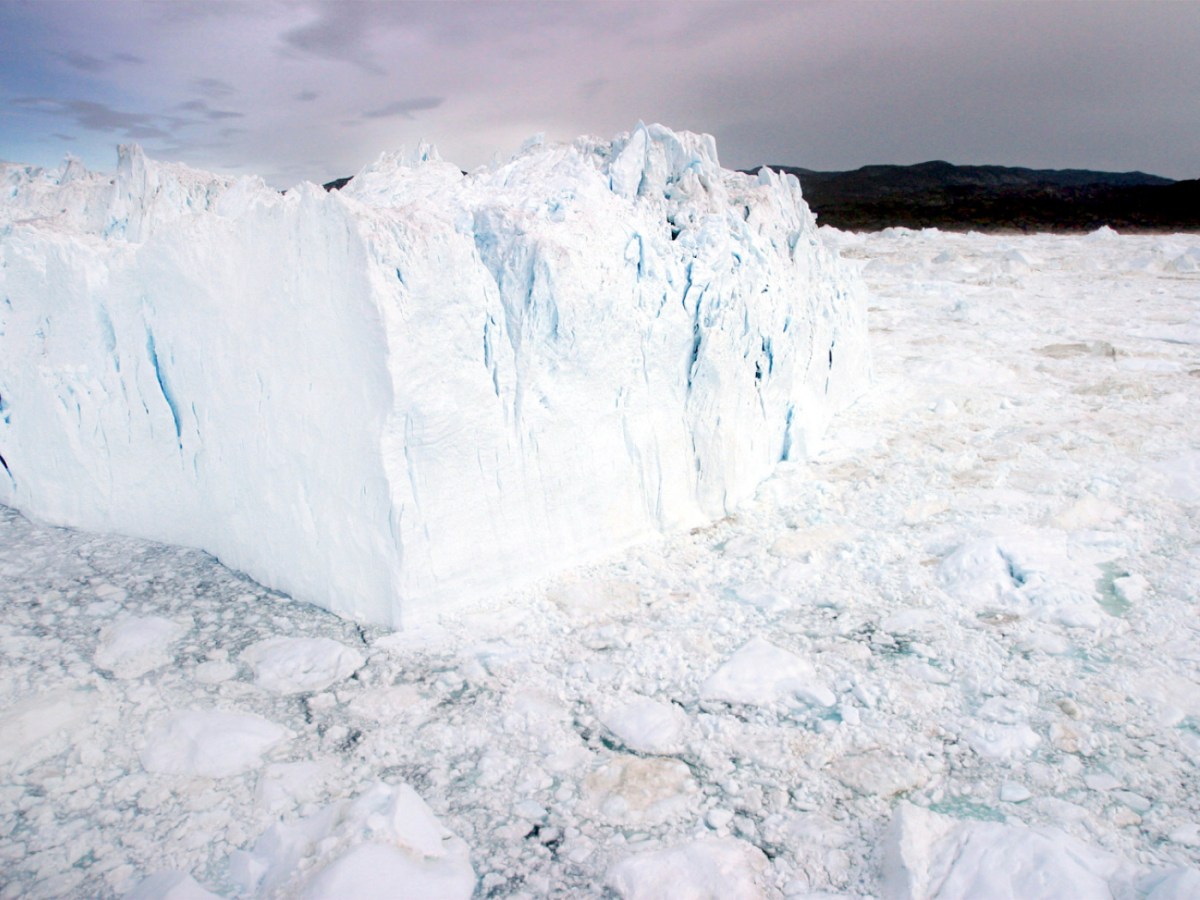
The researchers identified the reason for this as large quantities of melted freshwater, which had entered the North Atlantic from ever-growing glaciers and icebergs. This lighter freshwater stabilised the upper layer of the ocean and thus weakened the currents that transport oxygen-rich water into the depths.
More

More
How a Swiss-US study challenges what we know about the Gulf Stream system
“Since less of the CO2 dissolved in the ocean could reach the surface and escape into the atmosphere due to the weakened deep ocean currents in the North Atlantic there was a decrease in atmospheric CO2 concentration, the expansion of polar ice sheets- and thus a cooling of the planet,” says Hernández-Almeida.
“This made the North Atlantic – along with the Southern Ocean – a central arena for the transition to longer and colder ice ages.”
Closes gap in knowledge
The study thus closes an important gap. Previous work had mainly focused on processes in the Southern Ocean. The new data show that deep circulation and oxygen conditions also changed significantly in the North Atlantic and that both polar regions therefore contributed simultaneously to the change in ice age cycles.
For the researchers at the University of Bern, the results are also significant with regard to climate change today. Climate models predict that the Atlantic Ocean current could weaken due to global warming and the increasing input of meltwater from Greenland. This is an important warning sign of how sensitively this system can react even today.
More
More
Scientists sound alarm over climate ‘tipping points’ ahead of COP30
Adapted from German by AI/with additional input by sb
We select the most relevant news for an international audience and use automatic translation tools to translate them into English. A journalist then reviews the translation for clarity and accuracy before publication.
Providing you with automatically translated news gives us the time to write more in-depth articles. The news stories we select have been written and carefully fact-checked by an external editorial team from news agencies such as Bloomberg or Keystone.
If you have any questions about how we work, write to us at english@swissinfo.ch