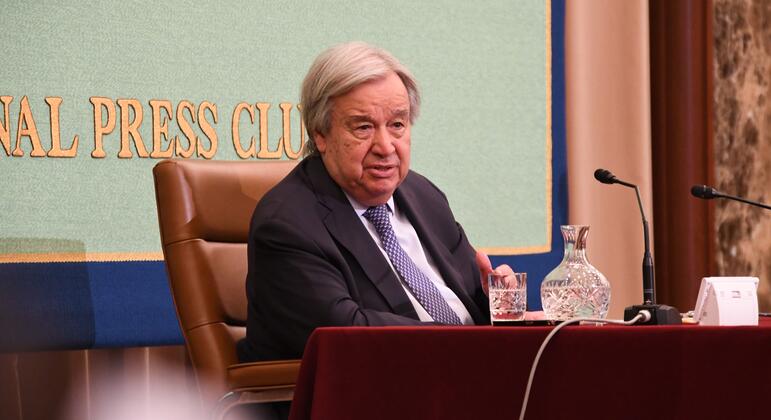
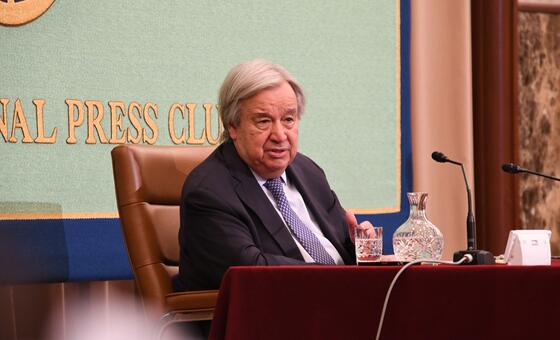
António Guterres was addressing a press conference on the final day of an official visit to Japan, which is marking 70 years of cooperation with the UN, and he highlighted the importance of partnership in a world “rocked by conflicts, climate chaos and inequality.”
He noted how rising inflation and the deepening cost-of-living crisis are being made worse by the current unrest in the Middle East which has led to “skyrocketing” prices for energy and raw materials, including fertilizers.
Uphold freedom of navigation
“It is essential to immediately re-establish the freedom of navigation in and around the Strait of Hormuz, and to end all ceasefire violations and create conditions for a political solution to the conflict,” he said.
The Secretary-General said mistrust and geopolitical divisions are blocking effective solutions.
“Countries are flouting international law with impunity,” he said. “Military spending is outpacing spending on aid, while funding cuts have devastating consequences for the world’s most vulnerable people.”
The UN Secretary-General regularly addresses the Security Council. (pictured)
Security Council reform
In his wide-ranging remarks, Mr. Guterres reiterated his long-standing call to reform outdated international institutions.
“The global problem-solving architecture — in particular, the UN Security Council and global financial institutions — are not as effective as they need to be at this challenging moment,” he said.
He stressed that “the most important reform that needs to be established is the reform of the UN Security Council.”
‘Serious problem of legitimacy’
The Council is comprised of five permanent members – China, France, the United Kingdom, the United States and Russia, who possess the right of veto – and 10 non-permanent members who are elected for two-year terms.
He called for expanding the number of permanent members, noting that only one Asian country is included when the continent contains half the world’s population, while no African or Latin American countries are represented.
“This is a serious problem of legitimacy and of ineffectiveness, and it is absolutely essential to increase the number of Permanent Members and to increase the number of non-Permanent Members to make the Security Council correspond to today’s world, to the realities of today’s world,” he said.
Mr. Guterres further underlined the need for “a multilateral system that is more fair, more able to continue to defend international law and hold countries accountable to it.”
He also upheld the UN as “the essential, one-of-a-kind meeting ground to advance peace, sustainable development and human rights,” but said the Organization is only as strong as Member States’ commitment to it.
Setting a ‘bad example’
The Secretary-General was asked whether international institutions like the UN can prevent conflict.
He responded that “it’s not multilateralism that is in crisis,” pointing to “the behaviour of superpowers that violate international law, that sometimes create conflicts themselves and that use their veto power in the Security Council to guarantee their impunity.”
This makes it “very difficult for the Secretariat of the United Nations to be able to contain the dramatic increase in the number of conflicts around the world,” he said.
“Because when the bad example comes from superpowers, other middle-sized powers all over the world think that they can do whatever they want, without any punishment,” he continued.
“And you see what happens in the DRC (Democratic Republic of the Congo), you see what happens in Sudan. You see what happens in the Horn of Africa.”
The Secretary-General said “it is clear that you have now a number of powers that have a permanent external interference inside the countries in conflict, making it extremely difficult for us to prevent and to mediate conflicts,” thus underlining the importance of Security Council reform.