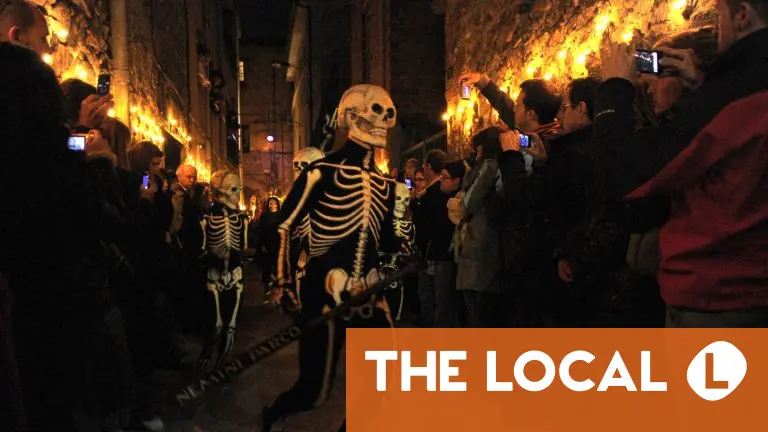
Every year, the small Catalan town of Verges celebrates Easter in a unique way – the hair-raising ‘Danza de la Muerte’, or Dance of Death.
Most places across Spain celebrate Semana Santa or Holy Week (the week leading up to Easter Sunday) with religious processions; floats adorned with candles and flowers, and robes symbolising ancient brotherhoods, but some places have downright bizarre celebrations at this time of year.
One of the most interesting occurs in the small town of Verges in the region of Catalonia, which would look more at home in October at Halloween, than at Easter.
Forget ornate religious statues, seatas (hymns) sung from balconies and incense-cloaked priests, here it’s all about skeletons and death.
The event happens every Maundy Thursday (this year on April 2nd) and its origins date back to Medieval times.
The main tradition is called the Danza de la Muerte or Dance of Death, in which five dancers dressed in skeleton costumes dance to the beat of a tabal, a drum-like instrument, in a hypnotic and eerie ritual.

Dancers dress in skeleton costumes. Photo: PAU BARRENA / AFP
Each of the five dancers has a specific purpose and has a symbolic meaning. The leader carries a scythe like the Grim Reaper with the words Nemini Parco (I spare no one) written on its handle.
A second dancer carries a black flag with the phrases Nemini Parco and Lo temps és breu (Time is short) written on it.
Two child skeletons hold plates of ashes, referring to the famous phrase, “dust you are and to dust you shall return”, representing the fragility of human life.

A penitent wearing a skull mask on Maundy Thursday’s procession in Verges. (Photo by Pau BARRENA / AFP)
The last dancer, bringing up the rear, which is another played by a child, holds a cloak, representing the uncertainty of the afterlife.
Advertisement
They stand always in the shape of a cross and their movements are precise and exact at all times.
The five skeletons make their way along what’s known as the Carrer dels Cargols or Street of Snails, hopping and jumping to the rhythm of the drum. Empty snail shells are glued to the walls filled with oil and wick so they can light the way.
The dance not only represents the death of Jesus Christ, but also death in general and the fragility of human life, referring to wars, famines and plagues which were prevalent in the Middle Ages.

Penitents parade in the Maundy Thursday procession in Verges, northeastern Spain. Photo: Pau BARRENA / AFP
It is believed these types of dances were first performed in the 14th century and took place all over Europe to remind the people that everyone is equal in the face of death, no matter their social status or class. Historical evidence of these performances has been found in France, England, Switzerland and Italy.
The church capitalised on this idea and used it as a way to explain to people that they had a live a moral life for fear of what might happen in death.
The small town of Verges, however, is the only place where this macabre tradition still lives on today and remains unchanged since. The first documented reference of this dance in Verges dates back to 1666.
Advertisement
This dance is preceded by a long procession of people carrying candles dressed in traditional Semana Santa garb with pointed hats, people dressed as Roman soldiers banging drums and those in Medieval peasant costumes. At some points musicians play songs and the crowds begin to sing.

Dancers perform the Dance of the Death during a Holy Week procession in Verges. Photo: PAU BARRENA / AFP
This unique tradition continues to be passed down from generation to generation, being kept alive through the ages. It has been declared a Heritage Festival of National Interest and attracts thousands of visitors each year, who come to watch this unique celebration of Easter.
The procession typically begins at midnight, although you can see other events beforehand starting from around 10pm.
The parade is free to watch, but you must arrive early to get a space. Afterwards, one of the main highlights in the Passion Play performed in the Plaza Mayor. This is a ticketed event, which must be paid for well in advance.