Blog

  • Middle East war: ‘Force of the law’ must prevail over the law of force, urges Guterres

    Middle East war: ‘Force of the law’ must prevail over the law of force, urges Guterres


    António Guterres was speaking to reporters outside the European Council in Brussels, where he briefed regional leaders on the importance of continuing multilateral cooperation between the EU and UN.

     He said the United States and Israel need to end their assault on Iran before it spirals “completely out of control”, leading to more civilian suffering, especially in least developed nations where the consequences of rising energy prices and supply chain bottlenecks could have “tragic consequences.”

    End the assault on energy

    Attacks in recent days by Israel and Iran on natural gas fields and other energy infrastructure in the Gulf have seen prices rise sharply for consumers, while multiple countries have called on Tehran to stop attacks and threats to shipping in the vital Strait of Hormuz off the Iranian coast. 

    Mr. Guterres urged Iran: “Stop attacking your neighbours; they were never parties to the conflict. The Security Council has condemned these attacks,” and has also ordered the reopening of the Strait.

    ‘Enormous pain’

    “The prolonged closure of the Strait of Hormuz causes enormous pain in so many people around the world that have nothing to do with this conflict,” the UN chief continued.

    “It’s time for the force of the law to prevail over the law of force. It’s time for diplomacy to prevail over war,” he said.

    Catch up on Thursday’s extensive live coverage from UN News here, if you missed it.
    Read More

  • MIDDLE EAST LIVE 19 March: Civilians bear the brunt as strikes and displacement rise

    MIDDLE EAST LIVE 19 March: Civilians bear the brunt as strikes and displacement rise


    The crisis in the Middle East continues, with ongoing strikes and rising humanitarian needs. The UN nuclear watchdog reported Wednesday that a projectile struck the site of Iran’s Bushehr nuclear power plant, although no casualties have been reported. In Lebanon, the humanitarian situation is worsening, with hundreds reported killed and more than one million people displaced. UN agencies are scaling up emergency assistance despite mounting challenges. Stay with us for live updates from across the UN system. App users can follow coverage here.

    Read More

  • Forests are more than a resource: How Belarus protects its vital ecosystem

    Forests are more than a resource: How Belarus protects its vital ecosystem


    Ahead of the International Day of Forests, observed on 21 March, deputy resident representative of the UN Development Programme (UNDP) in Belarus Armen Martirosyan told UN News about the threats facing this critical ecosystem and efforts to protect it.

    According to him, forests are not merely a natural resource, but a complex, self-regulating ecosystem. Its importance extends far beyond national borders.

    “Forests absorb and store carbon, playing a key role in climate change mitigation. They regulate water systems, protect soils from erosion and improve air quality,” Martirosyan said.

    Ecosystem and economy

    Today, forests cover nearly 10 million hectares of Belarus. That area has increased by one million hectares over the past 30 years, or one hectare per capita, which is twice the global average rate of growth, according to UNDP.

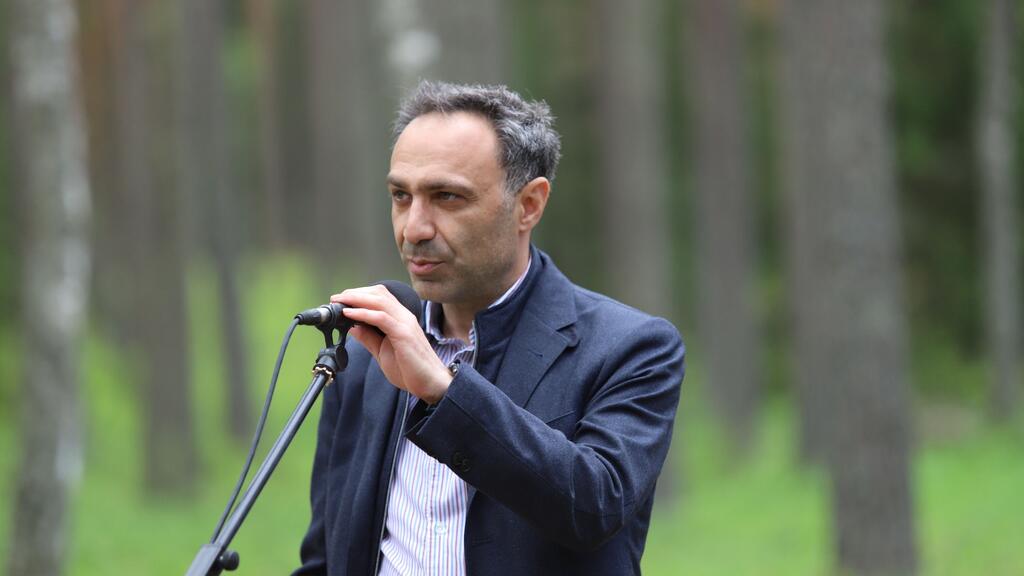
    A man in a suit speaking into a microphone in a forest setting.

    Armen Martirosyan, deputy resident representative of UNDP in Belarus.

    Forest ecosystems play a crucial role in preserving biodiversity, providing habitats for thousands of plant and animal species. Their economic contribution is equally significant, employing around 40,000 people in the forestry sector, with wood products accounting for 8.4 per cent of exports. Non-timber forest products, such as berries, mushrooms and medicinal plants, are also important.

    Forests also provide key spaces for recreation and tourism, creating new opportunities for small businesses and employment in the regions.

    “Ecotourism is becoming a priority in Belarus,” Mr. Martirosyan said. “Forests offer local communities opportunities to create jobs, develop small businesses and design educational eco-routes for residents and visitors alike.”

    Emerging threats

    However, forest ecosystems are facing growing threats, primarily linked to the impacts of climate change.

    One of the most serious challenges remains forest fires. Mr. Martirosyan stressed that this is directly connected to rising temperatures, shorter frost periods, changing precipitation patterns and intensity as well as the increasing frequency of extreme weather events. According to experts, since the start of the 2025 fire season, more than 700 fires have been recorded in Belarus, affecting over 1,200 hectares of forest, nearly twice as much as the previous year.

    Coniferous forests, which dominate in Belarus, are particularly vulnerable, as fires can cause severe damage to biodiversity and destroy entire ecosystems, he warned.

    “Forest pests are another serious challenge,” he said, pointing to an increase in recent years in insects such as bark beetles and sawflies, which is also linked to climate warming and the declining resilience of forest ecosystems.

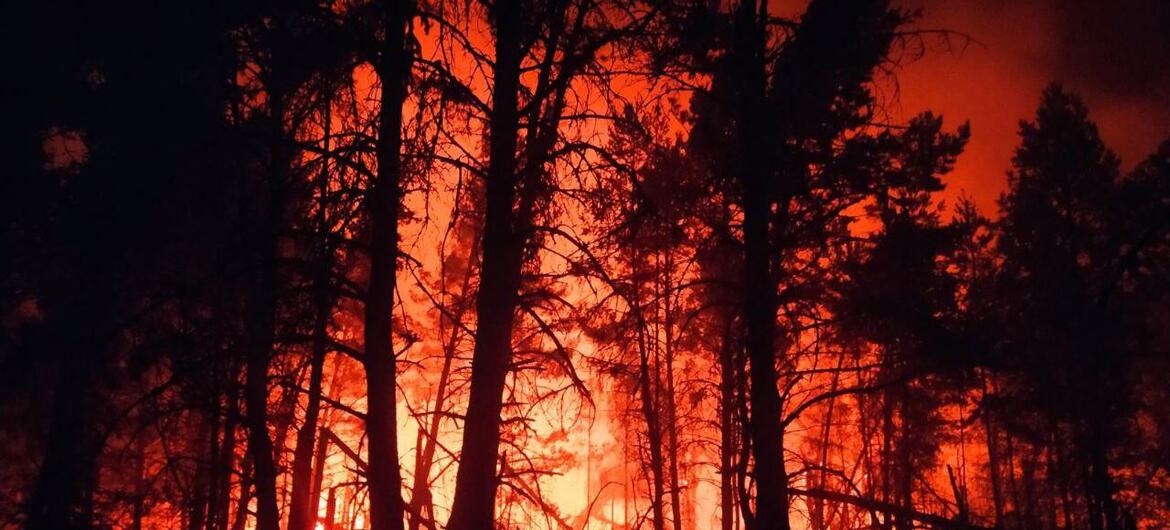
    A dramatic night scene of a forest fire in Belarus, with bright orange flames illuminating the silhouettes of tall pine trees against a dark sky.

    Forest fire in Belarus.

    UNDP support

    Cooperating with the Ministry of Forestry of Belarus for many years, UNDP is helping to introduce modern approaches to forest management and the UN agency’s experts have developed recommendations for updating legislation in this field.

    In 2025, proposals were prepared on the use of digital technologies and innovative methods for forest inventory, protection and conservation along with more effective fire management. In February 2026, with UN support, a strategy and national action plan for the conservation and sustainable use of biodiversity were adopted in Belarus.

    A new project was launched last year to strengthen preparedness for fire prevention and response. It is the first project implemented by UNDP in Belarus with financial support from the Government of the People’s Republic of China under South-South cooperation framework. Another project focuses on developing ecotourism and is being implemented in cooperation with the Ministry of Natural Resources with support from the Russian Federation.

    “Ecotourism creates new sources of income for local communities while supporting protected areas,” the UNDP representative explained, adding that the project helps develop ecotourism infrastructure, create new routes and services, and train specialists working in Belarus’s nature reserves.

    “A forest is a living organism, he said. “It must be treated not simply as a resource, but as part of our shared reality, one on which our future depends.”

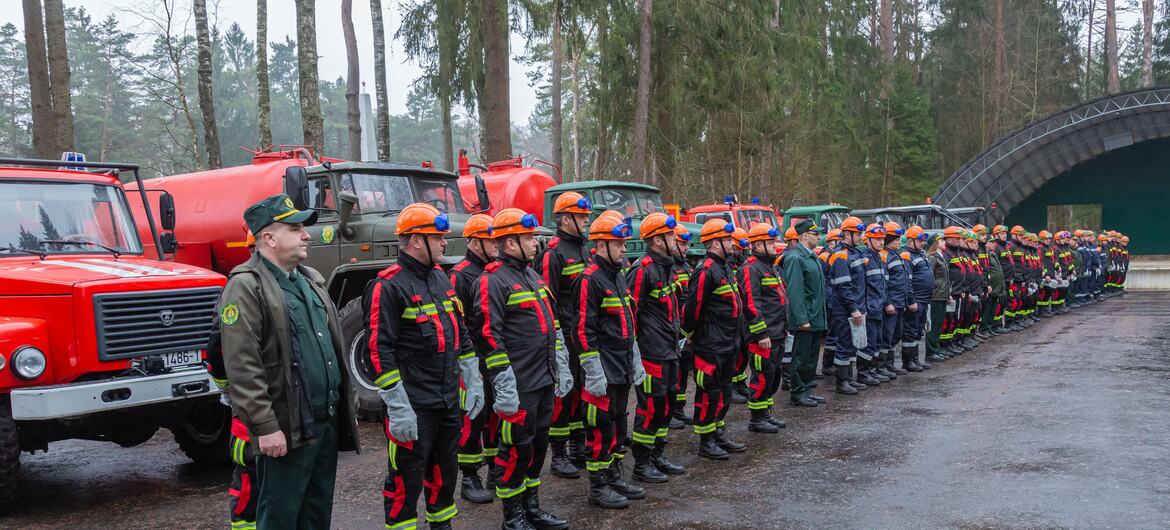
    A line of Belarusian firefighters in uniform and orange helmets standing in front of fire trucks in a forest.

    Firefighting personnel and equipment are inspected in preparation for the fire season in Belarus.

    Three steps to protect forests

    Joint efforts with partners at the international, national and local levels help build a systematic approach to forest management, ensure sustainable results and preserve forests for future generations, UNDP’s Mr. Martirosyan said, emphasising that protecting forests requires focusing on three key areas.

    • the use of innovation and digital technologies to monitor forest conditions and detect threats early
    • strengthening partnerships between the government, international organizations and local communities
    • education and raising environmental awareness, particularly among young people

    Read More

  • Video. Latest news bulletin | March 21st, 2026 – Morning

    Video. Latest news bulletin | March 21st, 2026 – Morning


    Updated:

    Catch up with the most important stories from around Europe and beyond this March 21st, 2026 – latest news, breaking news, World, Business, Entertainment, Politics, Culture, Travel.

    Read More

  • Kyrgyzstan’s Naryn region sees strong growth over past five years

    Kyrgyzstan’s Naryn region sees strong growth over past five years


    Kyrgyzstan
    Materials
    21 March 2026 10:55 (UTC +04:00)

    Kyrgyzstan’s Naryn region sees strong growth over past five years


    Kyrgyz President Sadyr Japarov shone a light on the robust economic growth and the wheels in motion for infrastructure and energy projects in the Naryn region. The president made it clear that the work will keep rolling to boost the region, enhance infrastructure, generate jobs, and elevate living standards.


    Subscription to paid content

    Gain access to all that Trend has to offer, as well as to premium, licensed content via subscription or direct purchase through a credit card.


    Read More

  • EU chief pays tribute to those killed in Brussels attacks


    EU chief Ursula von der Leyen has paid solemn tribute to those killed in one of Belgium’s darkest days.

    “Ten years ago, on 22 March 2016, Brussels, our common home, was attacked in a way it will never forget,” she said.

    “That morning, 32 people set out on ordinary journeys, heading to work or to catch a flight.

    “They never returned home,” said the Commission president.

    She was recalling the tragic events of a decade ago that shook Belgium to the core: the coordinated bombings killed dozens of people at Brussels Airport and Maalbeek metro station.

    On Friday, von der Leyen, in a statement, said, “Today, we take a solemn moment to remember the victims of that blind, heinous act of terrorism.

    “We think of them, and of their loved ones, who continue to carry a loss that time can hardly heal.

    “When Brussels was struck, it was the very heart of Europe that was under attack.

    “It was an assault on our values: freedom, peace, and tolerance.

    “The values which define our Union, and which we are determined to protect.

    “That is why, ten years ago, Europe rose and stood as one, united in solidarity with Belgium.”

    She went on, “Across the continent, city lights shone in black, yellow, and red. Crowds gathered on the streets, with candles flickering in remembrance.”

    “For the past 10 years, we have strengthened our resolve and deepened our cooperation to fight terrorism.

    “We have worked to prevent such horrors from happening again.

    “We now have a stronger legal framework,there is closer operational cooperation across borders, we have taken determined action against radicalisation, both online and offline.

    “Today, as in 2016, we stand united.” Von der Leyen said, “Nous sommes avec la Belgique.Wij zijn met België.Wir stehen an der Seite Belgiens.“

    She concluded: “We are with Belgium.”

    Belgium will mark the 10th anniversary of the attacks with a series of ceremonies organised by the airport, Brussels transport operator MIVB and the government, working with victims’ associations, the prime minister’s office said.

    King Filip and Queen Mathilde will attend ceremonies on Sunday marking the 10th anniversary of the terrorist attacks.

    Belgain broadcaster VRT nws reports: “The royal couple and the Federal Prime Minister (Flemish nationalist) Bart De Wever will attend 3 ceremonies on Sunday. The first will take place at Brussels Airport, where 2 bombs exploded at 7:58 on Tuesday 22 March 2016. The second will be at Maalbeek in Brussels’ European District where a a bomb exploded at 9:11am.”

    It goes on: “The third ceremony will take place at the Monument for the Victims of Acts of Terror on the Wetstraat, near to Jubel Park. 

    “There, the names of those who died will be read out. A minute’s silence will be observed.“

    Read More

  • How to watch Italy’s referendum like a pro – POLITICO

    How to watch Italy’s referendum like a pro – POLITICO


    In the 1990s, following the Mani Pulite (“Clean Hands”)corruption scandal that broke the Christian Democrats’ decades-long hold on power, politicians were discredited, while prosecutors were hailed as heroes and gained moral authority. This triggered lasting grievances on the right and a conviction that the judiciary has become a political force. 

    Things have not always been so binary.

    The idea of separating the career paths of judges and prosecutors was also previously supported by the left: Massimo D’Alema, who was secretary of the left-wing Partito Democratico di Sinistra and would soon become prime minister, proposed the reform as chair of a bipartisan parliamentary commission in 1997.

    But everything changed when Silvio Berlusconi came to power.

    The late prime minister took a more antagonistic stance toward the judiciary, alleging he was being prosecuted because of political interests. He nicknamed judges toghe rosse (“red robes”), accusing them of being Communist sympathizers and indulging a personal vendetta against him. He repeatedly attempted to rein in prosecutorial power, including curbing the use of wiretaps, instituting parliamentary immunity and shortening the statute of limitations. 

    In 2002 Berlusconi proposed a similar constitutional amendment to Meloni’s, but was forced to retreat after a fierce backlash. Since then most governments, like Mario Draghi’s in 2021, have focused on passing more targeted laws to improve efficiency.


    Read More

  • US pauses sanctions on some of Iran’s oil as gas prices surge


    U.S. sanctions on some Iranian oil will be temporarily lifted to allow the sale of shipments already in transit, Treasury Secretary Scott Bessent announced Friday.

    The partial pause on sanctions is intended to help ease what the Trump administration sees as a short-term shock to the global market as a result of the attack on Iran launched by the U.S. and Israel three weeks ago.

    Bessent said in a social media post that the U.S. is granting a short-term authorization to allow the sale of about 140 million barrels of Iranian oil in transit.

    “In essence, we will be using the Iranian barrels against Tehran to keep the price down as we continue Operation Epic Fury,” he said.

    Oil prices have spiked to more than $100 per barrel since the U.S. launched airstrikes on Iran last month, triggering a rise in gas prices. Israeli strikes on Iran’s vast offshore gas field and Iran’s closure of the Strait of Hormuz, a critical trade passage that facilitates a significant share of the world’s oil and natural gas trade, have helped drive the increases.

    The sales have been authorized for 30 days, according to a copy of the general license issued by the Treasury Department on Friday.

    The announcement marks a partial reversal of the longstanding aggressive economic pressure campaign by the U.S. intended to weaken Iran’s economy, though Bessent said the country would have “difficulty accessing any revenue generated” from the sales.

    “The United States will continue to maintain maximum pressure on Iran and its ability to access the international financial system,” he added.

    Trump appeared to acknowledge he was aware that entering a war with Iran could cause oil prices to spike, even as he touted the success of the U.S. military operation and the strength of the economy.

    “I expected it worse actually,” he told reporters at the White House on Friday. “I thought that oil prices would go much higher.”

    Bessent said he’s confident the suspension of sanctions on Iran will benefit the U.S. economy in the long run.

    “Any short-term disruption now will ultimately translate into longer-term economic gains for Americans — because there is no prosperity without security,” he said.

    Democratic Senator Jeanne Shaheen of New Hampshire, the ranking member on the Senate Foreign Relations Committee, said in response that the easing of sanctions gives the Iranian government “a financial lifeline” as Americans “continue to feel the impact” of the war.

    “To say the president has no plan is an understatement,” Shaheen said.

    Read More

  • Swiss government suspends arms exports to US

    Swiss government suspends arms exports to US


    Federal Council restricts arms exports to the USA due to Iran war

    Economics Minister Guy Parmelin.


    Keystone-SDA

    Due to the war in Iran, the Swiss government is no longer authorising any new arms exports to the United States. Existing licences and exports of other goods will be regularly reviewed by a group of experts.

    +Get the most important news from Switzerland in your inbox

    The government made its decision at its meeting on Friday. It based its decision on Switzerland’s neutrality and the provisions of the War Materiel Act.

    “The export of war materiel to countries involved in the international armed conflict with Iran cannot be authorised for the duration of the conflict,” the government wrote in a statementExternal link.

    Defence Minister Martin Pfister said the Swiss government did not fear a backlash from US President Donald Trump. The government’s application of the law of neutrality comes as no surprise to foreign countries, Pfister said at a press conference on the 2026 Armed Forces Dispatch in Bern in response to questions from journalists. “The US knows the maxims of Swiss foreign policy.”

    In initial reactions to the government’s decision, the industry association Swissmem spoke of a “premature statement of neutrality”. For the left-wing Social Democratic Party the decision did not go far enough, while the right-wing Swiss People’s Party reckons the government had no other choice.

    + Switzerland refuses two US requests for flyovers linked to Iran war

    Regular reviews

    In practice, the decision concerns the US. “No definitive licences for the export of war materiel to Israel have been granted for a number of years,” the government said. The same applies to Iran. According to the statement, no new licences have been issued for exports of war materiel to the US since the US and Israeli airstrikes on Iran began on February 28.

    According to the statement, the existing licences can continue to be used. According to the government, it has come to the conclusion that they have no relevance to the war against Iran. However, a group of experts with representatives from the economics ministry, the foreign ministry and the defence ministry “will regularly review developments in exports of the goods in question to the US and assess whether any action is required under neutrality law”.

    + As Middle East conflict rages, Swiss tradition of uniting adversaries is changing

    The group of experts will also examine exports of goods that can be used for both civilian and military purposes, as well as specific military goods such as training aircraft or military simulators. There are also plans to review exports of goods that do not fall into this category but are affected by sanctions against Iran. “A restrictive approach is already in place with regard to Israel,” the government said.

    According to international law expert Evelyne Schmid from the University of Lausanne, it would be legally possible to stop transactions that are already underway. “The legal basis for precisely such cases stipulates that the authorities can also revert to authorisations that have already been granted. It can suspend them, it can even revoke them,” Schmid told Swiss public television SRF on Thursday.

    Adapted from German by AI/ts

    We select the most relevant news for an international audience and use automatic translation tools to translate them into English. A journalist then reviews the translation for clarity and accuracy before publication.  

    Providing you with automatically translated news gives us the time to write more in-depth articles. The news stories we select have been written and carefully fact-checked by an external editorial team from news agencies such as Bloomberg or Keystone.

    If you have any questions about how we work, write to us at english@swissinfo.ch

    Read More

  • Swiss cable car slammed into pylon before falling

    Swiss cable car slammed into pylon before falling


    Engelberg cable car slams into a pylon before falling

    Engelberg cable car slams into a pylon before falling


    Keystone-SDA

    The fatal fall of a cable car gondola on Wednesday in central Switzerland was due to “an unexpectedly strong gust of wind”, according to its manufacturer. The gust blew the cabin against a pylon. The impact unhooked it from the support cable.

    +Get the most important news from Switzerland in your inbox

    At the time of the accident, the wind was strong and blustery,” Arno Inauer, managing director of the Zug company Garaventa, which built the Titlis Xpress eight-seater gondolas, wrote to the media on Friday. The checks carried out since Wednesday show that the installation in question was in perfect technical condition,” he said.

    The gondola fell on a snow-covered slope after the intermediate station of Trübsee (1,800m), on its way up to the upper station of Stan (2,430m). It rolled several times after the fall. Its sole occupant, a 61-year-old woman from the region, did not survive.

    + One dead after gondola cabin plunges in Swiss resort of Engelberg

    The upper section of the Titlis Xpress has been closed since the accident until further notice. The parallel cable car linking Trübsee to Stand will ensure transport on this route.

    On Thursday parliamentarian Hans Wicki, chairman of the board of directors of the Engelberg mountain railways, told the Tages-Anzeiger newspaper that just before the accident, employees working on the Titlis Xpress had begun to suspend operations because of the wind. They were putting the gondolas in a storage area when one of the gondolas still in service fell.

    Adapted from French by AI/ts

    We select the most relevant news for an international audience and use automatic translation tools to translate them into English. A journalist then reviews the translation for clarity and accuracy before publication.  

    Providing you with automatically translated news gives us the time to write more in-depth articles. The news stories we select have been written and carefully fact-checked by an external editorial team from news agencies such as Bloomberg or Keystone.

    If you have any questions about how we work, write to us at english@swissinfo.ch

    Read More