Blog

  • Switzerland halts weapons exports to US over Iran conflict – POLITICO

    Switzerland halts weapons exports to US over Iran conflict – POLITICO


    Switzerland said it won’t allow weapons exports to the U.S. as long as Washington is involved in its ongoing military campaign against Iran.

    The Swiss government said on Friday that it will not sign off on any new licenses for the export of war materiel to countries involved in the conflict, citing Switzerland’s commitment to neutrality.

    Switzerland said that it has not issued new export licenses to send weapons to the U.S. since the U.S. and Israel launched strikes on Tehran on Feb. 28. Existing licenses to export weapons to the U.S. can continue as they are not relevant “to the war at present,” but they will be kept under review in case they conflict with Swiss neutrality laws, it said.

    Exports of other dual-use and military goods, and other goods affected by sanctions against Iran, will also be kept under review, it added.

    Switzerland has not granted weapons export licenses for Israel or Iran for a “number of years,” the government said.


    Read More

  • Switzerland halts new arms exports to America

    Switzerland halts new arms exports to America


    Switzerland will no longer approve new licences for arms exports to the United States, reported SRF. The Federal Council announced the move on Friday in response to the American war against Iran.

    Ruag Aerospace © Marlon Trottmann | Dreamstime.com

    The government said its decision was guided by Switzerland’s neutrality and the War Materiel Act. For the duration of the conflict, it argued, exports of war materiel to countries involved could not be authorised.

    Existing licences remain valid for now. The Federal Council said they are not directly linked to the conflict. Nevertheless, an expert group drawn from the departments of economic affairs, foreign affairs and defence will monitor developments and assess whether further action is required under neutrality law.

    The review will extend beyond arms. Officials will examine exports of dual-use goods—those with both civilian and military applications—as well as specialised military items such as training aircraft and simulators. Other exports affected by sanctions on Iran will also be scrutinised.

    Legal experts note that Switzerland already applies a restrictive approach in comparable cases. Evelyne Schmid of the University of Lausanne argues that the authorities could go further if necessary. Existing licences, she says, can be revisited, suspended or even revoked.

    The decision has drawn mixed political reactions. Priska Seiler Graf of the Socialist Party supports the move but says it does not go far enough; existing deliveries, she argues, should also be halted, given the risk that Swiss materiel could end up in the conflict. Reto Nause of the Centre Party takes the opposite view, warning that the ban could have consequences for Switzerland’s own security. Countries that are denied exports, he suggests, may be less willing to supply Switzerland in return, potentially delaying systems such as the Patriot missile defence, the F-35 fighter jet or spare parts for the F/A-18.

    More on this:
    SRF article (in German)

    For more stories like this on Switzerland follow us on Facebook and Twitter.


    Read More

  • Une étape parisienne pour le plus célèbre des groupes de rock indé chinois

    Une étape parisienne pour le plus célèbre des groupes de rock indé chinois


    Shijiazhuang n’est pas la ville la plus riante de Chine. C’est peut-être même l’une des plus ennuyeuses. La capitale du Hebei (la province qui entoure Pékin) et ses plus de 11 millions d’habitant·es traînent une sale réputation : son taux de pollution dépassait celui de toutes les cités du pays dans les années 2010.

    Pour tenter de redorer son blason, cette ancienne cité industrielle, célèbre dans les années 1950 pour ses filatures, mise désormais sur le rock. Et ses autorités ont décidé de disputer à Pékin le titre de capitale chinoise du rock en organisant un festival annuel d’avril à septembre.

    Pour nourrir cette veine musicale, la cité met en avant la signification littérale des trois caractères qui forment son nom en chinois (avec une lecture de droite à gauche) : la « ville natale du rock », soit : zhuang, jia, shi. « Shi » signifie plutôt la pierre, tandis que rock, en chinois, se traduit par « yaogun » (bouger et rouler), mais tout est bon pour attirer les touristes. 

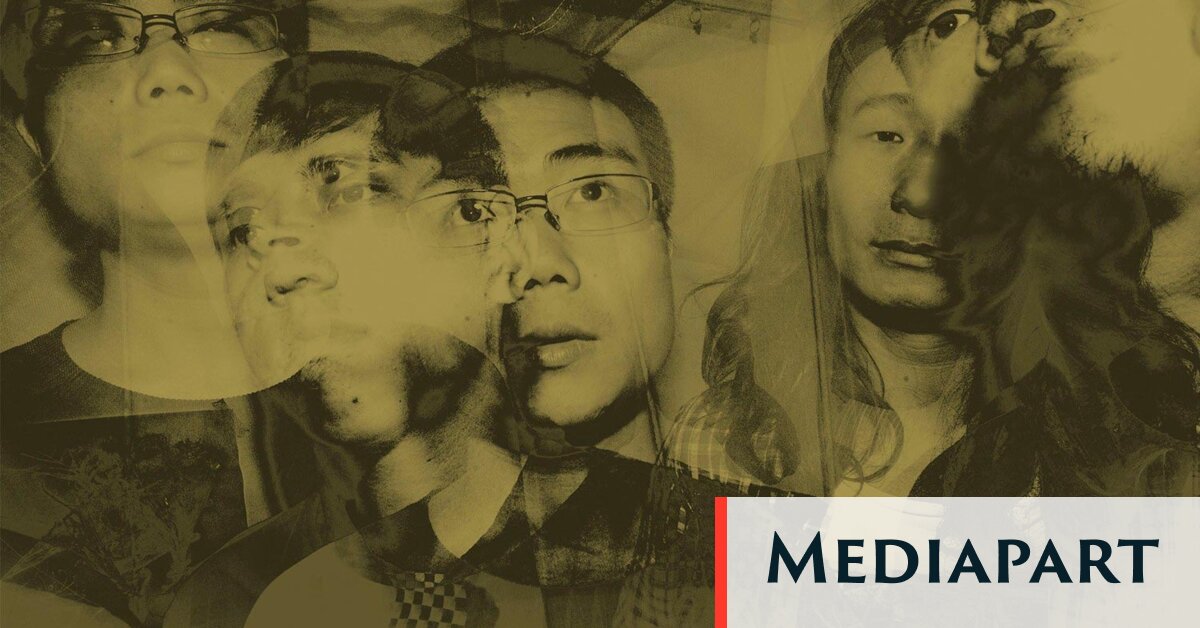
    Le groupe de rock indépendant chinois Omnipotent Youth Society. © Photo DR

    S’il s’agit surtout de faire marcher l’économie locale, la ville peut se targuer d’une histoire certaine avec ce genre musical né aux États-Unis, puisque c’est à Shijiazhuang que, de 1999 à 2013, a été publié So Rock ! Magazine (en chinois Wo ai yaogun yue, soit « j’aime le rock »), la publication de référence du rock indépendant chinois. Elle est aussi le berceau d’un des principaux groupes indépendants et l’un des plus populaires du pays : Omnipotent Youth Society (en mandarin Wanneng qingnian lüdian). 

    L’hommage du cinéaste Jia Zhangke

    Dans le cadre d’une tournée européenne, Omnipotent Youth Society se produit le 21 mars au Cabaret sauvage à Paris. Inutile de se précipiter à la billetterie, le concert est déjà complet, les plus de 1 000 places se sont vendues en moins d’une heure. Depuis les années 2010, le groupe a défini les bases d’un rock indépendant et populaire pour toute la scène sinophone, que ce soit en Chine, à Hong Kong ou à Taïwan, souligne Nathanel Amar, chercheur spécialiste du rock chinois et auteur du livre Scream for Life. L’invention d’une contre-culture punk en Chine populaire (Presses universitaires de Rennes, 2022).

    Omnipotent Youth Society compose la bande-son parfaite des réformes économiques et des inégalités sociales qu’elles ont entraînées. « Ce n’est pas un hasard si Jia Zhangke a utilisé leur chanson mythique “Kill the One from Shijiazhuang” [Shasi nage Shijiazhuang ren, « Tuer cette personne de Shijiazhuang » – ndlr] dans son dernier film Les feux sauvages pour représenter trente ans de réformes économiques », dit Nathanel Amar.

    Nous avons vécu la même période, même si nous utilisons des moyens artistiques différents pour exprimer nos sentiments.

    Le cinéaste Jia Zhangke

    Jia Zhangke et Omnipotent Youth Society ont commencé leur carrière à peu près en même temps. Lui en 1997, alors qu’il était étudiant et commençait à filmer Xiao Wu à Taiyuan, dans le Shanxi. Eux en 1996, à Shijiazhuang. Deux villes marquées par les mines de charbon exploitées alentour et la désindustrialisation qui les a frappées dans les années 1990. 

    Et lorsqu’il s’est agi d’illustrer musicalement des images d’une autre ville houillère du nord, Datong, dans son film Les Feux sauvages, le choix de la chanson « Tuer cette personne de Shijiazhuang » s’est imposé, a indiqué Jia Zhangke fin 2024 lors de la projection de son film à Shijiazhuang. « Que ce soit Shijiazhuang, Taiyuan, dans ma province natale, ou Datong, dans le film, toutes ces villes sont proches géographiquement et se ressemblent, elles ont en commun des atmosphères et la manière d’y vivre », a-t-il expliqué, soulignant que c’était une chanson qu’il aimait depuis longtemps. 

    « Nous avons vécu la même période, même si nous utilisons des moyens artistiques différents pour exprimer nos sentiments », a témoigné également le cinéaste. 

    « Tuer cette personne de Shijiazhuang » est une chanson sombre, dans laquelle un ouvrier d’une usine pharmaceutique raconte son triste quotidien. Elle se termine par : « Vivre comme ça pendant trente ans / Jusqu’à l’effondrement du bâtiment / L’obscurité au plus profond des nuages / Engloutit le paysage au fond du cœur. » Ji Geng, le parolier et bassiste du groupe, a expliqué que la chanson traitait de « l’érosion de l’enthousiasme et de l’estime de soi » au sein d’une famille. 

    Une influence dans le monde sinophone

    Les membres du groupe prennent leur temps. Leur premier album est sorti en 2010, le deuxième, plus centré sur les questions écologiques, en 2020. Leur influence s’étend jusqu’à Taïwan, où des groupes s’inspirent de leurs « passages mélodiques, instrumentaux, avec l’inclusion du jazz, de trompettes, de violons », souligne Nathanel Amar. « Et avec des paroles à la fois très poétiques et qui parlent vraiment de la situation sociale de la Chine des réformes, ce qui fait écho à ce que vivent les jeunes taïwanais, c’est-à-dire un grand ennui, notamment dans les centres urbains », poursuit-il.

    Omnipotent Youth Society donne très peu d’interviews, préférant garder un profil bas, ce qui explique sans aucun doute que ses membres aient pu éviter les ennuis politiques, le contenu de leurs chansons ne cadrant absolument pas avec la volonté de Xi Jinping depuis 2012 d’insuffler de l’énergie positive à la création artistique dans son ensemble.

    Un article savoureux du New York Times racontait comment la Ligue de la jeunesse communiste de Shijiazhuang avait réécrit les paroles de « Tuer cette personne de Shijiazhuang ». Désormais intitulée « L’indestructible de Shijiahuang », elle vantait les réformes économiques lancées par le Parti communiste et la capacité de la ville à se régénérer. Et la fin disait : « Vingt ans de transformation / Shijiazhuang l’internationale va de l’avant. Rassemblant les rêves de voler / répondant à l’appel. Vingt ans de changements rapides / l’aspiration initiale trace la voie. Comme une oie déployant ses ailes contre le vent / écrire un nouveau chapitre glorieux. » 

    On est bien loin de l’original. Mais c’est cette version remaniée qui a servi en 2023 aux autorités locales pour faire la promotion de Shijiazhuang capitale du rock. Un rock aseptisé et conforme au socialisme à caractéristiques chinoises. 

    À la même période, lors d’une tournée nationale, Omnipotent Youth Society n’a pas été autorisé à chanter « Tuer cette personne de Shijiazhuang » lors d’un concert à Shanghai. Le groupe l’a jouée sans les paroles. Une version instrumentale pour contourner la censure. À Paris, celles et ceux qui ont obtenu des billets auront le droit aux paroles.

    Read More

  • 2025-26 Men’s March Madness Odds: Arizona Favored Heading Into Round of 32

    2025-26 Men’s March Madness Odds: Arizona Favored Heading Into Round of 32


    And just like that, we’re one round down.

    Here’s a look at the odds for the men’s NCAA Tournament winner at DraftKings Sportsbook as of March 21.

    This page may contain affiliate links to legal sports betting partners. If you sign up or place a wager, FOX Sports may be compensated. Read more about Sports Betting on FOX Sports.

    2025-26 Men’s NCAA Tournament winner 

    Arizona: +340 (bet $10 to win $44 total)
    Michigan: +370 (bet $10 to win $47 total)
    Duke: +450 (bet $10 to win $55 total)
    Florida: +800 (bet $10 to win $90 total)
    Houston: +900 (bet $10 to win $100 total)
    Illinois: +1800 (bet $10 to win $190 total)
    Purdue: +2200 (bet $10 to win $230 total)
    UConn: +2500 (bet $10 to win $260 total)
    Iowa State: +2800 (bet $10 to win $290 total)
    Arkansas: +4000 (bet $10 to win $410 total)
    St. John’s: +4000 (bet $10 to win $410 total)
    Michigan State: +5000 (bet $10 to win $510 total)
    Gonzaga: +5500 (bet $10 to win $560 total)
    Vanderbilt: +6500 (bet $10 to win $660 total)
    Kansas: +7000 (bet $10 to win $710 total)
    Nebraska: +7500 (bet $10 to win $760 total)
    Tennessee: +8000 (bet $10 to win $810 total)

    Duke opened as the favorite, but after a shaky win over 16-seed Siena in the first round, the Blue Devils dropped to third. In that game, Duke trailed by 11 at half before outscoring Siena by 17 in the second half to secure a 71-65 win. 

    Next up for Duke is TCU in the second round. The Blue Devils are 11.5-point favorites in that matchup.

    The new favorite is Arizona, which put a beatdown on LIU in the first round, winning by 34. The Wildcats will face Utah State in the second round, also as 11.5-point favorites. 

    Michigan remains second on the board and its odds did not shift after a 21-point win over Howard. It next gets Saint Louis, and the Wolverines opened as 12.5-point favorites ahead of that clash.

    Read More

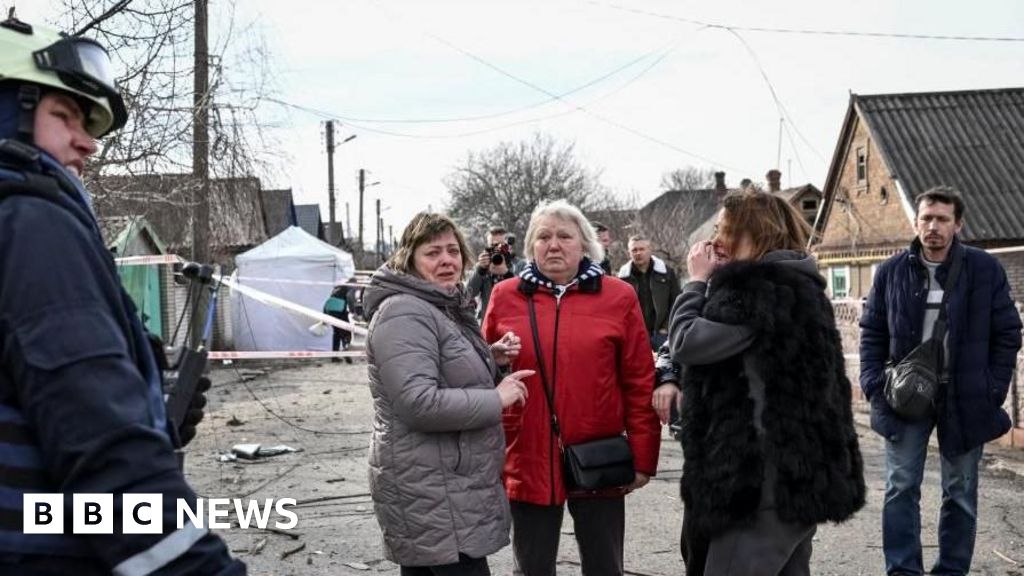
  • Russian drone attack kills two in Ukraine ahead of talks in US, officials say

    Russian drone attack kills two in Ukraine ahead of talks in US, officials say


    Two children, aged 11 and 15 were also injured in the attack which took place in Zaporizhzhia.

    Read More

  • POCO X8 Pro review: flagship feels at the price of a mid-ranger

    POCO X8 Pro review: flagship feels at the price of a mid-ranger


    POCO X8 Pro review: flagship feels at the price of a mid-ranger

    Global tech brand POCO is ending the first quarter with the release of its new midrange lineup, the POCO X8 Pro Series, which consists of two devices: the POCO X8 Pro Max and the POCO X8 Pro.
    The new series is promised to deliver a flagship-level experience at a more accessible price point, continuing the brand’s core proposition since its debut in 2018.

    In this review, I spent around a week to delve into the phone’s performance, battery capability, and its camera and screen performance.

    For starters, the key specs of the POCO X8 Pro include a MediaTek Dimensity 8500-Ultra processor, paired with a 6,500mAh battery capacity.

    It also comes with a 6.59-inch 1.5K AMOLED display, with up to a 120Hz refresh rate, and a 50-megapixel main camera.

    The review unit is in black, and comes with 512 gigabytes (GB) of storage capacity and 12GB of random access memory (RAM), extendable up to 12GB via virtual RAM.

    In terms of design, the device adopts a minimalist aesthetic, featuring a metal frame and Gorilla Glass 7i front that give it a premium feel.

    PERFORMANCE
    To test the performance of the POCO X8 Pro, I ran some of the country’s most popular mobile games and multimedia apps.

    Throughout the course of the test, the device was set to performance mode, and the 12GB virtual RAM was enabled to maximize its capability.

    The POCO X8 Pro scored 1.8 million points on the AnTuTu Benchmark, indicating that it is a high-performing device made possible by its 4-nanometer Dimensity 8500-Ultra chip.

    I played Mobile Legends: Bang Bang with the device on maxed-out settings. As expected, since the game is not graphically intensive, the experience was stable throughout, with no noticeable lag or frame drops.

    For Genshin Impact, a more demanding title, the phone was capable of running at high settings with generally stable performance. However, occasional frame rate dips were observed during extended gameplay sessions.

    App loading and multitasking were smooth, with no noticeable slowdowns.

    As for its thermal performance, based on testing, the phone ranges between 37°C to 39°C when browsing or using multimedia apps.

    However, during AnTuTu testing and gameplay, it can reach up to 43°C, which may feel warm if used for a longer period. Is it concerning? Not really, as it is still within the moderate range, and the heat may not be as noticeable when using a phone case.

    POCO said that the X8 Pro has its 3D dual-layer IceLoop cooling system to dissipate heat, which promises to reduce temperatures by up to 3°C.

    CAMERA
    The POCO X8 Pro features a triple-camera setup, consisting of a 50MP Sony IMX882 main sensor, an 8MP ultra-wide camera, and a 20MP front camera.

    While the device is not positioned as a camera-centric phone, the main camera is capable of capturing decent photos and videos. Images tend to lean toward a cooler white balance, with a good level of detail.

    One limitation observed was in close-up shots, where the camera struggled to maintain sharp focus on the subject.

    The ultra-wide camera produces images with a similar color profile, though with a noticeable drop in detail.

    For selfies, the front camera applies a slight tone-up effect by default, producing images suitable for posting without further editing.

    A personal favorite of mine is the main camera’s video performance. It is very stable and can be a good alternative for vlogging, as it is equipped with optical image stabilization. The details are quite decent, although the white balance leans cooler than I prefer.

    SCREEN AND BATTERY
    A personal favorite feature of the phone is its battery performance.

    Its 6,500mAh silicon-carbon battery is more than enough to last for more than a day.

    Charging does not take too long, as it is capable of up to 100W charging, which based on experience can fully charge the device from 0% to 100% in about 1 hour and 10 minutes.

    It is also capable of 27W reverse charging.

    POCO did not disclose if the device has bypass charging.

    Meanwhile, the POCO X8 Pro display can reach up to 3,500 nits of brightness due to its 1.5K AMOLED panel.

    It is also protected by Corning Gorilla Glass 7i, along with various TÜV Rheinland certifications for eye protection.

    Based on experience, the display is crisp and provides great detail, especially when viewing high-resolution videos.

    It also has Widevine L1 support, making it capable of playing high-quality video on most streaming platforms.

    Other key specs of the POCO X8 Pro include IP68 dust and water resistance rating.

    This means it can withstand submersion of up to 1.5 meters for 30 minutes in freshwater. However, it is not recommended to use it in saltwater or pool environments.

    VERDICT
    As for my final verdict, I am personally surprised by how well-rounded the POCO X8 Pro is. The brand did not hold back on other key features despite having a high-performing chip under the hood.

    This is definitely a good catch and a strong value-for-money option, especially if you are able to get it at its introductory price of ₱15,499 for the 8GB + 256GB variant, originally priced at ₱18,999.

    The larger variants, 8GB + 512GB and 12GB + 512GB, have launch prices of ₱16,599 and ₱17,499, respectively.

    Meanwhile, the Iron Man Edition of the POCO X8 Pro has an introductory price of ₱18,999 for the 12+512GB storage variant, originally priced at ₱22,999.

    As a suggestion, the 12GB + 512GB variant is a practical choice, as the storage is doubled by just adding P2000.

    The POCO X8 Pro and the POCO X8 Pro Max are already available on Shopee, Lazada, and TikTok Shop.

    The early bird sale is expected to last until March 26. — Edg Adrian A. Eva

    Read More

  • Amid deepening crisis in Palestine, girls face rising risks and a mounting mental health emergency

    Amid deepening crisis in Palestine, girls face rising risks and a mounting mental health emergency


    Sima Alami, adolescent and youth programme officer at the UN agency for sexual and reproductive health, UNFPA, painted a stark picture defined by alarming statistics.

    “We have more than one million children in Gaza who need mental health and psychosocial support services,” she told UN News.

    The scale of trauma is staggering.

    96% of children in Gaza feel death is imminent

    According to UNFPA data cited by Ms. Alami, 96 per cent of children in Gaza feel that death is imminent. “This reflects the depth of fear and trauma they experience daily,” she stressed.

    Among adolescents and youth, often overlooked in humanitarian crises, the psychological toll is equally severe. Some 61 per cent suffer from post-traumatic stress disorder (PTSD), 38 per cent from depression and 41 per cent from anxiety. “Alarmingly, one in five adults contemplates suicide almost daily,” she added.

    “This is not merely psychological distress,” Ms. Alami emphasized. “It is a widespread mental health emergency.”

    Girls at heightened risk

    Within this crisis, girls are among the most vulnerable. In Gaza, child marriage, which was previously on the decline, has resurged sharply. Rates had fallen from 25.5 per cent in 2009 to 11 per cent in 2022, but are now rising again as families struggle to survive.

    A recent UNFPA study found that 71 per cent of respondents in Gaza reported increased pressure to marry girls under 18. In a short monitoring period alone, more than 400 marriage licences were issued for girls aged 14 to 16 in emergency courts, but the figures are likely underreported.

    “Some families see marriage as a survival strategy amid displacement, poverty and insecurity,” Ms. Alami explained. Others believe it offers protection in overcrowded shelters or helps ease economic hardship following the collapse of livelihoods.

    Child marriage exposes girls to violence

    The consequences are severe. In 2025, approximately 10 per cent of newly registered pregnancies in Gaza were among adolescent girls, marking a significant increase compared to pre-war levels.

    At the same time, access to healthcare has dramatically shrunk. Only 15 per cent of health facilities in Gaza are currently able to provide emergency obstetric and neonatal services, increasing the risk of complications for young mothers and their babies.

    Child marriage also exposes girls to violence.

    “Some evidence suggests that 63 per cent of girls married at a young age have experienced physical, psychological or sexual violence,” Ms. Alami said. Reports indicate rising divorce rates and widespread severe psychological distress among married minors.

    In the most extreme cases, the consequences are life-threatening. “More than 100 suicides or attempted suicides have been documented among survivors of violence,” she noted, underscoring that child marriage is a form of gender-based violence.

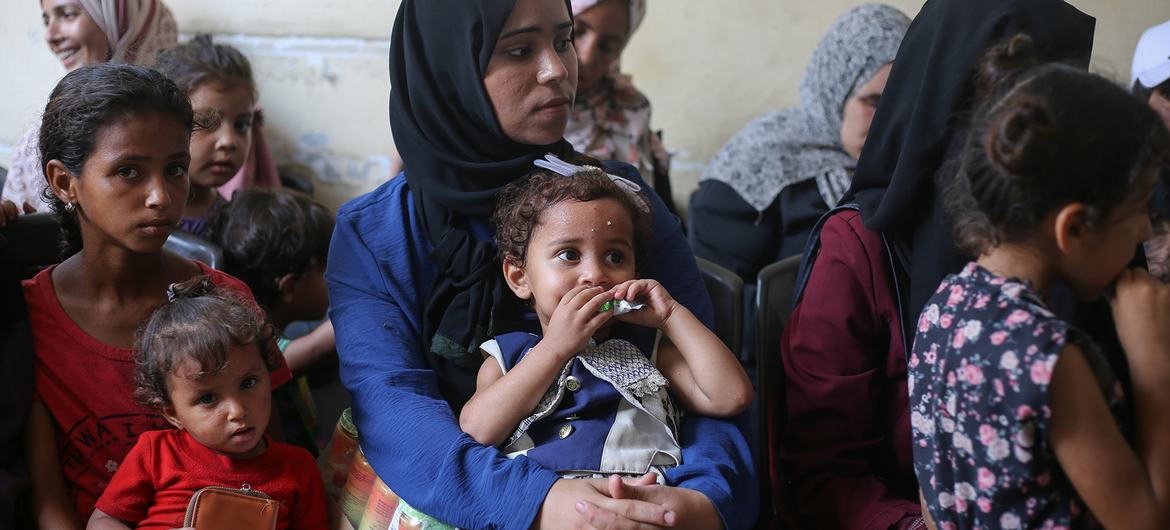
    Children who are not getting enough to eat attend a nutrition clinic in Deir al Balah, in Gaza.

    Children who are not getting enough to eat attend a nutrition clinic in Deir al Balah in Gaza.

    Persistent sense of insecurity in the West Bank

    While Gaza remains the epicentre of the crisis, conditions in the West Bank are also deteriorating. Escalating violence, military operations and settler attacks have driven displacement, particularly in refugee camps, while movement restrictions and checkpoint closures have disrupted daily life and forced many schools to shut.

    Children and young people are living under constant stress.

    “They face fear of raids, restrictions on movement, and uncertainty about livelihoods and access to services,” Ms. Alami said. “This creates chronic anxiety and a persistent sense of insecurity.”

    Such pressures can have long-term consequences, shaping behaviour and mental health well into adulthood. Some young people are even considering leaving Palestine altogether.

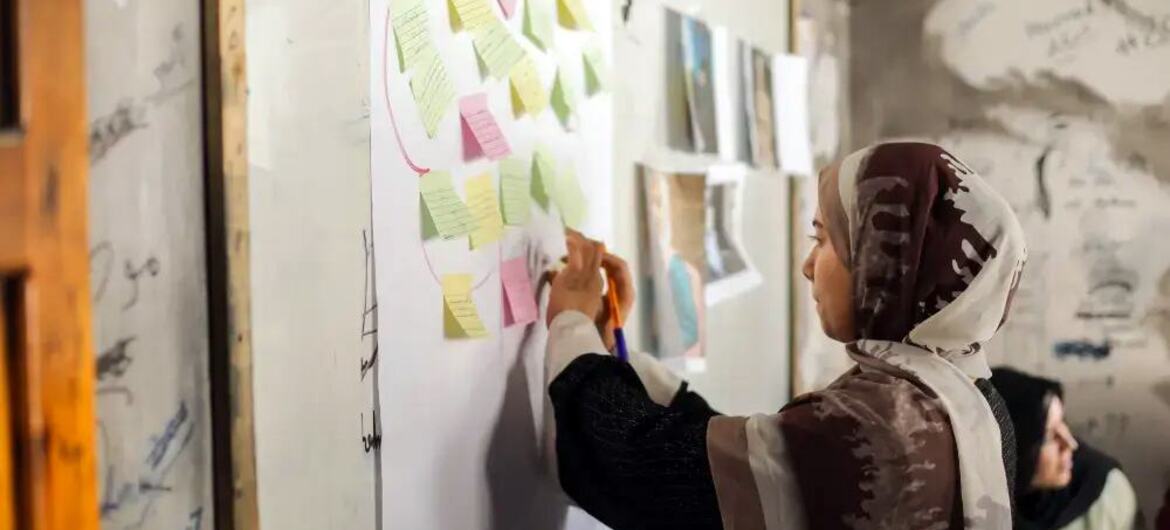
    A woman wearing a headscarf actively participates in a planning session, writing on a whiteboard covered with colourful sticky notes.

    © UNFPA/Social Development Forum

    To provide a secure environment where girls can seek immediate and longer-term help from gender-based violence, UNFPA supports safe spaces, youth hubs and girls’ tents across Gaza.

    Safe spaces offer lifelines

    Amid these challenges, UNFPA has expanded support services. Over the past three years, the agency has reopened and supported more than 35 safe spaces for women and girls, providing case management and multi-sectoral responses to gender-based violence.

    More than 120,000 dignity and hygiene kits have been distributed, and across Palestine, over 15 multi-purpose youth centres are operating, with 11 dedicated to girls.

    “These spaces provide psychosocial support, education and life skills while promoting community engagement and a sense of belonging,” Ms. Alami said. Youth are not just beneficiaries, she added, but “active partners” in designing and implementing initiatives.

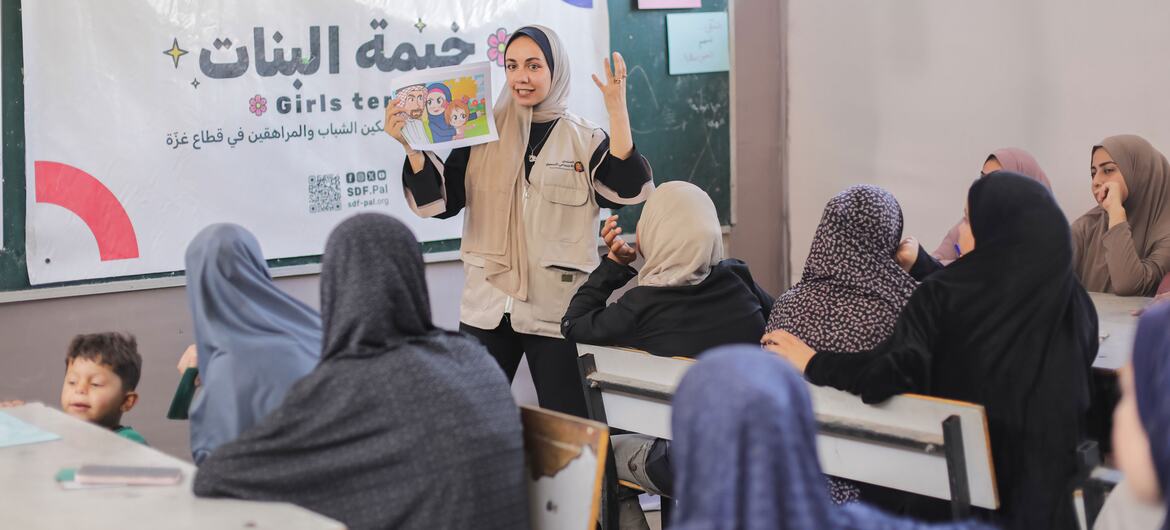
    A young female volunteer from the Social Development Forum conducts a Girls’ Tent initiative session for Comprehensive Sexual Education awareness for mothers and women in Gaza.

    © UNFPA/Social Development Forum

    A volunteer from the Social Development Forum conducts a Girls’ Tent initiative session.

    Services include group sessions, psychological first aid, individual counselling and a digital helpline known as the Youth Window, offering free remote support to marginalised young people.

    Still, challenges remain immense. Displacement, limited resources and harsh conditions, particularly in Gaza, where some safe spaces operate in tents exposed to extreme weather, continue to hinder operations.

    “Many families prioritise survival over mental health,” Ms. Alami noted, highlighting the need for integrated responses linking psychosocial support with food, health and education services.

    Read More

  • Spain to spend €5 billion to ease Middle East war fallout

    Spain to spend €5 billion to ease Middle East war fallout


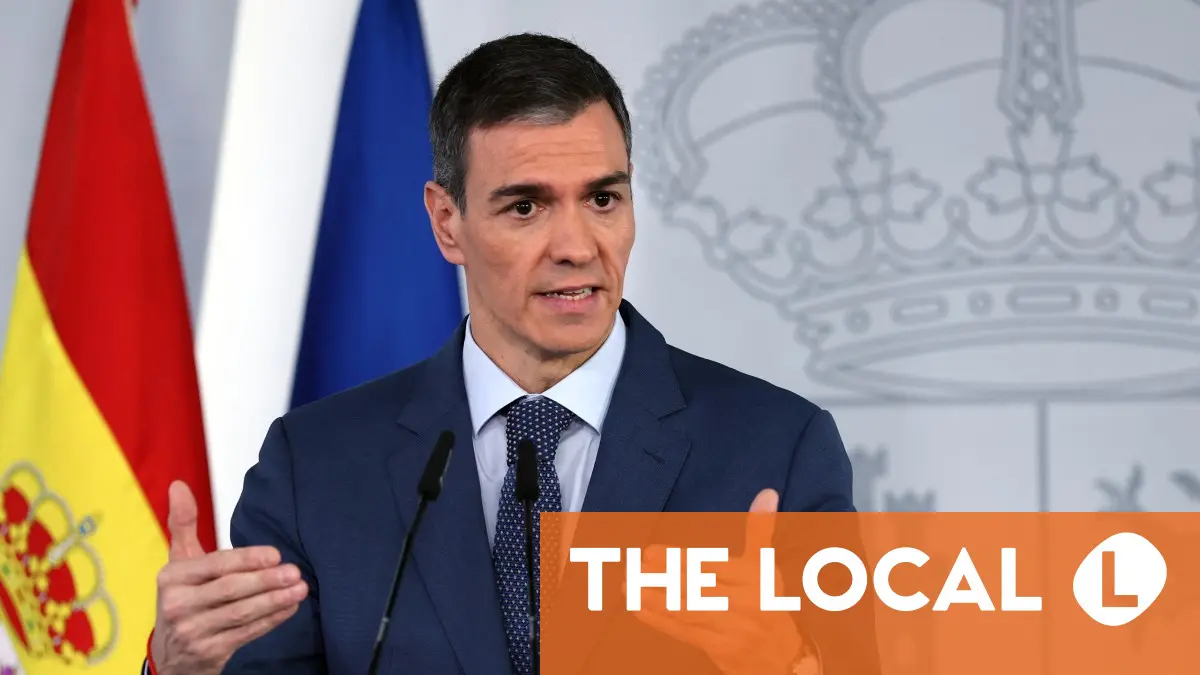
    Spanish Prime Minister Pedro Sánchez announced Friday a sweeping package worth €5 billion ($5.8 billion) aimed at cushioning the economic impact of the Middle East war, including a “drastic reduction” in energy-related taxes.

    Read More

  • British schoolgirl barred from flying home over UK dual national rules

    British schoolgirl barred from flying home over UK dual national rules


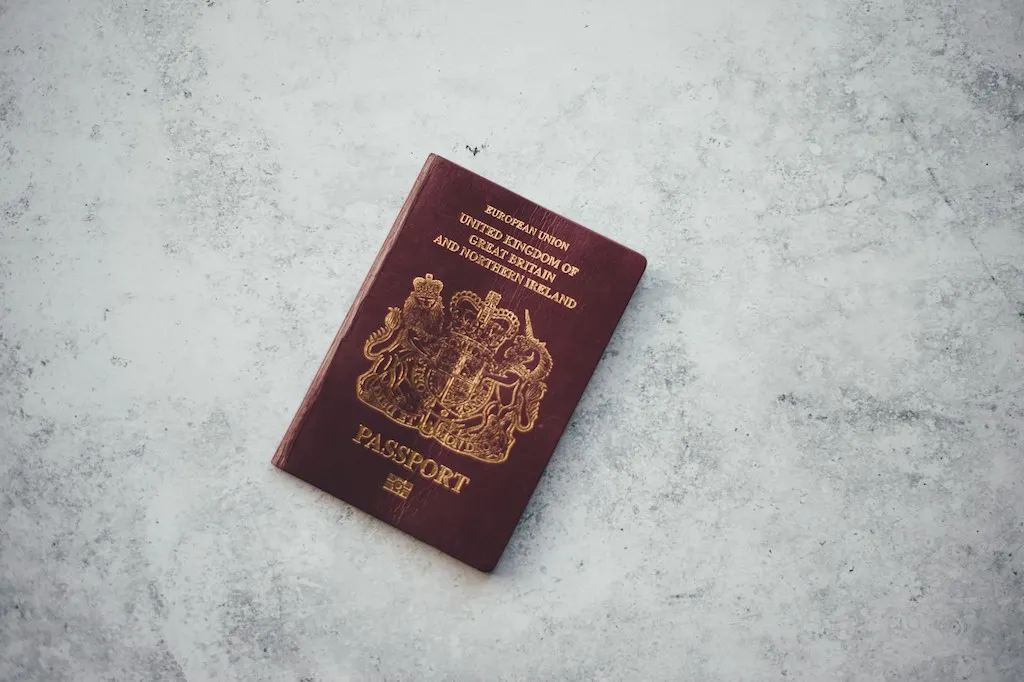
    A dual-national British schoolgirl has been left stranded on mainland Europe after she was refused entry on a return flight under new UK border rules.

    A British schoolgirl has been left in Denmark after being denied boarding on her return flight to London because of new UK border rules imposed on dual nationals.

    The girl planned to catch a Norwegian Air flight back to the UK on March 8th after a weekend visiting her father, a British academic working at a university in Copenhagen, but was unable to board both online and in person at the airport.

    The Guardian reports that she had travelled with her Norwegian mother and did not have a valid British passport with her, but was in the process of applying for one. The article does not state which other passport the girl was travelling on, but given the nationality of the mother we can presume it was likely a Norwegian one.

    READ ALSO: Can dual national Brits travel to UK without valid British passport after all?

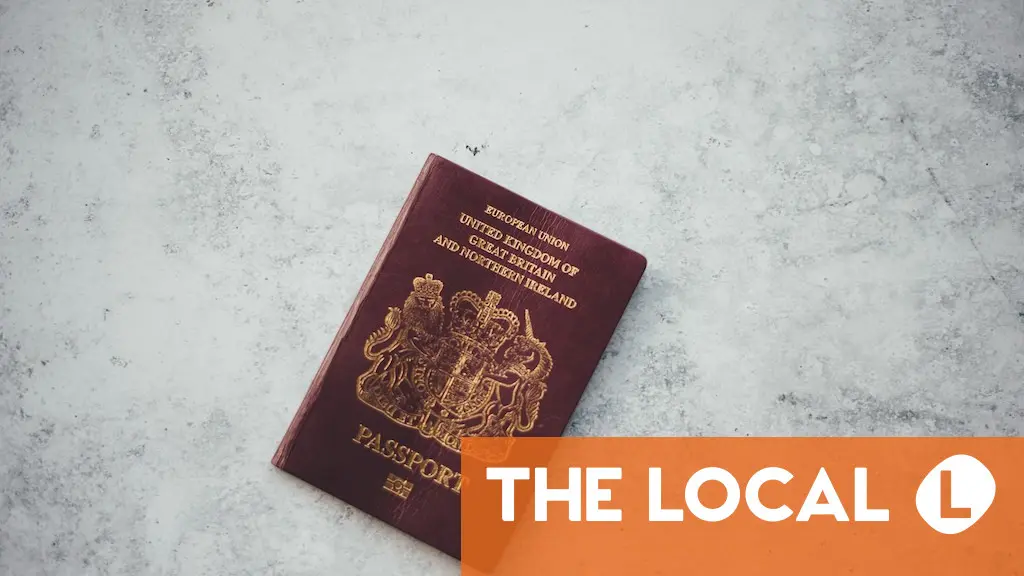
    Under new border rules for the Electronic Travel Authorisation (ETA) system in place from 25th February, British dual nationals can only enter the UK if they have a valid British passport or alternatively a Certificate of Entitlement, which costs £589.

    Under pressure the UK’s Home Office has softened the rules slightly saying Brits can prove the UK nationality using an out of date passport if they don’t have a current one. However there was no solution offered for those who have never had a British passport such as children born abroad to British parents, or dual nationals born in the UK like this girl.

    The schoolgirl’s parents were not aware of the rule change and she was not allowed to board her return flight, meaning the student has been stranded in Denmark as her GCSE exams approach.

    “We tried to check in on the app and it allowed me to check in but not Hanne,” her mother told The Guardian.

    “When we got to the airport… they wouldn’t let her check in either.”

    This is reportedly the third child the British publication knows of who has been refused entry on a return flight to the UK under the new dual citizen rules.

    Advertisement

    The report does not specify why she was denied boarding or if she had applied for an ETA, the UK’s new Electronic Travel Authorisation for for foreign arrivals.

    The Local has contacted Norwegian for clarification on the case but has not yet received a response.

    The family’s local MP, James MacCleary, has spoken publicly and blamed mixed messages from the government: “The government’s hopeless planning and communication of its changes to entry requirements for dual nationals has caused an untold amount of chaos and stress. 

    “Too many dual nationals have found themselves stranded abroad in heartbreaking situations, missing funerals, weddings, or in the case of my constituent, an absolutely crucial time in education.

    “The home secretary needs to pull her finger out and urgently provide a low-cost and quick alternative for dual nationals stuck abroad. If she fails to act, the prime minister must step in to bring an end to the chaos, otherwise more children and families will pay the price.”

    In a statement, the Home Office said: “Public information advising dual nationals to travel with a valid UK passport or certificate of entitlement has been available since October 2024, including official guidance on gov.uk”.

    Advertisement

    What are the rules?

    Dual-nationals abroad have expressed anger at the change, telling The Local they felt they were being ‘punished for having dual citizenship’ and describing the ETA system as a  “money making racket”.

    Ever since the launch of ETA, there has been confusion when it comes to British dual nationals. The Home Office had done little to allay these fears, but for a full breakdown of the rules, or what is understood of them so far, at least, read The Local’s explainer here.

    In short: British or Irish nationals travelling on their UK or Irish passport do not require the electronic travel authorisation known as the ETA.

    Many British dual nationals, however, might not have a British passport anymore. These people have always previously had the option of simply using their other passport to enter the UK but the rule change makes this more difficult, if not impossible.

    This is because the website and app used to apply for the ETA demands that people list any other nationalities they possess – but does not allow applicants to select ‘British’ as another nationality – meaning that dual nationals cannot truthfully complete the ETA application and travel on their other passport. Basically British dual nationals have been told they cannot get an ETA.

    They would therefore be at risk of being accused of making a false declaration if they hadn’t applied for and paid for a new passport (for £108) or a Certificate of Entitlement, which costs £589.

    READ ALSO: Explained: The UK’s £16 ETA travel permit

    Read More

  • French author cleared of libel over Nazi ‘collaborator’ family novel

    French author cleared of libel over Nazi ‘collaborator’ family novel


    A Paris court has found a historian of the Nazi occupation of France not guilty of libel for having described her mother and other family members as “collaborationist” during World War II.

    Cecile Desprairies, 68, says her debut autobiographical novel The Propagandist – published in English last year – is inspired by her own childhood, but her brother and a cousin have accused her of lying and want the title removed from bookstores.

    They sued Desprairies and her publisher for libel.

    The civil court on Wednesday recognised that the plaintiffs may have been “upset” by the novel and “lack of any conclusive evidence” to support her account of the family’s history, according to a copy of the ruling seen by AFP on Thursday.

    But neither had it seen evidence that Desprairies wrote the book with the intent to harm them, it said.

    During a hearing in January, the author and her publisher’s lawyer had argued some creative licence was allowed in a novel, even if autobiographical.

    “I ask you to give precedence to freedom of creation and expression over family quarrels,” attorney Benedicte Amblard had argued.

    After the book came out in French in 2023, Desprairies had said she grew up “in a collaborationist family”.

    In her book, the narrator’s mother is described as a “fervent collaborator” and propagandist during the Nazi occupation of part of France from 1940 to 1944.

    To support her claim, Desprairies said she had found a Nazi propaganda poster in the attic of the family home, according to the complaint filed by her relatives. But the plaintiffs said it bore the same tear marks as one conserved at a Paris library, a copy of which could be downloaded.

    She has also sent the judiciary a photograph of three people she said included her mother on a mountain in winter, arguing it showed “clear attachment to the sports values advocated by the Reich”.

    Desprairies in January published a new novel published by another publisher, titled “La Fille du Doute” (“The Daughter of Doubt”).

    Read More