From the early launch of France’s 2027 presidential race to stained glass windows and a trailblazing French athlete, Inside France is our weekly look at the news and talking points from France.
Inside France is editor Emma Pearson’s weekly look at some of the news, talking points and gossip in France that you might not have heard about. It’s published each Saturday and members can receive it directly to their inbox, by going to their newsletter preferences or adding their email to the sign-up box in this article.
Election fever
Within 48 hours of France’s highly contested local elections ending, attention had already switched to the presidential elections in spring of 2027.
Really we’ve been talking about them since 2024, due to a combination of France’s fractured political landscape, deadlocked parliament and the fact that Emmanuel Macron cannot stand again, due to the constitutional limit of two consecutive terms for French presidents.
But the local elections represented the last time that French voters are due to go to the polls before 2027 (there are Senate elections in September, but senators are elected using a byzantine system that doesn’t involve a direct vote) so we’re now into full campaign mode.
And I can pretty much guarantee that the number one media topic – especially non-French media – will be the likelihood of the far right candidate winning.
I wrote about how it feels, as an immigrant, to live in a state of constant gnawing anxiety about the growth of the far right.
READ ALSO: OPINION: For foreigners in France, each election brings a creeping sense of dread
I don’t pretend to be able to predict an election more than a year out – actually I don’t think anyone can – but I think it’s important to note that Marine Le Pen’s Rassemblement National party consistently under performs compared to polls, as it did on Sunday, where predicted close races such as Marseille, Toulon and Nîmes turned into reasonably comfortable wins for their centre right and centre left opponents.
Also the parties of the centre-right, centre and left can unite to block the far right, and indeed have done so repeatedly during recent French history – there is nothing inevitable about this.
Podcast
There’s an election special episode of the Talking France podcast this week, looking at all the results of Sunday’s local elections and well as what, if anything, they tell us about the French political landscape – listen here.
Headline of the week
Sometimes speaking two languages just makes the world a lot funnier, for example in this headline from French daily Le Parisien: 100 g de shit étaient cachés entre les fesses d’un détenu de la prison de Beauvais
In French ‘shit’ (pronounced sheeet) is a common slang term for cannabis, so for Francophones the headline is entirely unremarkable “100g of hash found between the buttocks of a detainee at Beauvais prison”.
For the rest of us, it goes in another direction entirely.
Stained glass of the week
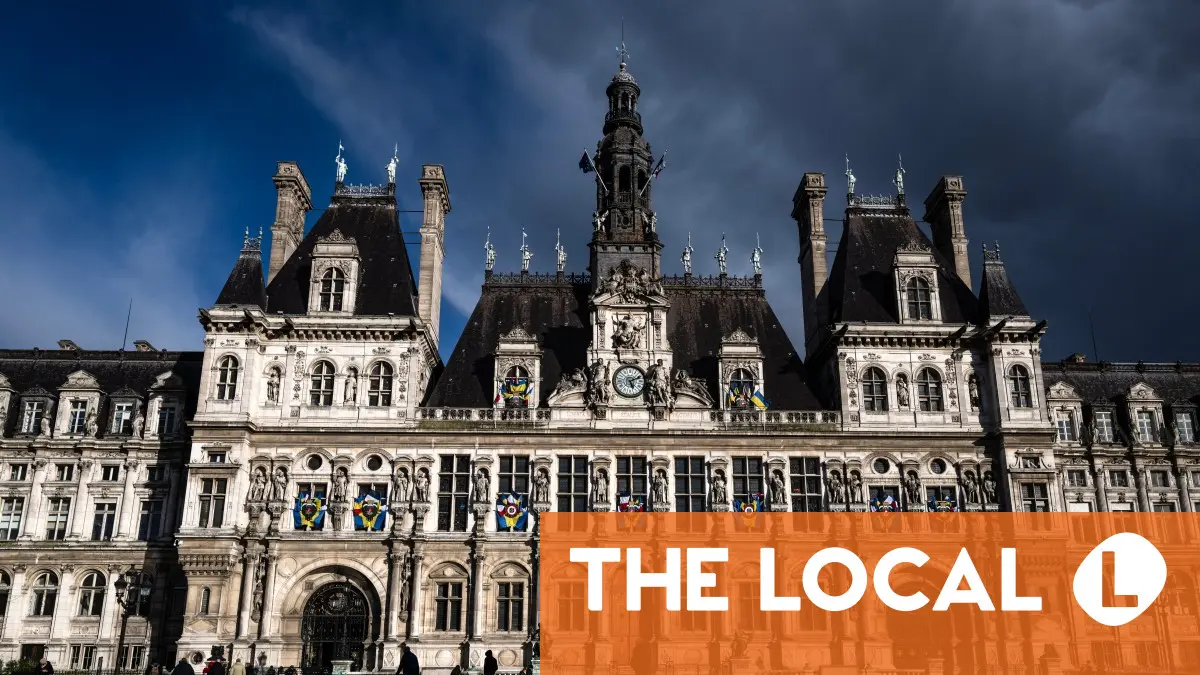
I learned this week that Paris’ Hotel de Ville has an old-looking stained glass window which is in fact not only modern but regularly updated, as the name of each mayor of the city is engraved on it once they leave office – here’s Anne Hidalgo with her newly inscribed name.
C’est une tradition pour chaque Maire de Paris à la fin de son mandat, mon nom est désormais gravé sur un vitrail de l’Hôtel de Ville. Un des derniers temps de ce mandat !
— Anne Hidalgo (@annehidalgo.bsky.social) 23 March 2026 at 17:45
In fact the entire Hotel de Ville building is much newer than it looks, having been rebuilt in 1874 due to the previous town hall being burned down during the Paris Commune.
The site is very old, however, and there has been a municipal building in roughly the same place since 1357.
The square in front of the town hall is now Place de l’Hotel de Ville, but was previously known as the Place de grève. It served as the place where day-labourers went to try and find work, and gave us the modern French word grève (strike).
It was also used for high-profile executions including of François Ravaillac, the man who had assassinated Henri IV, who was “scalded with burning sulphur, molten lead and boiling oil and resin, his flesh then being torn by pincers” before being torn apart by four horses, and his body burnt – the entire process took hours and was apparently watched by a large and enthusiastic crowd.
These days, entertainment in the square includes the Christmas market and annual free summer concert, Fnac Live.
Trailblazer
Below is the French gold-medal winning athlete Violette Morris, who was banned from taking part in the 1928 Olympics for ‘immorality’, due mainly to her habit of wearing trousers.
She’s in my mind following the news that all female athletes will have to submit to gender testing to prove that they are ‘normal women’ in order to take part in the 2028 Olympics.

Violette Morris, pictured in 1938 at a police station after being arrested for murder. She was later acquitted by reason of self defence. Photo by AFP
Violette herself was perhaps not the greatest human being – she went on to become an enthusiastic Nazi collaborator and was assassinated by the resistance in 1944 – but she was a genuine trailblazer for women’s sport, winning medals in javelin, discus and shot put and then switching careers to motor racing.
Inside France is editor Emma Pearson’s weekly look at some of the news, talking points and gossip in France that you might not have heard about. It’s published each Saturday and members can receive it directly to their inbox, by going to their newsletter preferences or adding their email to the sign-up box in this article.
Leave a Reply