
At least 47 taken to hospital following Iranian missile strike in Dimona, Israeli media reports
Following an Iranian ballistic missile strike in the southern city of Dimona, 47 people were taken to Soroka Hospital in Beersheba, The Times of Israel’s correspondent Emanuel Fabian said on social media, citing Israeli medics.
The wounded included a young boy in serious condition from shrapnel and a woman in her 30s moderately injured by glass shards, while 31 others sustained minor injuries from shrapnel or falls, and an additional 14 were treated for acute anxiety, he said.
Israel medics say injured toll from strike on nuclear town rises to 39
Israel army says Iranian missile struck town housing nuclear facility
Israel’s military said an Iranian missile on Saturday struck the southern town of Dimona, home to a nuclear facility, after medics reported some 20 people injured by shrapnel.
The army told AFP there was a “direct missile hit on a building” in the town in the Negev desert.
Shrapnel wounds 20 after Iran missile warning in Israel nuclear town
Israeli medics said shrapnel wounded 20 people in the town of Dimona, home to a nuclear facility, after warnings of incoming missile fire from Iran.
Magen David Adom first responders said their teams were treating approximately 20 victims at a number of impact sites, including a 10-year-old boy and a 40-year-old woman in moderate condition.
Israeli police released pictures of officers in a building with a large hole blown in the wall.
Dimona in southern Israel hosts a facility widely believed to possess the Middle East’s sole, if undeclared, nuclear arsenal.
At least 1,024 killed in Israeli strikes in Lebanon, authorities say
Around 1,024 people have been killed in Israeli strikes since March 2, according to Lebanese authorities.
The World Health Organization and Lebanese health authorities said more than 100 of those killed were children.
UK says its bases on Cyprus will not be used in offensive operations, Cypriot spokesperson says
Britain will not be using its bases in Cyprus for any offensive action in the Iran crisis, the Cypriot government spokesperson said on Saturday, citing a phone call between British Prime Minister Keir Starmer and Cypriot President Nikos Christodoulides.
“The British Prime Minister reiterated … that the security of the Republic of Cyprus is fundamental to the United Kingdom and, to that end, a decision has been taken to enhance the means contributing to the preventive measures already in place,” the spokesperson said in a written statement.
“Finally, the Prime Minister reiterated that the British Bases in Cyprus will not be used for any offensive military operations.”
An Iranian-type Shahed drone caused slight damage when it hit facilities at Britain’s Akrotiri airbase in southern Cyprus on March 2, with two others later intercepted. There have been no further known security incidents.
Britain retained sovereignty over two bases on the island when it granted its colony independence in 1960.
From Gaza to Lebanon, doctor races against time to treat war-wounded children
For nearly three weeks of ongoing conflict in Lebanon, Dr. Ghassan Abu-Sittah, a British-Palestinian pediatric surgeon, has been working tirelessly to treat children severely injured in Israeli airstrikes.
At Beirut’s American University Medical Center, his unit has received critical cases from across the country, including children with shrapnel wounds, partial amputations, and brain injuries. Abu-Sittah described the scale of the injuries as overwhelming, requiring multiple surgeries and long-term reconstructive care, while lamenting that “a child should never become faceless, they never become numbers”.
The conflict has forced several hospitals to evacuate amid relentless bombardment, complicating the transfer of critically wounded children from less-equipped regions like Nabatiyeh and the Bekaa Valley. Health workers have been directly targeted, with 40 killed and 119 wounded, further straining Lebanon’s medical system.
Abu-Sittah, who founded the Ghassan Abu-Sittah Children’s Fund in 2024, highlighted the long-term challenges for surviving children, particularly those from poor families who have lost relatives, emphasizing that the war destroys not only bodies but entire family units.
EU urges reduced gas-storage target as Mideast war crimps supply
The European Commission on Saturday urged EU member countries to lower their target for filling natural gas storage in the coming months, to alleviate price pressures caused by the war in the Middle East.
EU energy commissioner Dan Jorgensen sent a letter asking to “consider reducing your filling target to 80 percent as early as possible in the filling season to provide certainty and reassurance to market participants”, down from the usual 90 percent goal.
‘Anxiety and fear’: Israeli strikes intensify in Beirut
Israel launched a new wave of strikes on Beirut targeting Hezbollah, prompting evacuations and adding to growing civilian distress.
“The sounds of strikes and thunder … were impossible to differentiate, creating so much anxiety and fear amongst the population,” said Renée Davis, FRANCE 24’s correspondent in Beirut.
Iran sends ‘strong message’ with strike attempts on US-UK air base
As the Iran conflict enters its fourth week, attempted strikes on the distant Diego Garcia base highlight Tehran’s military reach.
“What happened with Garcia was a show of that,” said Hoda Abdel Hamid, FRANCE 24 correspondent in Doha, noting Iran’s long-range missile capabilities. Meanwhile, the UN calls for restraint, and the US temporarily waives sanctions on Iranian oil to ease global market pressures.
‘Nothing but impunity afforded to Israel’: Lebanese front overlooked as strikes intensify
Lebanon is the second front of the war in the Middle East. While there has been excellent reporting by domestic and foreign press, FRANCE 24’s media show Scoop asks why there hasn’t been more international coverage.
There has been “nothing but impunity afforded to Israel” since the Gaza war, said Rania Khalek, a Lebanese-American journalist with BreakThrough News, adding that she feels terrorized as Israel continues to strike Lebanon.
Iran conflict escalates as strikes signal wider regional risks
As the Iran conflict enters its fourth week, strikes on nuclear sites and a reported attack on a US-UK base signal further escalation. With no clear exit in sight, fears are mounting of wider instability and humanitarian fallout.
“The attack on Diego Garcia is an escalation… it’s a joint US-UK base, not just US territory – that in and of itself is definitely an escalation,” said Ali Vaez, director of the Iran Project and senior adviser at the International Crisis Group.
Israel says it has struck Iranian IRGC ballistic missile facility in Tehran
The Israeli military on Saturday said its forces struck ballistic missile production facilities belonging to Iran’s Revolutionary Guards in overnight attacks on Tehran.
“Facilities utilised for the production of critical components for the development of ballistic missiles belonging to the Iranian regime’s security apparatus were targeted,” the military said.
The strikes hit a central Guards’ compound, a missile components production facility, and a separate compound belonging to Iran’s defence ministry, it said.
“The strikes significantly degrade the Iranian terror regime’s capabilities to continue producing critical components for ballistic missiles at these sites,” the military said.
The US and Israel launched their joint campaign against Iran on February 28, saying they seek to dismantle the country’s ballistic missile capabilities, alongside its nuclear facilities.
US military says Iran threat to Hormuz ‘degraded’
The head of US Central Command says in his latest video update on the war that US forces “remain on plan to eliminate Iran’s ability to project meaningful power outside its borders.”
Adm. Brad Cooper also detailed steps taken to undermine Iran’s control of the Strait of Hormuz, the waterway vital to international commerce such as oil shipments.
He says in a post on X that earlier in the week, multiple 5,000-pound bombs were dropped on an underground facility along Iran’s coastline that was used to store anti-ship cruise missiles, mobile missile launchers and other equipment “that presented a dangerous risk to international shipping.”
Cooper says intelligence support sites and missile radar relays used to monitor ship movements were destroyed.
“Iran’s ability to threaten freedom of navigation in and around the Strait of Hormuz is degraded as a result and we will not stop pursuing these targets,” he says in the video.
Cooper also said that “we have built the most extensive air defense umbrella in the world over the Middle East right now.”
Explosions heard in Bahrain capital, AFP journalist reports
In pictures: Families displaced by Israel’s bombardment of southern Beirut seek shelter in the capital
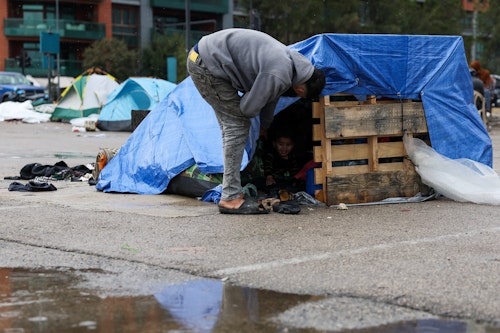
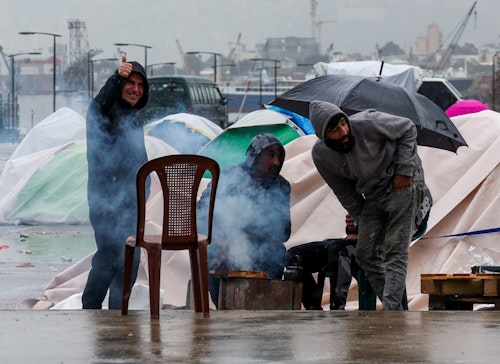
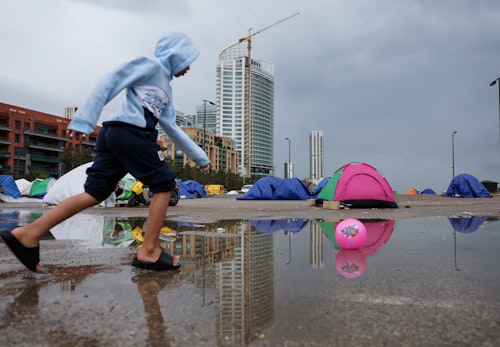
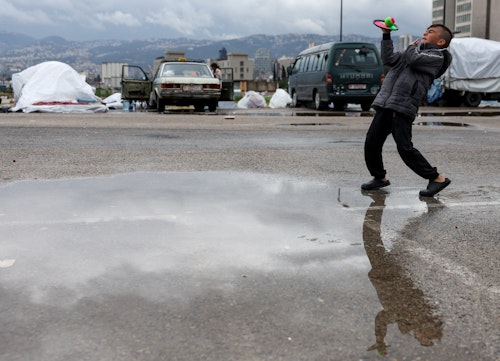
Displaced families from Beirut’s southern suburbs stand by makeshift shelters after being driven from their homes by the latest escalation between Hezbollah and Israel, in Beirut, Lebanon, March 21, 2026. Photo: Amr Abdallah Dalsh, Reuters
Iranian gas to Iraq resumes after South Pars attack, Iraqi state news agency says
Iranian gas supplies to Iraq have resumed at a rate of five million cubic metres per day, the Iraqi electricity ministry said, according to the state news agency.
Flows had been halted after Israel attacked Iran’s main gas field, South Pars, on Wednesday.
Iran ‘unsuccessfully’ targeted Diego Garcia base, UK official source confirms to AFP
Iran was “unsuccessful” in targeting the joint UK-US Indian Ocean military base at Diego Garcia, a UK official source confirmed to AFP, after the Wall Street Journal reported Tehran fired two ballistic missiles at it.
The source said the “unsuccessful targeting of Diego Garcia” took place before the UK government announced Friday that it would allow the United States to use some of its bases to target Iranian sites being used to attack ships in the Strait of Hormuz.
Bahrain says Patriot missile system involved in March 9 blast over residential area that injured civilians
A Patriot air defence system was involved in the interception of an Iranian drone over a residential area of Bahrain on March 9, Bahrain’s government told Reuters on Saturday, describing an incident that led to civilian injuries.
The interception prevented a drone strike and saved lives, the spokesperson said. The US military had previously said an Iranian drone had struck a residential neighbourhood on March 9, injuring civilians.
India’s Modi speaks to Iranian President Pezeshkian
India’s Prime Minister Narendra Modi said in a post on X on Saturday that he had spoken with Iran’s President Masoud Pezeshkian.
Modi condemned attacks on critical infrastructure in the Middle East region, while also reiterating the importance of ensuring that shipping lanes remain open and secure.
“Appreciated Iran’s continued support for the safety and security of Indian nationals in Iran,” Modi added.
Leave a Reply