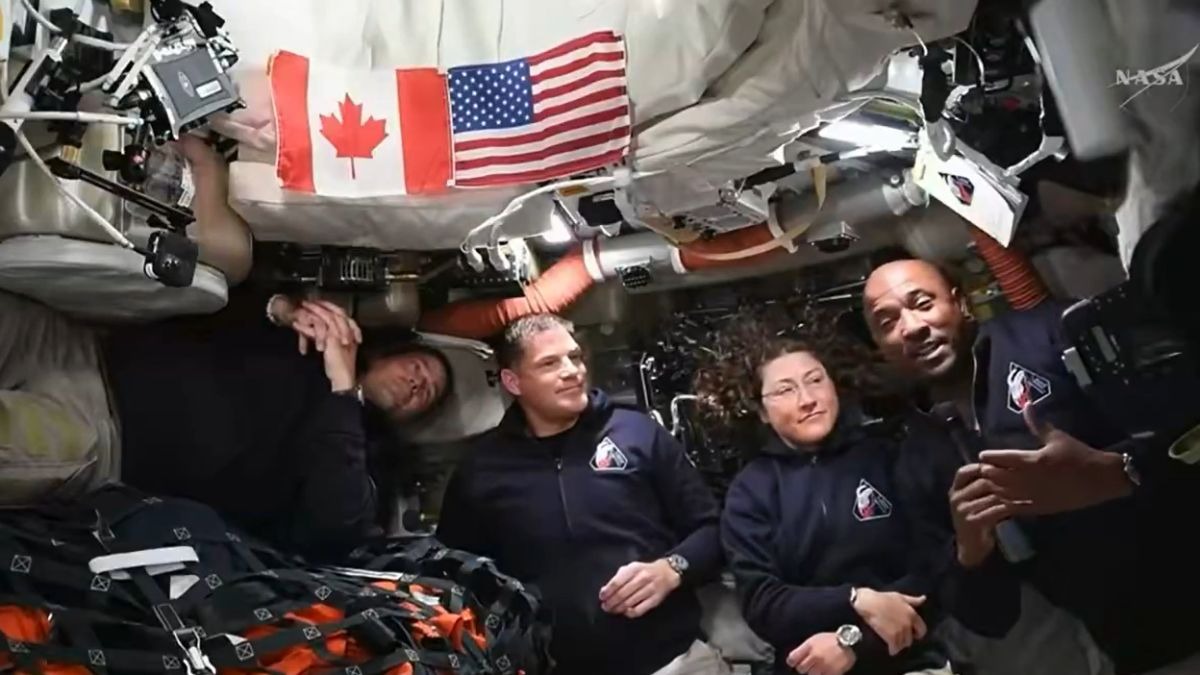
Sleeping in space is nothing like drifting off in a bed on Earth. For the astronauts aboard Artemis II, rest comes in unusual positions — sometimes even hanging upside down “like a bat.”
The four-member crew — Reid Wiseman, Victor Glover, Christina Koch, and Jeremy Hansen — are traveling around the Moon aboard Orion spacecraft. While the mission marks a major milestone in human space exploration, daily life inside the capsule requires plenty of creativity, especially when it comes to sleep.
Finding a place to float
Inside Orion’s compact cabin, there are no traditional beds. Instead, astronauts secure themselves in sleeping bags attached to different parts of the spacecraft so they don’t drift away while resting.
Each astronaut has improvised a personal sleeping spot within the spacecraft’s tight interior. One crew member has chosen the docking tunnel as a resting place, floating there while strapped into a sleeping bag — a position that prompted a crewmate to joke that it looks like sleeping “like a bat.”
Others have found equally unconventional spots. One astronaut wedges into a small corner of the capsule, another stretches out across a seat, while another sleeps beneath the instrument panels.
Why sleeping in space looks so strange
In microgravity, there is no real sense of up or down. Without gravity pulling the body toward a mattress, astronauts can sleep in nearly any orientation — sideways, upright, or upside down.
However, floating freely can cause astronauts to drift around the cabin or bump into equipment. To avoid this, sleeping bags are usually tethered to the spacecraft’s interior walls or seats.
Mission schedules typically allow about eight hours of sleep each day, though adjusting to the unusual environment — combined with the excitement of spaceflight — can make rest more challenging during the early days of a mission.
Living in a flying capsule
The unusual sleeping arrangements also highlight the limited space inside Orion. The spacecraft’s crew module must serve as cockpit, workspace, dining area, and sleeping quarters for four astronauts during their roughly 10-day journey.
Despite the cramped environment, the crew continues to share glimpses of everyday life in deep space, offering the public a rare look at what it is like to live and work beyond Earth.