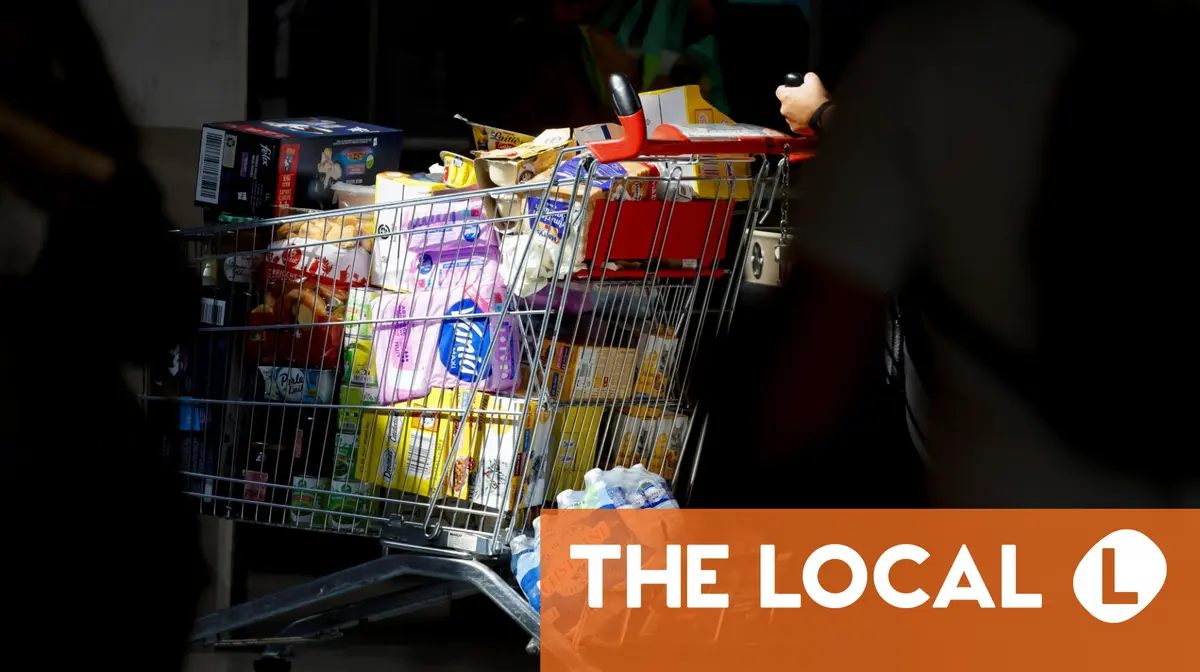

Fuel prices have increased sharply across the world since the US-Israeli attacks on Iran, and one month into the conflict the ripple effects are being felt in everything from farming to fishing, flights to road transport.
The most immediate effect of the war in Iran is a sharp rise in fuel prices due to disruptions in the Strait of Hormuz, a global energy route.
France is, thanks to its nuclear sector, less exposed to international factors when it comes to the price of electricity, but the price of petrol/gasoline and diesel prices has soared at the pumps.
And now, a month into the conflict, the ripple effects seem to be expanding.
From supermarket shelves to farm fields, transport networks to fishing ports, industries across France are facing growing uncertainty.
MAP: How to find the cheapest petrol and diesel in France
Plastic
The consequences of the blocked Strait of Hormuz are beginning to be felt beyond rising fuel prices. In addition, the region normally exports a wide variety of goods, often found at the upstream end of production chains. This includes sulfur, aluminium, helium, and these basic elements are used to manufacture essential goods from plastic to fertilisers to semiconductors.
Supermarket shelves are filled with plastic – from water bottles to household products, and even fruits and vegetables. Packaged goods are mostly made from petroleum-based materials, and their prices could rise.
Today, the plastic component accounts for 20 cents, but according to French media France Info, prices could rise to 30 cents. Take strawberries, for example, a tray costs €3.99, and it will soon cross the €4 mark. For bottles of water at €2.84, the plastic accounts for 28 cents, so the product could end up costing €2.96.
Fabrice Bachelier, CEO of Utz France, one of the biggest manufacturers of plastic in the country, told France Info that he fears the “prices of products will go up very quickly”.
Farmers
Fuel costs are rocketing, impacting many different jobs. Farmers, for example, are feeling the difference in bills.
Nicolas Ervin, a farmer in Val-d’Oise, farms 200 hectares of grain. His tractor consumes 20 litres of diesel per hectare. According to his calculations, refilling his farm’s fuel tank would cost him €9,800 – twice as much as before the war.
“On the farm itself, cash flow is already at rock bottom, and we’re really going to have to ask ourselves how we’re going to make our farms profitable in the future,” he told France Info.
Fertiliser prices have also risen by 15 percent.
In his view, government aid offering payment deferrals is insufficient. “They’re just letting us spread out the payments, but we’ll still have to pay them at some point. So it’s still very difficult” said Ervin.
With the arrival of spring and planting season, demand will increase.
“In the food sector, the critical situation is likely to affect prices for wheat, corn, and other grains,” said economist Anne-Sophie Alsif to Le Parisien. “While there are currently sufficient stocks, it’s conceivable that manufacturers will anticipate rising raw material costs by raising the prices of pasta or rice within the next two to three weeks.”
Truckers
Meanwhile, truckers have announced several planned blockades in the first week of April to protest spiralling fuel prices and to call for government aid.
READ MORE: French truckers plan blockades to protest fuel prices
Fishermen
The price of marine diesel in Europe has risen by 80 per cent since the war began.
Fishermen’s unions are now warning that the “situation is critical” as fuel usually makes up one of their biggest expenses. The situation is leading to forced shutdowns, a gradual reduction in activity, and, in the very short term, a risk of disruption to seafood supply chains.
In an article for French media Le Figaro, the unions also said that fishermen are unable to pass on the increase in their operating costs, as fish prices are set at auctions.
Catherine Chabaud, Minister Delegate for the Sea and Fishery, announced a series of measures to industry stakeholders on Monday March 23rd.
The government has put forward three measures to “support cash flow” – fishing companies can request a deferral of social security contributions and an extension of their tax deadlines; meanwhile Bpifrance (the French public sector investment bank) stands ready to provide them with “attractive” working capital loans.
Flights
More than 40,000 flights have been cancelled since the war began. The conflict is disrupting air traffic from Europe to Asia via the region’s major hubs, including Doha, Dubai, and Abu Dhabi.
Air France-KLM has been severely affected and is suspending Air France flights to the Middle East until at least March 28th. This affects Beirut, Tel Aviv, Riyadh, and Dubai, with more than 210 flights cancelled.
Some airlines are also cancelling flights to areas outside the Middle East due to spiralling fuel costs and falling demand.
Inflation
Recent forecasts from the Banque de France (French central bank) also show the broader economic impact for the country – inflation is expected to rise above 2 per cent in the coming months.
As a result, household consumption, especially spending on fuel and vehicles, is expected to slow, and business investment is likely to remain weak due to such uncertainty.
France’s economy minister Roland Lescue has warned of an “oil shock” to the French economy, telling a parliamentary committee that: “The idea that this is a temporary crisis, and that the economic effects will fade away once the bombing stops, is unfortunately no longer relevant.”
He later slightly walked back on his comments, saying he was speaking about the situation if the conflict continues.
Housing
Several estate agencies in France have said that the war in Iran is not slowing down property buyers for the moment. However, there has been a sharp rise in France’s government bond, also known as the OAT. This indicator, which is closely watched by investors, reflects France’s borrowing costs and the level of confidence within the economy.
It serves as a benchmark for banks when setting their long-term lending rates. Yet, in just one month, it has risen by more than 14 percent, reaching its highest level since 2009.
“This is bad news for our public finances because it means the French government will have to refinance its debt at a higher – and therefore more expensive – rate,” said banker Olivier Lendrevie to French daily le Parisien. “This trickles down to the banks, whose financing rates are themselves highly dependent on the government’s borrowing rate”.
When banks lend money, two-thirds comes from their customers’ savings and one-third is borrowed from the markets just like the government. “So inevitably, in the long run, if the situation persists, mortgage rates will rise, which is not good news for either the government or households looking to buy a home,” he said.