Category: Switzerland

  • Which countries in Europe have the biggest share of foreign residents?

    Which countries in Europe have the biggest share of foreign residents?


    In 2025, people born outside the European Union made up about 10 percent of the EU’s 450 million population. But which countries have the largest share of foreign-born residents?

    New Eurostat data revealed that on January 1st 2025, some 46.7 million people living in the EU were born in third countries (non-EU/Schengen), a 1.9 million increase over the previous year.

    When it comes to citizenship, 30.6 million residents in the EU were third country nationals, 1.6 million more than in 2023, representing 6.8 per cent of the total EU population.

    Eurostat, the EU statistical office, analyses data on both the country of birth and nationality given that a person’s citizenship can change over a lifetime.

    In 2025 some 18 million residents were born in another EU member state and 14.1 million had the citizenship of another EU country, about 100,000 more than the previous year. EU citizens who had moved across the bloc represented about 4 per cent of the EU population.

    Countries with most foreign-born residents

    Smaller countries in Western Europe had the biggest share of foreign-born residents in 2024. In the lead was Luxembourg, where 51 percent of the total population was born abroad, in Malta some 32 percent of residents were born abroad, and in Cyprus it was almost 28 percent. In Ireland 23 percent of residents were born abroad and in Austria the figure stood at 22 percent.

    Advertisement

    Then came two of the bigger European countries – Sweden and Germany, where just over 20 percent of residents in each country were born abroad.

    The figures revealed that some 19.3 percent of Spain’s population was born abroad, for Denmark it was 14.4 percent, France was slightly lower on 14 percent and Italy at 11.8 percent.

    Switzerland, which is in Schengen and the European Free Trade Association, counted 31.7 percent of its population as foreign-born whilst for Norway – also a Schengen/EFTA country – the figure was 18.7 percent.

    In contrast, the proportion of foreign born residents among the population was less than 5 per cent in Poland, Romania, Bulgaria and Slovakia. Similar patterns were recorded regarding citizenship.

    Advertisement
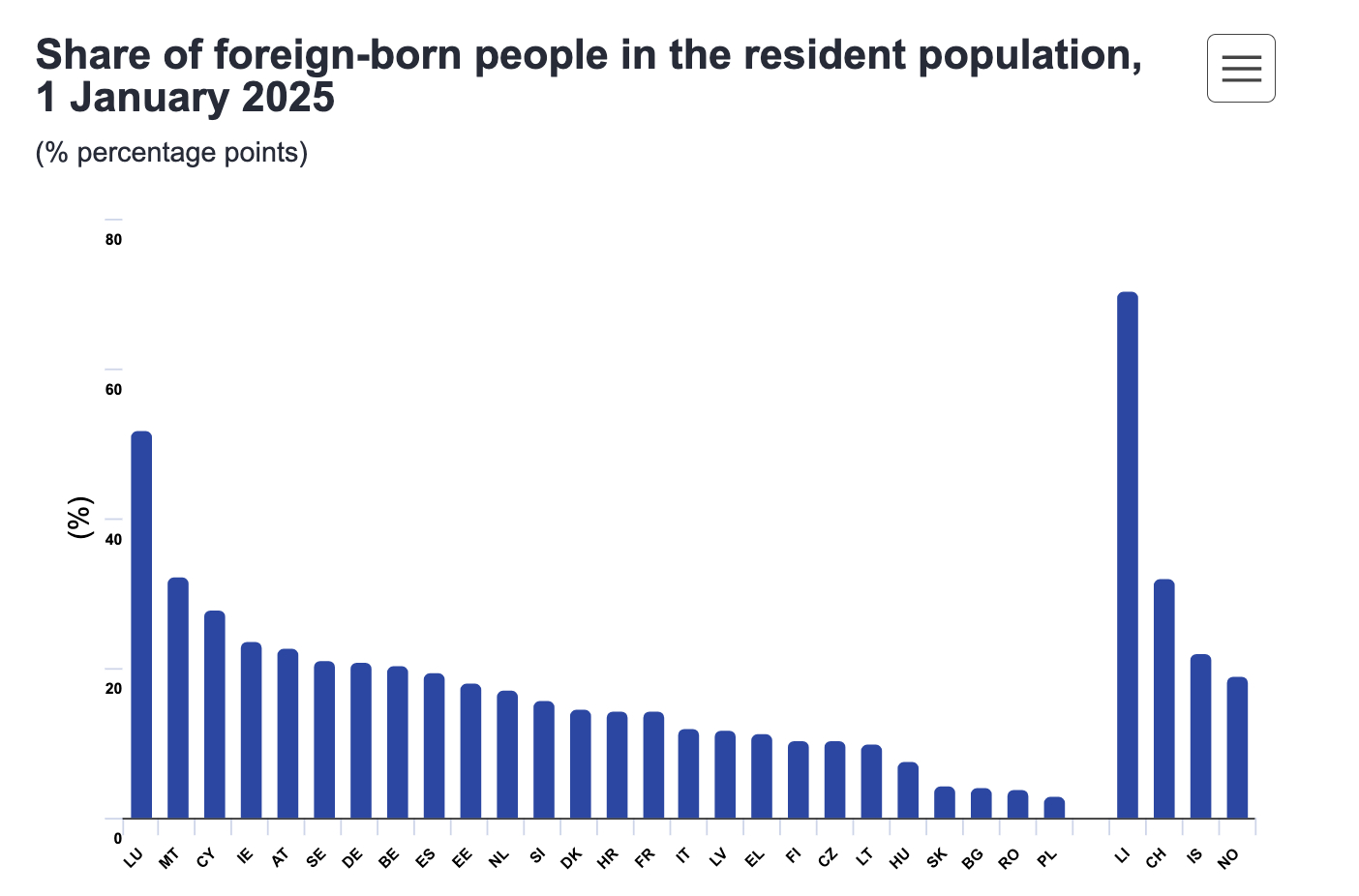
    Eurostat chart

    In absolute numbers, Germany (17.2 million), France (9.6 million), Spain (9.5 million) and Italy (6.9 million) had the largest number of foreign-born residents. Taken together, these four countries counted almost 67 percent of the total of foreign-born residents in the EU.

    Sweden counted 2.2 million foreign-born residents, Denmark 862,000, Austria 2.1 million whilst Switzerland was home to 2.8 million foreign-born residents and Norway around 1 million.

    Eurostat noted that in the past 10 years – between January 1st 2015 and January 1st 2025 – the proportion of foreign-born residents increased in most EU countries. Only in Latvia and Greece did it decline.

    “Migration is influenced by a combination of economic, environmental, political and social factors: either in a migrant’s country of origin (push factors) or in the country of destination (pull factors),” the Eurostat report says.

    “Historically, the relative economic prosperity and political stability of the EU are thought to have exerted a considerable pull effect on immigrants,” the document adds.

    The largest groups of third country nationals living in EU countries were from Ukraine, Turkey and Morocco, while Romanian, Italian and Polish citizens were the three largest groups living in other EU member states.

    Advertisement

    International migration

    Data on international migration refers to people who have migrated to an EU country for various reasons for one year or more, according to Eurostat. In 2024, 4.2 million people moved to the EU from non-EU countries, compared to 4.4 million in 2023.

    In the same year, 1.5 million people moved from one EU member state to another, and 1.6 million moved from the EU to a country outside the bloc.

    All EU countries with available data, except for Latvia, reported more immigration than emigration.

    Many people also move to return to their country of origin. For example in 2024, native-born people made up more than half of the number of immigrants in Romania and Latvia.

    With almost 1,288,600 million arrivals, Spain reported the largest total number of immigrants in 2024, followed by Germany (1,078,500), Italy (451,600), and France (438,600).

    Spain, Germany and France also reported the biggest number of emigrants in 2024, 662,300, 584,200 and 263,200 respectively, Eurostat reports.

    Read More

  • Man arrested after crossbow attack on stranger in Switzerland

    Man arrested after crossbow attack on stranger in Switzerland


    Man arrested after crossbow attack in Lyss

    Man arrested after crossbow attack in Lyss


    Keystone-SDA

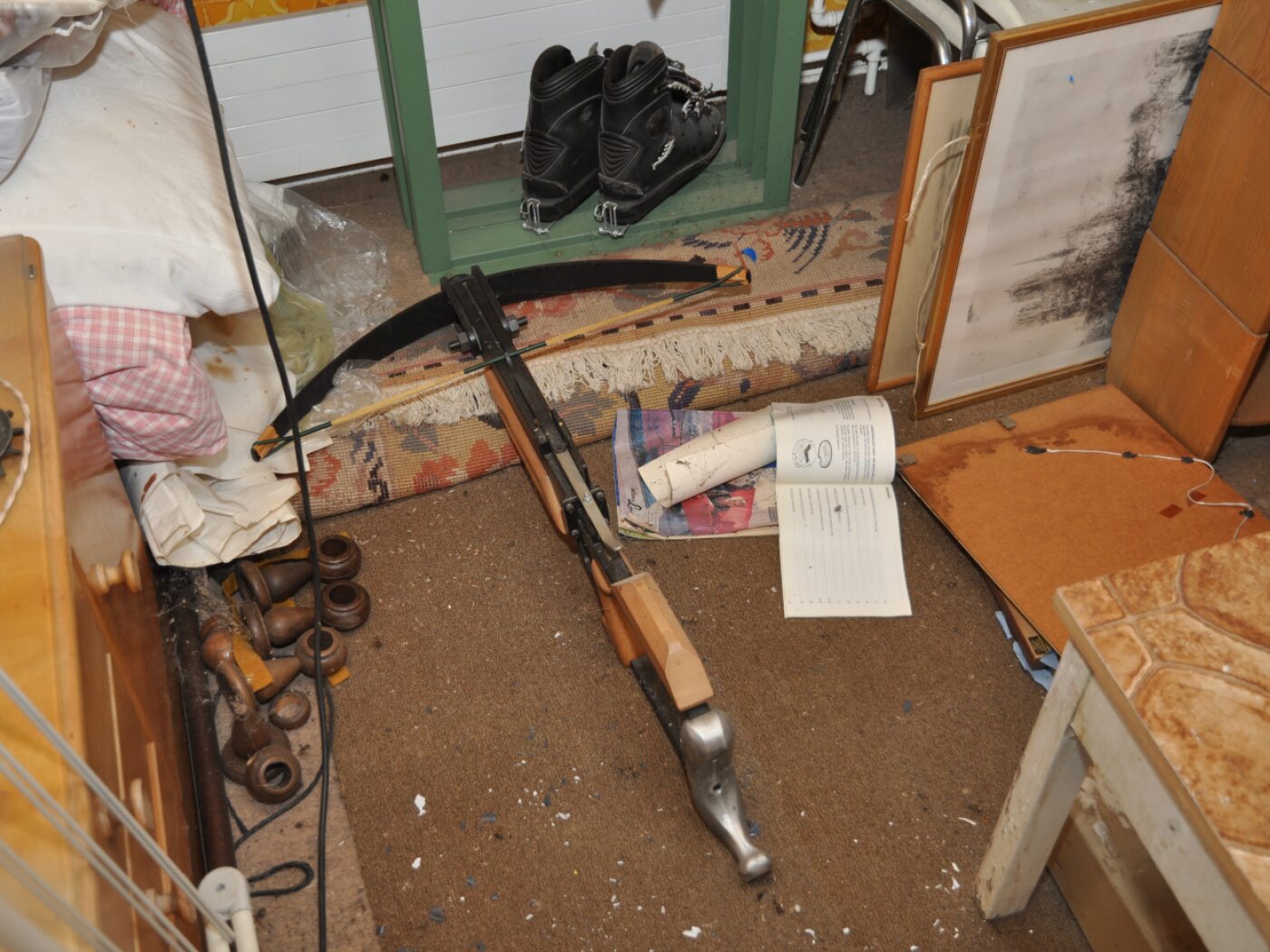
    On Monday morning a man was shot at with a crossbow at Lyss train station in canton Bern. He was not injured, the Bern cantonal police said on Tuesday.

    +Get the most important news from Switzerland in your inbox

    An investigation has been opened to determine the circumstances and motives behind this act.

    Emergency services received the call shortly before 5am and attended to the victim on the spot. The man was taken to hospital by ambulance for a check-up.

    The suspect fired several arrows and was arrested shortly afterwards. He is currently in custody. Preliminary findings indicate that the victim and the alleged perpetrator did not know each other.

    + Swiss crime fell in 2025 but homicides and serious violence rose

    Adapted from French by AI/ts

    We select the most relevant news for an international audience and use automatic translation tools to translate them into English. A journalist then reviews the translation for clarity and accuracy before publication.  

    Providing you with automatically translated news gives us the time to write more in-depth articles. The news stories we select have been written and carefully fact-checked by an external editorial team from news agencies such as Bloomberg or Keystone.

    If you have any questions about how we work, write to us at english@swissinfo.ch

    Read More

  • Death toll from Crans-Montana bar fire rises to 41 | Crans-Montana fire

    Death toll from Crans-Montana bar fire rises to 41 | Crans-Montana fire


    A teenager injured in the fire that engulfed a bar in the Swiss ski resort of Crans-Montana during new year celebrations has died in hospital, taking the death toll from the blaze to 41.

    The Wallis canton’s public prosecutor, Beatrice Pilloud, said in a brief statement on Sunday: “An 18-year-old Swiss national died at a hospital in Zurich on January 31. The death toll from the fire at Le Constellation bar on January 1 2026 has now risen to 41.”

    Pilloud said her office, which is investigating the tragedy, would release no further information at this stage.

    Those killed in the disaster were aged 14 to 39, and most were teenagers. Only four were aged over 24. Another 115 people were injured, most of whom remain in various hospitals.

    Among the dead were 23 Swiss nationals, including one French-Swiss dual national, and 18 foreigners. There were eight French nationals, including a French-British-Israeli girl; six Italian teenagers, including an Italian-Emirati dual national; and one Belgian, one Portuguese, one Romanian and one Turkish national.

    Public prosecutors believe the fire started when revellers raised champagne bottles with sparklers attached too close to sound insulation foam on the ceiling of the bar’s basement.

    Four people are under criminal investigation: the bar’s co-owners, the Crans-Montana municipality’s head of public safety and a former Crans-Montana fire safety officer.

    After the fire, seriously wounded patients were airlifted to various hospitals and specialist burns units throughout Switzerland and in four other European countries.

    Switzerland’s federal office for civil protection said on Friday that as of Monday 44 patients were being treated abroad – 18 in France, 12 in Italy, eight in Germany and six in Belgium.

    The Wallis health ministry said 37 patients were still in Swiss hospitals as of Monday.

    The picture is constantly changing, with patients moving between hospitals for different stages of their treatment, and some patients being readmitted. Some remain in intensive care.

    Read More

  • Handy-Blitzer: Wo KI Smartphone-Sünder im Auto überführt

    Handy-Blitzer: Wo KI Smartphone-Sünder im Auto überführt


    Handy-Blitzer: Wo KI Smartphone-Sünder im Auto überführt

    Bis Ende 2026 sollen in griechischen Städten flächendeckend Kameras in Betrieb genommen werden, die mit künstlicher Intelligenz ausgestattet sind. Sie erfassen nicht nur, wenn jemand ein Rotlicht überfährt, sondern auch, ob alle im Auto angeschnallt sind – und ob die Fahrerin oder der Fahrer telefoniert. 

    Read More

  • Switzerland’s hard-right launches anti-immigration referendum campaign

    Switzerland’s hard-right launches anti-immigration referendum campaign


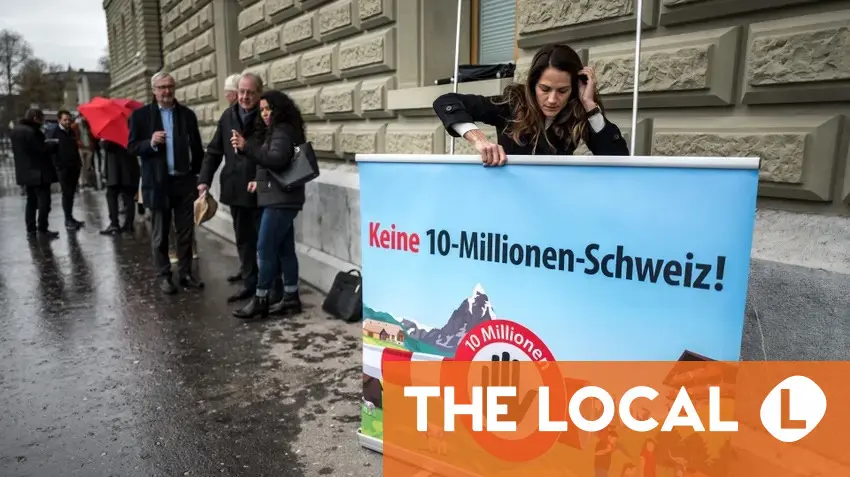
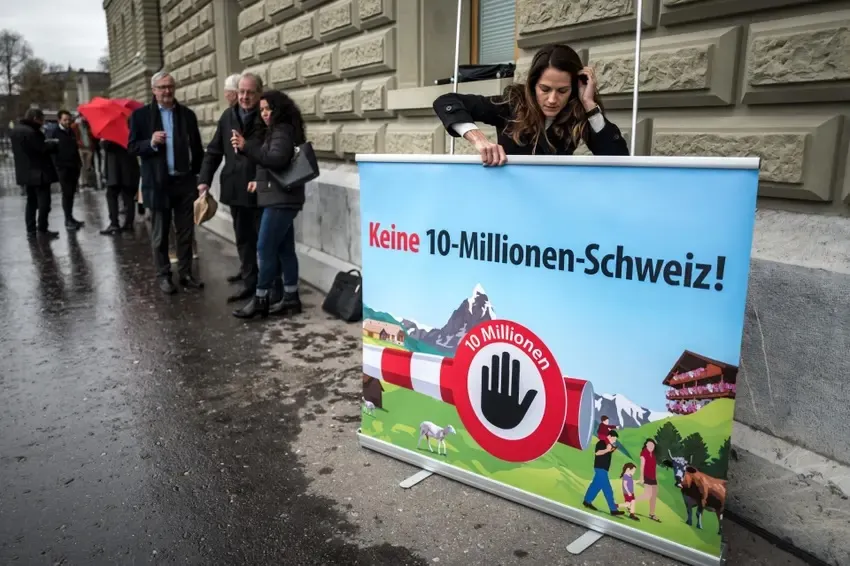
    Though the initiative to curb the influx of foreigners from the EU has been sparking controversy for a while, the Swiss People’s Party (SVP) has officially launched its campaign on March 24th – less than thre months before the issue is voted on in a referendum.

    Read More

  • Swiss highlight risks of e-bikes and e-scooters

    Swiss highlight risks of e-bikes and e-scooters


    BFU warns of high accident risk with e-bikes and e-scooters

    BFU warns of high accident risk with e-bikes and e-scooters


    Keystone-SDA

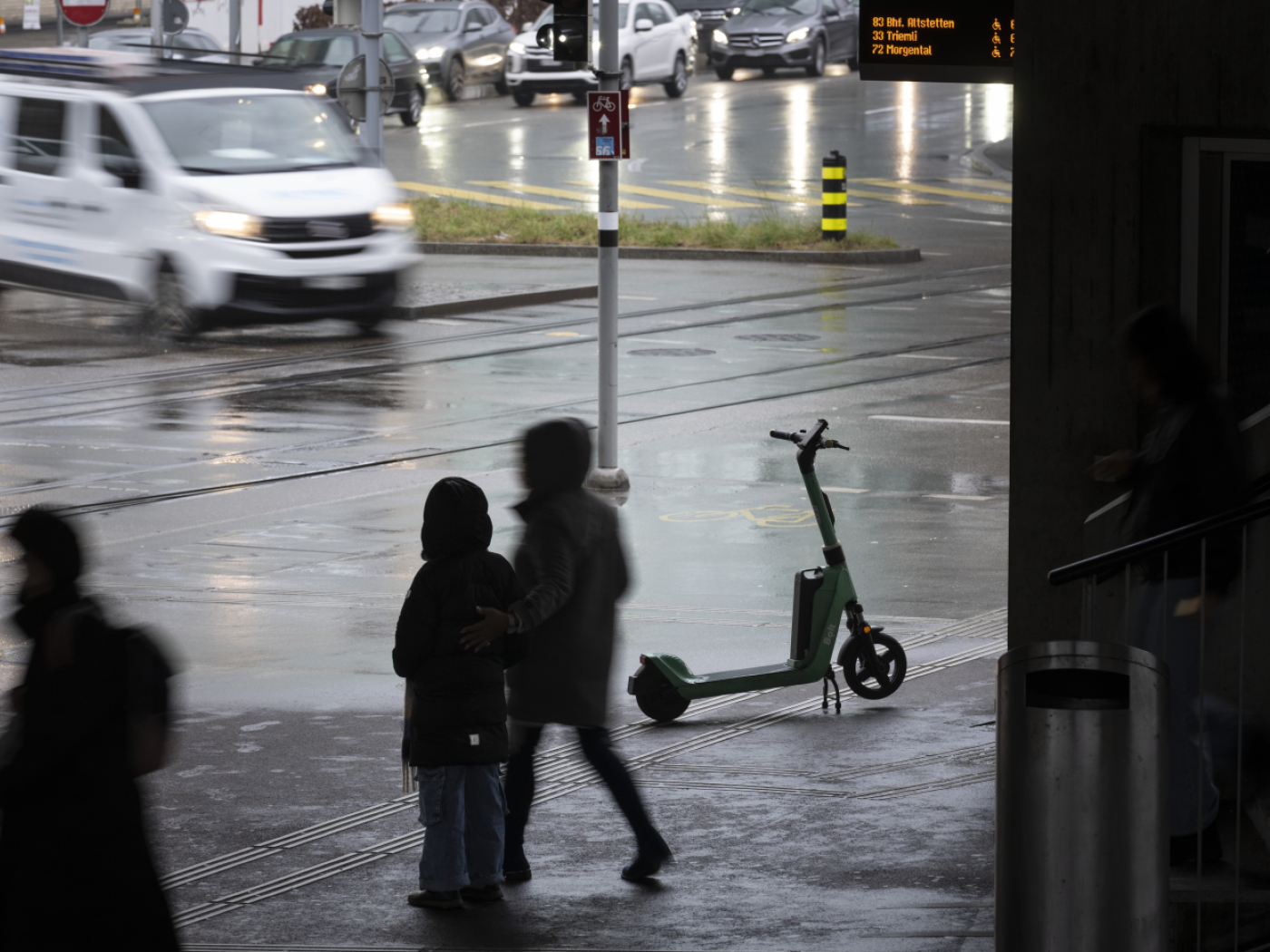
    The number of serious accidents involving e-bikes and e-scooters in Switzerland is high. Last year, 27 people were killed in accidents. The Swiss Council for Accident Prevention urges users to anticipate road situations and to follow the rules.

    +Get the most important news from Switzerland in your inbox

    According to the Swiss Council for Accident Prevention (BFU), 586 people on e-bikes and 152 on e-scooters were seriously injured last year; 24 e-bike riders and three people on e-scooters suffered fatal injuries in accidents.

    The BFU cites the higher speeds, which increase braking distances and shorten reaction times, as the reason for the high risk. The vehicles also lack a crumple zone. Other road users often recognise the narrow silhouettes too late or misjudge the speed.

    + Brain overload and faulty judgment cause most road accidents

    The BFU recommends anticipating the road situation and adapting one’s speed to the circumstances. It is also important to use clear hand signals when turning, to have functioning lights and to wear a helmet and light-coloured clothing for better visibility.

    Helmets are compulsory for fast e-bikes. In general, e-bikes and e-scooters may only be ridden from the age of 14 with a moped licence and from the age of 16 without a licence. For all e-vehicles, lights are also compulsory during the day and an alcohol limit of 0.5 per mille applies.

    Adapted from German by AI/ts

    We select the most relevant news for an international audience and use automatic translation tools to translate them into English. A journalist then reviews the translation for clarity and accuracy before publication.  

    Providing you with automatically translated news gives us the time to write more in-depth articles. The news stories we select have been written and carefully fact-checked by an external editorial team from news agencies such as Bloomberg or Keystone.

    If you have any questions about how we work, write to us at english@swissinfo.ch

    Read More

  • Memorial for Swiss bar fire victims goes up in flames | Switzerland

    Memorial for Swiss bar fire victims goes up in flames | Switzerland


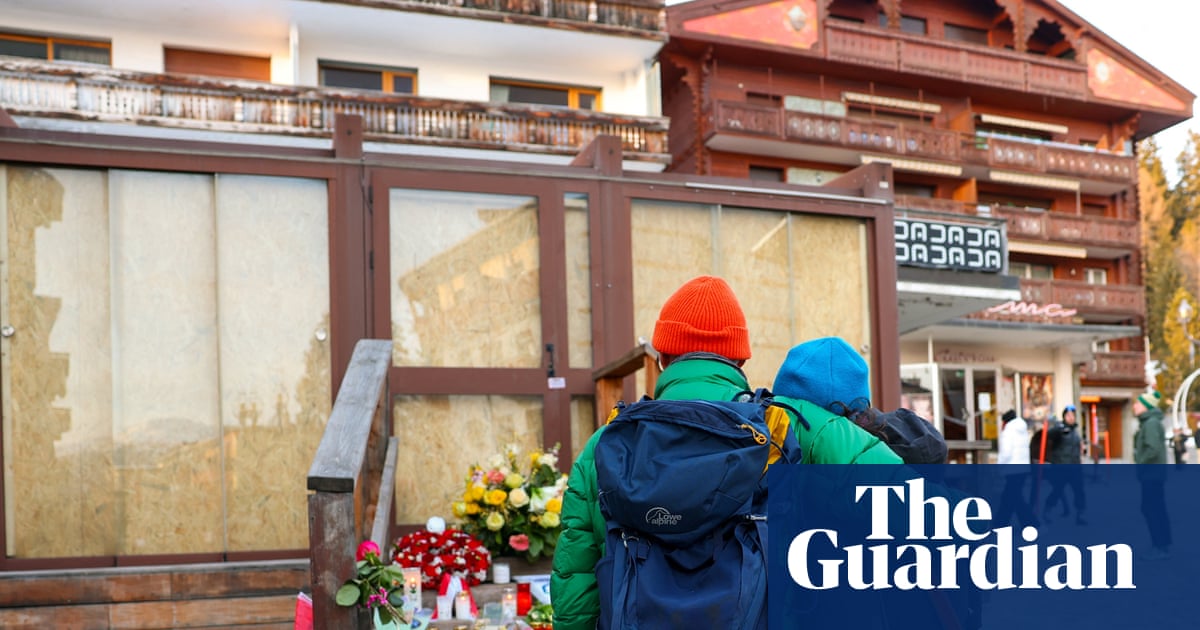
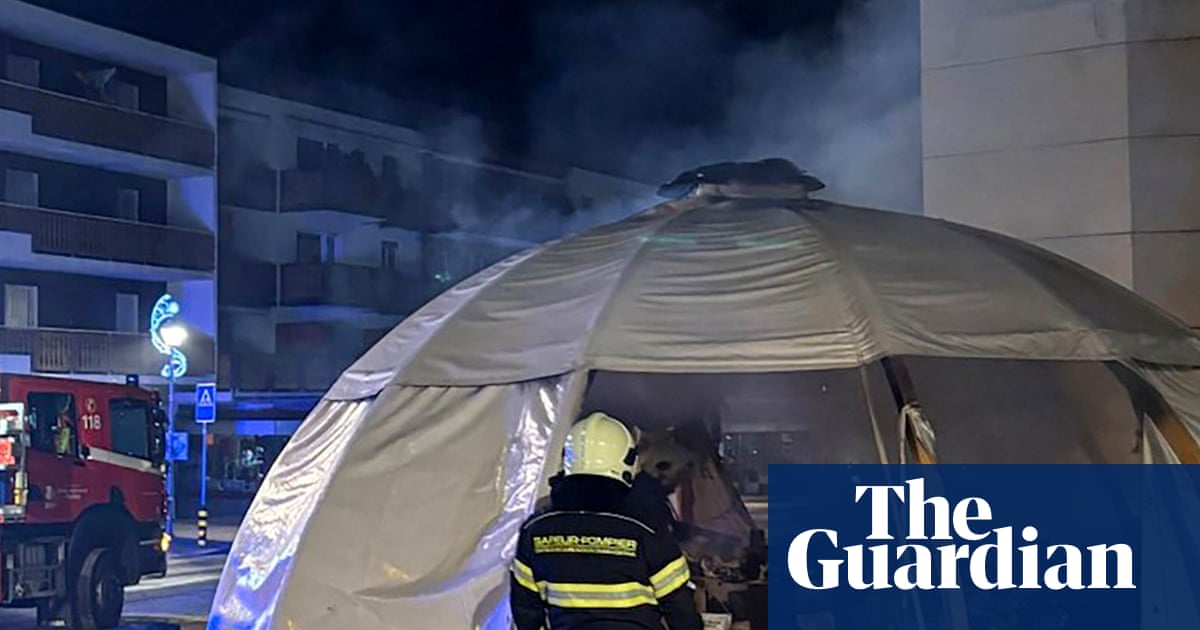
    A memorial for the victims of a deadly fire at a new year party in Switzerland caught fire early on Sunday, probably sparked by candles left burning inside, police have said.

    The memorial was a makeshift tribute to the 41 people killed and the 115 injured in the fire that erupted in the early hours of 1 January at Le Constellation bar in the ski resort town of Crans-Montana, which was packed with mainly teenagers and young adults.

    Laden with flowers, candles and messages of condolence, it had been set up near the site of the tragedy. It caught alight shortly before 6am on Sunday, regional police in Switzerland’s south-western canton of Valais said in a statement.

    The memorial was set up near Le Constellation a few days after the 1 January fire. Photograph: Maxime Schmid/AFP/Getty Images

    Images broadcast by Swiss public broadcaster RTS on Sunday showed the blackened top of a white, igloo-like tarpaulin erected over the memorial to protect it from the weather, visible behind a white screen and police tape.

    “Thanks to the rapid intervention of the emergency services, the fire was quickly brought under control,” police said.

    No one was injured in the fire at the memorial, they said, though “several commemorative objects were damaged by the flames”.

    A large book of remembrance, filled with messages of condolence left by those who have visited the memorial over the past five weeks, had been saved, the statement said.

    Police said an investigation had been opened into what caused the blaze at the memorial, which had initially been placed in front of the burned-out bar but which had recently been moved a bit farther away.

    “According to initial reports, the fire started near the candles placed on a table in the centre of the memorial,” the statement said. “At this stage, third-party involvement can be ruled out.”

    Investigators believe that the new year inferno at Le Constellation started when champagne bottles with sparklers attached were raised too close to a ceiling in the bar crowded with revellers, igniting sound insulation foam.

    The French couple who co-owned the bar, Jacques and Jessica Moretti, are facing charges of manslaughter by negligence, bodily harm by negligence and arson by negligence.

    Crans-Montana’s head of public safety and a former local fire safety officer are also under criminal investigation in connection with the blaze at the bar, which had not undergone mandatory annual fire inspections since 2019.

    Following weeks of harsh criticism of local and regional authorities’ handling of the crisis and the investigation, family members voiced consternation upon learning of the fire at the memorial.

    “What to say?” Laetitia Brodard-Sitre, whose 16-year-old son Arthur Brodard was among those who died at Le Constellation, posted on Facebook over a link to a report about the memorial fire. “It is the municipality’s responsibility to ensure a memorial that is secure.”

    Read More

  • Kapprecht Schweiz: Wann man Nachbars Pflanzen schneiden darf

    Kapprecht Schweiz: Wann man Nachbars Pflanzen schneiden darf


    Kapprecht Schweiz: Wann man Nachbars Pflanzen schneiden darf

    Knospen treiben, Blüten brechen auf, Samen keimen – wer einen Garten besitzt, freut sich im Frühling besonders über das Erwachen der Natur.

    Doch meist reicht die Freude nur bis zum Gartenzaun, denn die Blütezeit bringt oft auch Nachbarschaftskonflikte rund um Pflanzen mit sich. Was tun, wenn die überhängenden Äste von Nachbars Staude die Aussicht versperren? Was, wenn fremde Bambuswurzeln ins Erdreich vordringen?

    Read More

  • A roundup of the latest news on Tuesday

    A roundup of the latest news on Tuesday


    Swiss MPs discuss how to combat an increase in crime among foreign residents; plus more and more foreigners travel to Switzerland to die and more news on Tuesday.

    Read More

  • Swiss stock exchange makes loss of over CHF300 million

    Swiss stock exchange makes loss of over CHF300 million


    SIX makes a loss of over 300 million due to Worldline

    SIX makes a loss of over 300 million due to Worldline


    Keystone-SDA

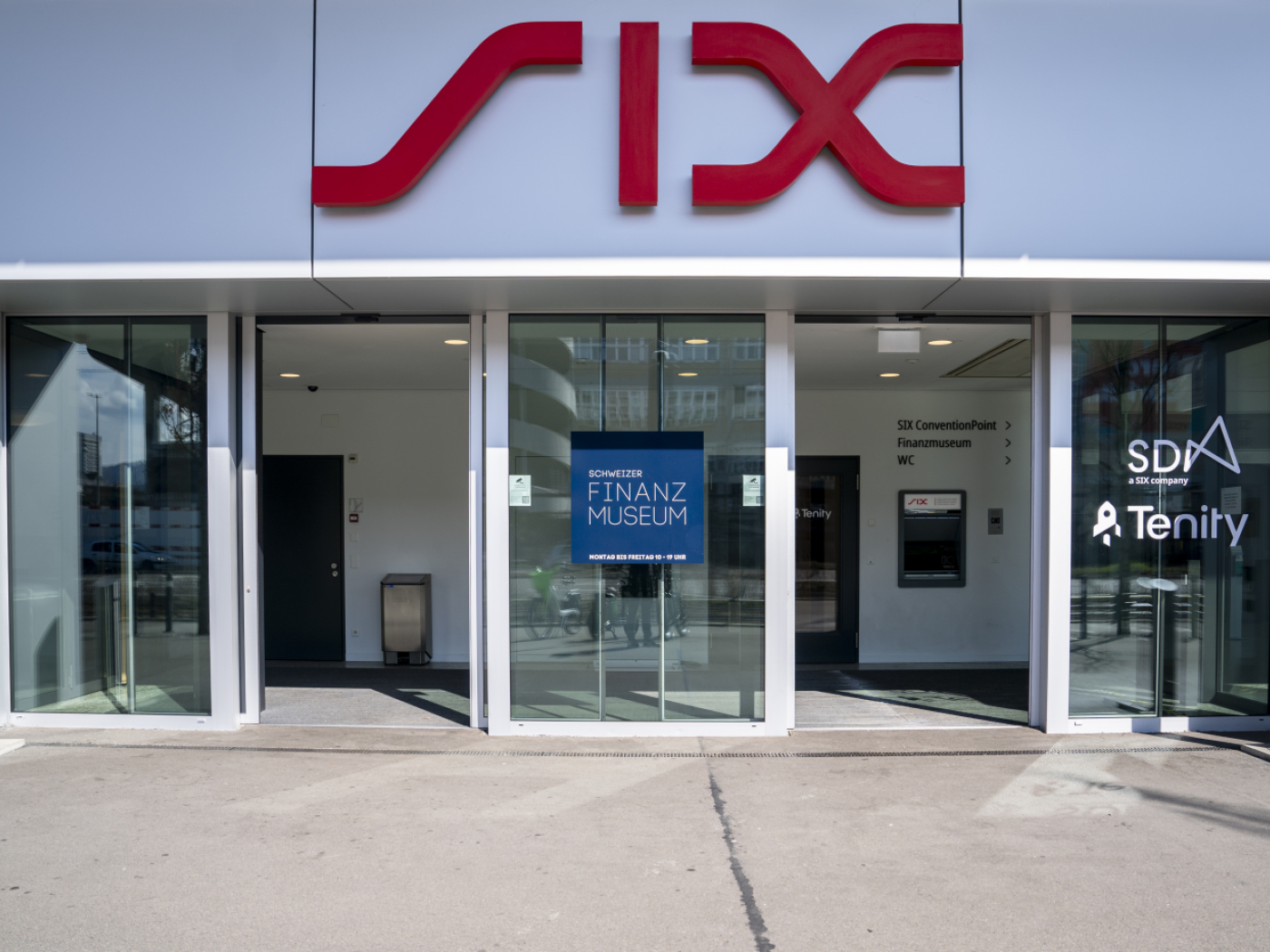
    The Swiss stock exchange SIX suffered a high loss in 2025. The Worldline shareholding responsible for this has now fallen to below 1.5%.

    +Get the most important news from Switzerland in your inbox

    At CHF561 million ($713 million), the value adjustment announced at the beginning of November due to the investment in the crisis-hit Worldline was even slightly higher than expected. The loss for 2025 thus totalled CHF314 million after a profit of CHF39 million in 2024, SIX announced on Tuesday. Adjusted for the one-off effect, net profit totalled CHF247 million.

    As SIX has decided not to participate in the capital increase announced by Worldline, the stake will be diluted to around 1.3%. The remaining value of the stake will no longer have a material negative impact on the financial results of SIX, it said.

    + Swiss stock exchange takes off after US truce

    Operating income rose by 4.7% to CHF1.66 billion in 2025. In addition to higher trading volumes and growth in the Exchanges business unit, the Financial Information and Banking Services business units also increased. Meanwhile, income in the Securities Services business unit declined slightly. The operating result EBITDA at Group level increased by 3.7% to CHF460 million.

    Product portfolio ‘optimised’

    It said 2025 was characterised by the restructuring of the Group initiated around a year ago: in addition to measures to promote sales growth, business models were “harmonised”, governance structures were “streamlined” and project, product and investment portfolios were “optimised”.

    The Board of Directors is proposing a stable dividend of CHF5.30 per share for 2025 to the Annual General Meeting. SIX is owned by around 120 financial institutions, which are also clients of the financial infrastructure service provider, with UBS holding the largest stake at 34.5%.

    Meanwhile, Roger Reist will not be standing for re-election to the Board of Directors at the Annual General Meeting on May 6. He has been a member of the Supervisory Board since May 8, 2023. Reist was Raiffeisen’s representative on the SIX Board of Directors but will become Head of “Institutionals & Multinationals” at Zürcher Kantonalbank (ZKB) on July 1. A successor has not yet been named.

    Adapted from German by AI/ts

    We select the most relevant news for an international audience and use automatic translation tools to translate them into English. A journalist then reviews the translation for clarity and accuracy before publication.  

    Providing you with automatically translated news gives us the time to write more in-depth articles. The news stories we select have been written and carefully fact-checked by an external editorial team from news agencies such as Bloomberg or Keystone.

    If you have any questions about how we work, write to us at english@swissinfo.ch

    Read More