
Category: Business

  • Springsteen headlines Minnesota ‘No Kings’ rally as protesters march across U.S. and Europe

    Springsteen headlines Minnesota ‘No Kings’ rally as protesters march across U.S. and Europe


    Large crowds protested Saturday against the war in Iran and President Donald Trump’s actions in “No Kings” rallies across the U.S. and in Europe. Minnesota took center stage, with thousands of people standing shoulder-to-shoulder to celebrate resistance to Trump’s aggressive immigration enforcement.

    Minnesota’s flagship event on the Capitol lawn in St. Paul drew Bruce Springsteen as its headliner. He and other speakers praised the state’s people for taking to the streets over the winter in opposition to a surge of U.S. Customs and Immigration Enforcement agents.

    Springsteen performed “Streets of Minneapolis,” the song he wrote in response to the fatal shootings of Renee Good and Alex Pretti by federal agents. Springsteen lamented Good and Pretti’s deaths but said the state’s pushback against ICE has given the rest of the country hope.

    “Your strength and your commitment told us that this was still America,” he said. “And this reactionary nightmare, and these invasions of American cities, will not stand.”

    People rallied from New York City, with almost 8.5 million residents in a solidly blue state, to Driggs, a town of fewer than 2,000 people in eastern Idaho, a state Trump carried with 66% of the vote in 2024.

    Biggest crowds yet expected

    U.S. organizers have estimated that the first two rounds of No Kings rallies drew more than 5 million people in June and 7 million in October.This week they told reporters they expected 9 million participants Saturday, though it was too early to tell whether those expectations were met.

    Organizers said more than 3,100 events — 500 more than in October — were registered, in all 50 states.

    In Topeka, Kansas, a rally outside the Statehouse had people impersonating a frog king and Trump as a baby. Wendy Wyatt drove with “Cats Against Trump” sign from Lawrence, 20 miles (32 kilometers) to the east, and planned to drive back to her hometown for a later rally there.

    Wyatt said “there are so many things” about the Trump administration that upset her, but “this is very hopeful to me.”

    GOP officials dismissive of protests

    White House spokesperson Abigail Jackson characterized them as the product of “leftist funding networks” with little real public support.

    The “only people who care about these Trump Derangement Therapy Sessions are the reporters who are paid to cover them,” Jackson said in a statement.

    The National Republican Congressional Committee was also sharply critical.

    “These Hate America Rallies are where the far-left’s most violent, deranged fantasies get a microphone,” NRCC spokesperson Maureen O’Toole said.

    Protesters have a long list of causes

    Trump’s immigration enforcement push, particularly in Minnesota, was just one item on a long list of protester grievances that also included the war in Iran and the rollback of transgender rights. Speakers at the Minnesota rally decried billionaires’ economic power.

    In Washington, hundreds marched past the Lincoln Memorial and into the National Mall, holding signs that read “Put down the crown, clown” and “Regime change begins at home.” Demonstrators rang bells, played drums and chanted “No kings.”

    Bill Jarcho was there from Seattle, joined by six people dressed as insects wearing tactical vests that said, “LICE” — spoofing ICE, as part of what he called a “mock and awe” tour.

    “What we provide is mockery to the king,” Jarcho said. “It’s about taking authoritarianism and making fun of it, which they hate.”

    About 40,000 people marched in San Diego, police there said.

    In New York, Donna Lieberman, executive director of the New York Civil Liberties Union, said during a news conference that Trump and his supporters want people to be afraid to protest.

    “They want us to be afraid that there’s nothing we can do to stop them,” she said. “But you know what? They are wrong — dead wrong.”

    Organizers said two-thirds of RSVPs for the rallies came from outside of major urban centers. That included communities in conservative-leaning states like Idaho, Wyoming, Montana, Utah, South Dakota and Louisiana, as well in electorally competitive suburbs in Pennsylvania, Georgia and Arizona.

    Main event at the Minnesota Capitol

    Organizers designated the rally there as the national flagship event.

    Before Springsteen took the stage, organizers played a video in which actor Robert DeNiro said he wakes up every morning depressed because of Trump but was happier Saturday because millions of people were protesting. He also congratulated Minnesotans for running ICE out of town.

    The bill also included singer Joan Baez, actor Jane Fonda, Vermont U.S. Sen. Bernie Sanders and a long list of activists, labor leaders and elected officials.

    Protesters held up a massive sign on the Capitol steps that read, “We had whistles, they had guns. The revolution starts in Minneapolis.”

    “Donald Trump may pretend that he’s not listening, but he can’t ignore the millions in the streets today,” said Randi Weingarten, president of the American Federation of Teachers.

    Rallies outside the US

    Demonstrations were also planned in more than a dozen other countries, from Europe to Latin America to Australia, Ezra Levin, a co-executive director of Indivisible, a group spearheading the events, said in an interview. In countries with constitutional monarchies, people call the protests “No Tyrants,” he said.

    In Rome, thousands marched with defiant chants aimed at Premier Giorgia Meloni, whose conservative government saw its referendum for streamlining Italy’s judiciary fail badly this week amid criticism that it was a threat to the courts’ independence. Protesters also waved banners protesting Israeli and US attacks on Iran, calling for “A world free from wars.”

    In London, people protesting the war held banners with slogans such as “Stop the far right” and “Stand up to Racism.”

    And in Paris, several hundred people, mostly Americans living in France, along with labor unions and human rights organizations, gathered at the Bastille.

    “I protest all of Trump’s illegal, immoral, reckless, and feckless, endless wars,” rally organizer Ada Shen said.
    Read More

  • Access Error


    The page you are trying to access is unavailable because we detected potential misuse. Please wait a moment and try again.

    For help please visit help.ft.com. We
    apologise for any inconvenience.

    The following information can help our support team to resolve this issue.

    Reason
    Access Blocked
    Request ID
    9e3b4604eb8d3f68
    Status Code
    403

    Read More

  • Asia hit by oil shock as Strait of Hormuz disruptions deepen

    Asia hit by oil shock as Strait of Hormuz disruptions deepen


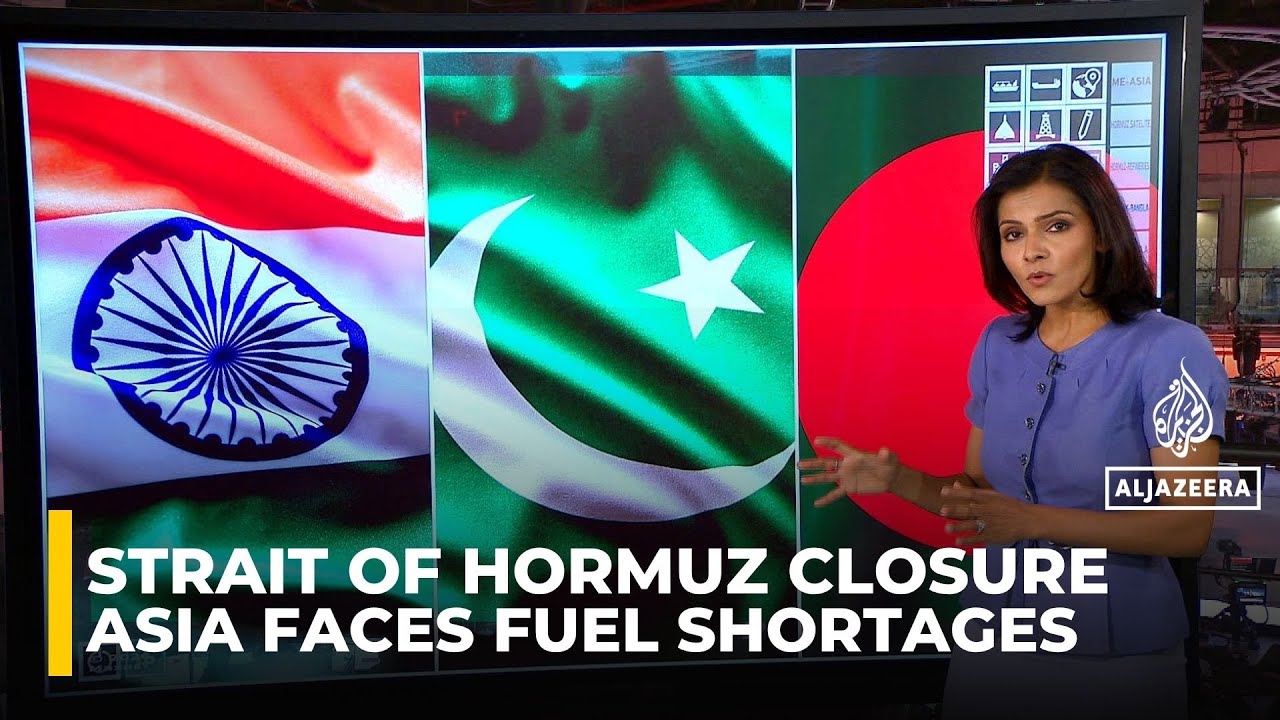
    The US-Israel conflict with Iran has disrupted global energy, especially in Asia, as Iran blocks the Strait of Hormuz, limiting 20% of oil shipments. Countries like India, China, Japan, and South Korea are adopting strategies such as stockpiling, subsidies, or seeking alternative sources. Vietnam and the Philippines face severe shortages amid rising fuel prices and supply disruptions

    Impact of Middle East War on Asian Energy Security

    The ongoing conflict in the Middle East has severely affected Asia, the world’s largest consumer of Middle Eastern oil. The Strait of Almos, a critical energy corridor where about 20% of global oil and gas supplies pass, has seen disruptions since Iran effectively shut it down, blocking shipments primarily destined for Asian nations. Attacks on energy infrastructure across the region have further reduced production, heightening concerns over energy shortages across Asian countries.

    Diverse Responses Among Asian Countries

    Asian nations are responding differently to the crisis. India, Pakistan, and Bangladesh face significant challenges due to their heavy dependence on Gulf energy supplies; India has invoked emergency measures and turned to unsanctioned Russian supplies. In contrast, China has managed better, thanks to pre-war stockpiles and its ongoing trade with Iran and Russia. Japan, South Korea, and Taiwan have implemented energy voucher programs and reserve strategies, while Thailand and Indonesia have introduced fuel caps and subsidies to stabilize prices.

    Struggling Nations and Strategic Measures

    In Thailand, an oil shock caused by disruptions in the Strait of Hormuz could have several noticeable effects:

    1. Higher Fuel Prices

    • At the pump: Gasoline and diesel prices would likely rise quickly, making it more expensive to drive cars, motorbikes, and trucks.
    • Transportation costs: Taxis, buses, and delivery services would charge more, affecting daily commutes and the cost of goods.

    2. Increased Cost of Living

    • Food prices: Since food is transported by trucks and ships, higher fuel costs can make groceries more expensive.
    • Electricity bills: Thailand uses oil for some electricity generation, so bills could go up.

    3. Impact on Tourism

    • Air travel: Higher jet fuel prices could make flights more expensive, potentially reducing the number of tourists visiting Thailand.
    • Local travel: Tourists and locals might cut back on trips if fuel and transport costs rise.

    Vietnam and the Philippines are among the most vulnerable, with limited reserves and declared energy emergencies to control distribution. Vietnam’s reserves last about 20 days, while the Philippines’ president has empowered authorities to prioritize fuel distribution amid shortages. These measures reflect the varying degrees of energy security challenges faced by Asian nations amid the Middle Eastern conflict.

    source

    Read More

  • Manny Pacquiao Prepares for April Exhibition Against Ruslan Provodnikov While Mayweather Rematch Talks Heat Up

    Manny Pacquiao Prepares for April Exhibition Against Ruslan Provodnikov While Mayweather Rematch Talks Heat Up


    Boxing legend Manny Pacquiao is set to return to the ring on April 18, 2026, for a 10-round welterweight exhibition against former junior welterweight champion Ruslan Provodnikov at the Thomas & Mack Center in Las Vegas, marking his second outing since emerging from a four-year retirement.

    Manny Pacquiao

    The bout, promoted by Banner Promotions in association with Manny Pacquiao Promotions, serves as another step in the 47-year-old Filipino icon’s unlikely comeback journey. Tickets are already on sale via Pacquiao’s official website, with the event billed as “The Road to Glory.” Pacquiao, a former eight-division world champion and 2025 International Boxing Hall of Fame inductee, previously fought to a controversial draw against WBC welterweight champion Mario Barrios in July 2025.

    Pacquiao expressed enthusiasm in a statement, saying he carries the Philippines with him every time he fights and that the support from his country and fans worldwide continues to inspire him. The matchup with Provodnikov — nicknamed “The Siberian Rocky” — reunites Pacquiao with a rugged former sparring partner known for his aggressive style and power, though the Russian has not fought professionally since 2016.

    Comeback Context and Shifting Plans

    Pacquiao’s return to boxing after retiring in 2021 has been marked by ambition and schedule adjustments. He initially targeted world title opportunities, including potential bouts against champions like Rolando “Rolly” Romero, but plans evolved. The April exhibition against Provodnikov was confirmed in mid-February after earlier dates for a more competitive return shifted. Some reports in late March indicated the April 18 date might move to June to better align with broader plans, though promoters have not issued a final update.

    The 2025 Barrios fight, which ended in a draw despite Pacquiao landing significant volume, reignited public interest in the “Pac-Man.” At 46 during that bout, he showed flashes of his legendary speed and footwork, though questions about age and ring rust persisted. Pacquiao has since trained rigorously, maintaining that he still has unfinished business in the sport he dominated for nearly two decades.

    Mayweather Rematch Buzz

    Beyond the Provodnikov exhibition, speculation swirls around a potential blockbuster rematch with Floyd Mayweather Jr. Pacquiao confirmed negotiations are underway, with some reports pointing to a September 2026 showdown at The Sphere in Las Vegas, possibly streamed on Netflix. Promoters, including Jas Mathur of Pacquiao’s team, have described the prospective bout as “historic” rather than mere nostalgia, emphasizing its global appeal more than a decade after their controversial 2015 encounter.

    Mayweather, who defeated Pacquiao by unanimous decision in a welterweight title unification bout that generated record pay-per-view numbers, has teased his own exhibition activity. A Pacquiao-Mayweather II would undoubtedly shatter financial records again, though both fighters are well into their 40s and the contest would likely carry exhibition elements.

    Pacquiao has framed his current activity as driven by passion and national pride rather than purely financial motives. He has repeatedly stated that he fights for the Philippines and its people, a theme consistent throughout his career.

    Life Beyond the Ring

    Pacquiao has stepped back from active politics, describing the field as “dirty” in 2025 interviews and choosing to focus on boxing and family. The former senator and one-time presidential contender had filed candidacy papers for a Senate return in past cycles but now appears committed to the ring. He continues philanthropic work and community engagement in the Philippines, where he remains a national hero.

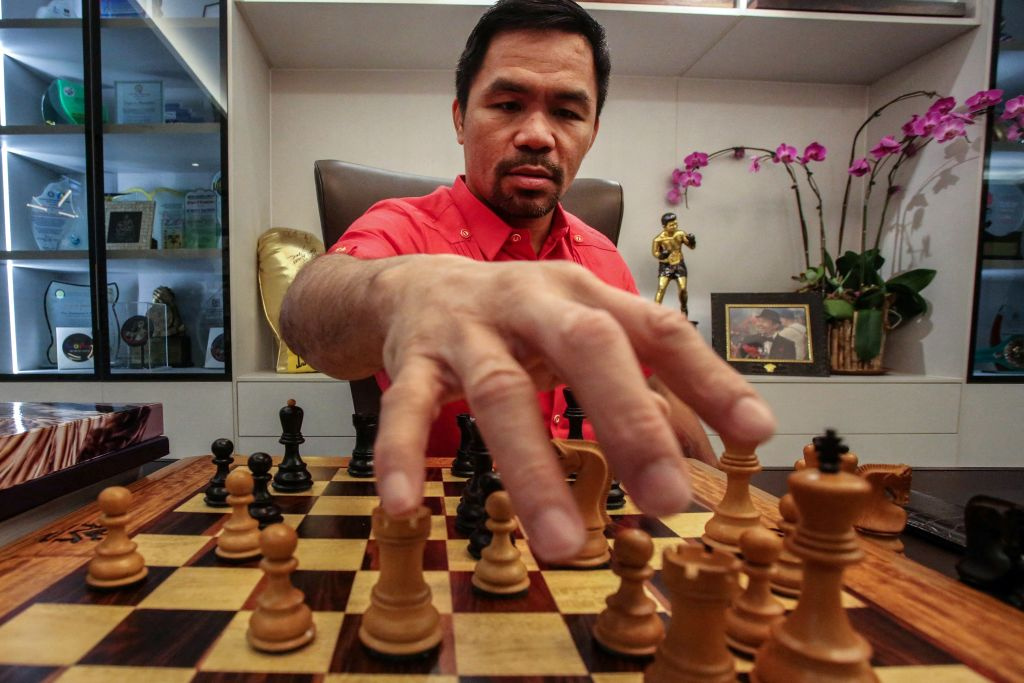
    In addition to boxing, Pacquiao has been involved in other sporting endeavors, including supporting chess events bearing his name, such as the Manny Pacquiao International Chess Festival held earlier in 2026 in General Santos City. These activities highlight his broader influence as a sports figure and role model in his home country.

    At 47, Pacquiao maintains a disciplined training regimen under longtime trainer Freddie Roach’s guidance in past camps, though specifics for the Provodnikov fight remain under wraps. He has spoken about the physical demands of returning at an advanced age but insists his love for the sport outweighs the risks.

    Legacy and Cultural Impact

    Pacquiao’s career stands as one of boxing’s most remarkable. From humble beginnings in General Santos City to becoming the only fighter to win world titles in eight weight divisions, he transcended the ring to become a global superstar, politician and philanthropist. His fights against Oscar De La Hoya, Ricky Hatton, Miguel Cotto and others defined an era of pay-per-view dominance.

    The current comeback chapter divides fans. Some celebrate the opportunity to see a living legend one more time, while others worry about potential health risks or diminished performance. Promoters frame the exhibitions as celebratory events that allow Pacquiao to stay active without the full rigors of a championship schedule.

    The April 18 card in Las Vegas will likely feature additional bouts under Manny Pacquiao Promotions, building on the fighter’s history of delivering exciting events. An undercard with rising prospects or fellow Filipino talents could add national flavor for the large diaspora expected to attend or watch.

    Outlook for Pacquiao in 2026

    As spring 2026 progresses, all eyes remain on whether the Provodnikov exhibition proceeds on April 18 or shifts, and how quickly talks for a Mayweather rematch advance. Regardless of the opponent, Pacquiao’s presence alone guarantees attention in a sport that has long revered his speed, power and charisma.

    The Filipino icon has repeatedly defied expectations throughout his career — winning titles late into his 30s and now mounting a comeback in his late 40s. While the physical prime may be long past, his heart and determination continue to inspire millions.

    For boxing fans, the coming months offer a chance to witness history in the making once more. Whether it leads to another world title attempt or culminates in a lucrative Mayweather rematch, Manny Pacquiao’s 2026 journey ensures the “Pac-Man” remains a central figure in the sweet science.

    Pacquiao’s message remains consistent: He fights not just for himself, but for his country and the dreams of underdogs everywhere. As tickets sell and training intensifies, the boxing world waits to see if lightning can strike twice — or more — for one of the sport’s all-time greats.

    Read More

  • Trade gap widens to .68B in February

    Trade gap widens to $3.68B in February


    Trade gap widens to $3.68B in February

    THE Philippines’ trade-in-goods deficit widened year on year in February as imports rose by double-digits while exports eased, the Philippine Statistics Authority (PSA) reported on Friday.

    Analysts said that February trade data suggests that recovery remains intact but vulnerable to external shocks due to the rising energy prices from the Middle East conflict.

    Preliminary data from the PSA showed that the country’s trade balance — the difference between exports and imports — reached a $3.68-billion deficit in February, 23.1% wider than the $2.99-billion gap posted a year earlier.

    Month on month, the trade gap narrowed from the revised $4.27 billion posted in January.

    February saw the smallest trade balance in nine months or since the $3.64 billion recorded in May 2025.

    Merchandise imports climbed by 12.6% year on year in February 2026. It was faster than the 2.1% expansion a year ago but a turnaround from the 1% drop in January.

    The import bill for that month reached $11.01 billion, bigger than the $9.78 billion in February 2025.

    On the other hand, total outbound sales of Philippine-made goods went up by 8% year on year in February to $7.33 billion, slower than the 12.8% expansion in February 2025 and 8.7% gain a month earlier.

    It was the slowest pace for exports in six months or since the 5.5% growth in August 2025.

    For the first two months of the year, the trade-in-goods deficit widened to $7.96 billion, 0.1% higher than the $7.95 billion-gap in the January-February period last year.

    Outbound sale of goods expanded by 8.3% to $14.47 billion in the first two months of 2026, while imports rose by 5.3% to $22.43 billion.

    The Development Budget Coordination Committee (DBCC) projects 6% and 5% growth in exports and imports, respectively, this year.

    IMPORTS REBOUND
    Chinabank Research said in a research note that imports rebounded through near-term growth will largely be driven by oil price effects as the demand for capital goods surged even before the Middle East conflict escalated.

    It added that surging oil prices will likely push up total imports and widen the trade deficit in the near term.

    “However, softer demand due to supply shortages will correct this price-driven import growth by the second half of the year,” it said.

    Ruben Carlo O. Asuncion, chief economist at Union Bank of the Philippines said that the trade deficit widening is due to the double-digit growth in imports, driven by higher purchases of electronic products, capital goods, fuel, and intermediate inputs.

    He added that the imbalance mechanically widened the trade gap even as export earnings improved.

    “The faster expansion reflects a combination of firm domestic demand, ongoing capital spending, and higher global prices, particularly for energy and industrial inputs,” he said in an e-mail.

    Imports of raw materials and intermediate goods in February fell by 13.7% to $3.22 billion. These accounted for 29.3% of the total February import bill.

    In February, imports of capital goods grew by 55.5% to $4.15 billion, while the imports of consumer goods also jumped by 10.4% to $2.14 billion.

    Imports of mineral fuels, lubricants and related materials increased by 3.8% year on year to $1.46 billion.

    China was the top source of imports, accounting for 28.4% of the total or $3.12 billion of the total import bill in February. It was followed by South Korea with an 12.5% share or $1.37 billion and Japan with 8.5% or $933.36 million.

    EXPORT GROWTH EASE
    “On the export side, growth continued to be supported by the electronics sector, which remains the country’s largest export contributor, alongside gains in machinery and gold,” Mr. Asuncion said.

    He added that the modest growth on exports is due to base effects “as February 2025 already posted double‑digit expansion, and lingering softness in global demand in selected non‑electronics products.”

    For Chinabank Research, even with the 8% decent growth, the conflict in the Middle East could disrupt supply chains.

    “Exports face headwinds from supply chain disruptions and a potential slowdown in global economic activity. This could temper earlier gains from lower-than-expected US tariffs,” it said.
    Electronic products, which made up almost three-fourths of manufactured goods and more than half of total exports in February, grew by 20.5% to $4.23 billion.

    With 43.7% share from semiconductors of the total exports, it jumped by 26.9% to $3.20 billion.

    Exports of mineral products also expanded by 52.7% to $615.26 million in February, while petroleum products declined by 34.5% to $16.54 million.

    The United States was the main destination of Philippine-made goods in February, accounting for 19.3% or $1.41 billion in export sales. Other top export destinations were Hong Kong, which accounted for 16% or $1.17 billion and Japan, which accounted for 13.5% or $986.44 million.

    Chinabank Research added that exports to the US—the country’s largest export market—surged by 42.9%. The 10% global US tariff currently in place, lower than the reciprocal tariffs that were struck down by the US Supreme Court, could help improve US demand.

    “Still, market diversification was evident as US trade policy remains highly uncertain. Shipments to East Asia rose by 14.2% and the EU by 9.5%,” it said.

    MIDDLE EAST CONFLICT
    Chinabank also said that the conflict in the Middle East poses a significant risk to the country’s trade performance this year.

    For Mr. Asuncion, if these geopolitical tensions in the Middle East persists, the most immediate transmission channel would be through higher global oil prices, which could raise the peso value of fuel and transport‑related imports.

    “This may again put upward pressure on import values and the trade deficit in the near term. Higher fuel costs could also push up production and logistics expenses, with possible spillovers to export costs and margins.”

    He added that the March trade performance will depend not only on oil prices but also on global electronics demand, exchange rate movements, supply chain conditions, and seasonal trade patterns.

    Additionally, any easing in shipping disruptions or currency support from remittance and portfolio inflows could partly cushion the impact on external trade.

    “In the coming months we could see imports rise further for mineral fuels with crude oil prices surging. Other energy costs will also likely increase. We could also see imports of capital goods and raw materials take a back seat as investor sentiment takes a hit,” Nicholas Antonio T. Mapa, chief economist and markets strategist at Metropolitan Bank & Trust Co., said in an e-mail.

    He added that one development that is being monitored is the import of materials used in electronics exports.

    “It is now negative which suggests that companies are no longer importing factors of production for our mainstay electronics. Thus, we could eventually see exports face challenges in the coming months.”

    GOVERNMENT EFFORTS
    Even if geopolitical risks remain elevated, the country can still work toward the DBCC’s export and import growth targets through a mix of policy support and structural measures, said Mr. Asuncion.

    “On the export side, improving trade facilitation, easing logistics bottlenecks, and accelerating investments in manufacturing, electronics, and high‑value agro‑exports will be crucial. On the import side, continued emphasis on productive imports, particularly capital goods that expand supply capacity, will help support sustainable growth rather than widen vulnerabilities,” Mr. Asuncion added.

    “From a policy perspective, government efforts that would help ease the impact of prolonged external shocks include energy diversification, targeted fuel support during price spikes, strengthening local supply chains, and maintaining macroeconomic stability,” he said.

    Mr. Asuncion also said that Monetary and fiscal coordination will also be important to keep inflation expectations anchored while supporting growth and external competitiveness. — Lourdes O. Pilar

    Read More

  • US Job Market Likely Thawed Out This Month After February Chill


    In the UK, a record of the Bank of England’s most recent Financial Policy Committee meeting is due on Wednesday, potentially offering insights on volatility that infected the gilt market this month. The BOE’s Decision Maker Panel report, featuring price expectations, is scheduled for the following day.

    Read More

  • ICICI Prudential AMC Q3 Results: Profit Jumps 10% To Rs 917 Crore, Dividend Declared


    ICICI Prudential AMC logged a total income of Rs 1,624 crore in the third quarter, marking an 8.9% sequential jump.

    Read More

  • Stock markets and AI: How to use artificial intelligence tools to up your investing game

    Stock markets and AI: How to use artificial intelligence tools to up your investing game


    Artificial intelligence (AI) is here and the world as we knew is changing rapidly. AI tools have evolved greatly and are complementing workflows in all disciplines. The software industry is a good example. Gone are the days where knowledge of syntaxes of programming languages was a skill an engineer would be proud of. With AI in the picture now, prompt engineering has become the more sought-after skill—whether they can construct smart prompts to leverage the power of AI and bring about a leap in efficiency.

    How about the field of personal finance? Can AI tools help a humble retail investor leapfrog his capabilities? This is a tricky question to answer, as it involves one’s hard-earned money. While there is no doubt that AI tools have become more mature and powerful than before, they could still hallucinate and generate wrong outputs. We tried experimenting with free AI tools available. In short, we found them to be extremely handy in generating quick analyses, compiling data available on the web, building stock-screeners and making complex calculations. This is a boon for investors who are crunched for time. At the same time, these tools are prone to be inaccurate that it is not safe to bet real money based purely on an AI-generated analysis.

    The best way then, is to use AI-generated results to gain a quick perspective and treat them as a launchpad for your further analyses—and this alone, in our view, makes a good case for AI tools to be part of one’s personal finance arsenal. In this story, we share a few simple use-cases for fundamental investors to get started and also highlight the limitations of AI tools so that you can steer clear of those pitfalls.

    Sector primers

    Often you would find yourself new to a sector and would appreciate a crisp primer on the sector to get started. We prompted Google’s Gemini to generate a primer on the tyres industry. We recommend a pointed prompt as below to guide the model in getting the answers you need.

    Assume you are a veteran of the Indian tyres industry. Generate a sector primer. Focus on factors such as the incumbents and their market share, the segments they serve, the raw materials, input cost volatility, margins that can be expected and the sector’s cyclicality.

    Here are a few pointers we learnt from the output.

    * MRF, Apollo, CEAT, JK Tyre and Balkrishna Industries together control over 85 per cent of the organised market

    * MRF has the deepest distribution network, Apollo has a presence in Europe through the Vredestein brand and Balkrishna Industries is a leader in off-highway tyres

    * Replacement/ after-market sales generate higher margins than sales to OEMs

    * Natural rubber and carbon black (a derivative of crude oil) are key raw materials and their prices impact margins, which could range between 10 per cent and 17 per cent

    * The industry is semi-cyclical, given the OEM demand is tied to new vehicle sales (cyclical) and replacement demand is tied to wear and tear (non-cyclical)

    AI could compile such a primer in seconds, which could have taken days otherwise. You can also use the ‘Deep Research’ feature for a thoroughly-researched output, but it takes a few hours to generate the output depending on the prompt.

    Looking up documents

    As a fundamental investor, you cannot shy away from reading verbose documents like annual reports and earnings call transcripts. AI tools are here to make it simple, and this is the use-case we found to be the most useful.

    We were curious to know how Maruti Suzuki’s cost structure and margins were impacted in FY23, when crude oil and commodities’ prices spiked after the outbreak of the Russia-Ukraine war. Apart from higher logistics costs, suppliers of cast/ forged and plastic parts are dependent on crude derivatives and generally pass on cost inflation back to OEMs like Maruti. Since we are in a similar situation today, reading the FY23 annual report would give meaningful perspective.

    We uploaded the annual report into NotebookLM, a Google product. The USP of this product is that it largely sticks only to the documents uploaded to generate its answers and also gives citations. We learnt that the company did undergo commodity cost pressures. Yet, it managed to expand its EBIT margin from 3.5 per cent in FY22 to 7.3 per cent, driven by operating leverage (19 per cent volume growth) and calibrated price hikes.

    Now, going into FY27, can FY23 repeat itself for Maruti? Back then in FY22, sales volume was impacted due to the semiconductor shortage, giving the company a low base to work with in FY23. The same cannot be said about FY27, as OEMs have had a good year in FY26 post the GST cuts. Hence, to protect margin, the company is left with the sole option of hiking prices/ scaling discounts back. This leaves us with closely tracking price hikes and any resultant impact on demand as key monitorable.

    For earnings call transcripts, readers can use Perplexity Finance, where transcripts of the recent 10 quarters are readily available (under ‘Earnings’ tab). It also segregates them into topics. You can choose a topic from the drop-down list. For instance, the management’s prepared remarks, platform synergies and scaling, margins and risks in modules and polymers segment, strategy for aerospace and semiconductor business are some of the topics we found in Samvardhana Motherson’s Q3 FY26 earnings call.

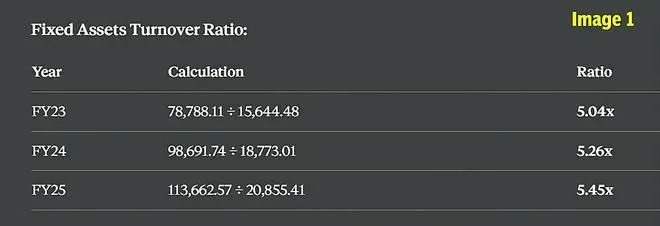
    Here’s another extrapolated use-case. Some ratios such as EBITDA margin and fixed assets turnover ratio are not readily available in quarterly earnings releases. You can just upload those PDFs into the AI model of your choice and get them calculated in a jiffy. We prompted Claude to calculate fixed assets turnover ratio of Samvardhana Motherson for FY23-25. The screenshot of the output can be found in Image 1.

    Post-market brief

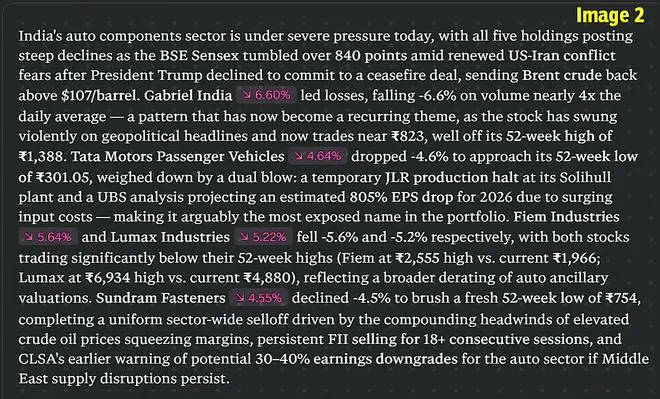
    It is not practical for retail investors to watch the market through the day. Perplexity Finance and Google Finance (Beta) can help solve this to an extent. Once trading for the day closes, you can get a summary of how your stocks performed. All you need to do is create a custom watchlist. While Perplexity gives you a readymade summary (under ‘Watchlist’ tab), you will need a prompt to do the same on Google Finance (Beta). We had created a watchlist with stocks from the auto sector on Perplexity Finance. A screenshot of the market brief for March 27 is given for reference (see Image 2).

    Screening stocks

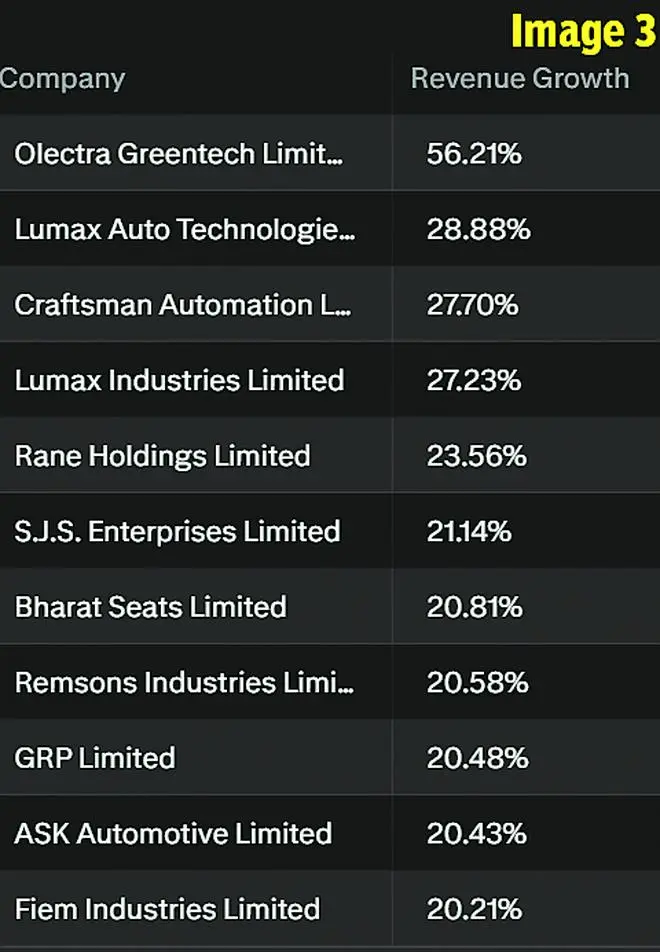
    Building screeners to filter stocks is inevitable in bottom-up investing. Though there are free screeners available online, they work with fixed syntaxes. It takes some time to learn how exactly they work and would be difficult for some investors who may not be savvy enough. For this specific use-case, an investor can use the ‘Screener’ feature of Perplexity Finance. It lets you frame your conditions/ parameters in natural language itself. Here is a simple screener we tried. To identify fast growing auto ancillary stocks, we gave the following prompt. The output is given in Image 3.

    Prompt: Filter auto ancillary companies that had revenue growth of over 20 per cent in FY25

    DCF simulations

    If you prefer the discounted cash flows (DCF) model for valuation decisions, AI tools can handle that too. Simply put, under DCF method, future free cash flows are discounted for time value to estimate an investment’s worth. The method requires you to assume values for the variables involved and the model itself is only as good as the logical accuracy of the assumptions. But once done with this step, you can use any of the AI models to run simulations. This use-case could very well find favour with investors who may not be familiar with spreadsheets.

    Prompt:

    Calculate Infosys’ market value of equity per share using discounted cash flow model. Also indicate if there is any upside left from current market price of ₹1,275.

    Assume the following variables.

    Free cash flow to firm (FCFF) for FY26 = ₹30,000 crore.

    FCFFs to grow at 5 per cent between FY27 and FY30.

    Perpetual growth rate for FCFFs at 2 per cent.

    The company is net-debt free and so, cost of debt can be taken as nil.

    For cost of equity, assume risk free rate at 4.4 per cent, equity risk premium at 7.1 per cent and beta of 0.9 times.

    Number of shares outstanding at 406 crore.

    We replicate the output in short here, without the calculation steps.

    Output: Expected per-share equity value = ₹951

    At current price, there is no margin of safety. Instead, the market price is about 34 per cent above the DCF‑derived intrinsic value.

    Readers can play around with the same prompt by altering variables to simulate a bull case, a bear case and a neutral case.

    Caveat emptor

    We have barely scraped the surface in this story, and we admit that the possibilities are endless. However, the technology is in its infancy and has some rough edges to be smoothened. Once you decide to adopt AI for your finances, you should thoroughly know its limitations as your portfolio may be one hallucination away from disaster. Here are some of the limitations we observed during our short time testing the models.

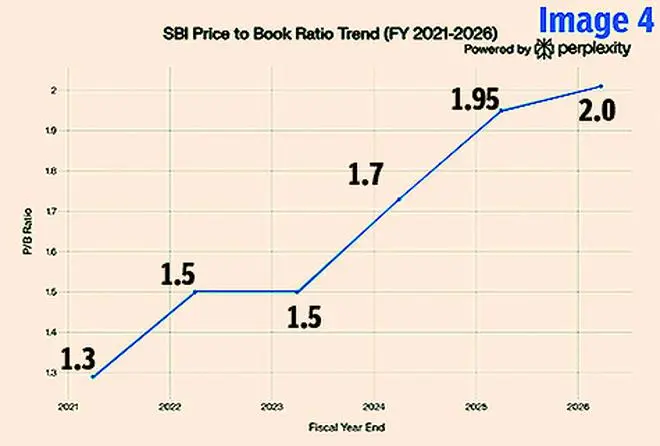
    Charts with valuation multiples (P/E, P/B for example) in a time-series are really useful. A P/E time-series, based on daily prices, is a classic example. Such charts help put current valuations in perspective, relative to the past. We tried building a daily P/B chart for SBI with Perplexity. What we got instead was a P/B chart as of financial year-ends, also not without errors (see Image 4).

    Note that while P/B values for FY21-24 are largely accurate, that of FY25 and the current P/B are not. Actual P/B ratio as of FY25 end is 1.4x and the current P/B ratio is 1.6x – which are 2x, according to Perplexity..

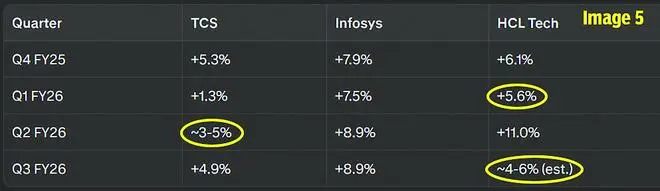
    Next, we tried comparing revenue growth (year on year) of TCS, Infosys and HCLTech over the last four quarters. Perplexity does have quarterly financial data under the ‘Financials’ tab. Ideally, the model should have picked up data from here to build the output table. Instead, it tapped web sources to do it. This meant some values were incorrect (see Image 5).

    Note that TCS’ revenue in Q2 FY26 actually grew 2.4 per cent and HCLTech’s revenue grew 8.2 per cent and 13.3 per cent in Q1 FY26 and Q3 FY26 respectively.

    Next, take a look Image 3 again. It includes Olectra Greentech, which is an OEM and not a supplier of auto components.

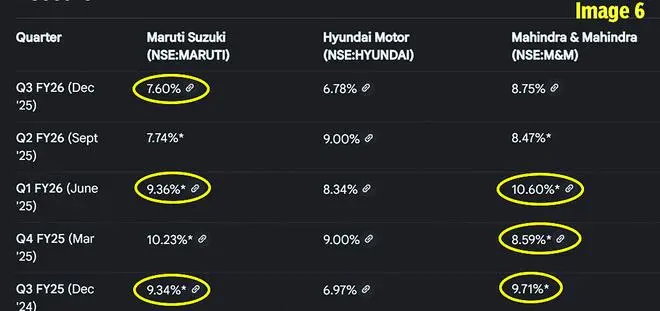
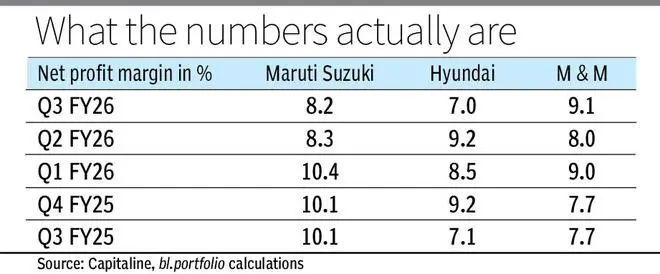
    Moving on, we tried prompting Google Finance (Beta) to compute net profit margin of Maruti Suzuki, Hyundai and Mahindra & Mahindra for the last five quarters. Similar to Perplexity, Google Finance too, natively houses quarterly financial data. However, it sourced data from web sources to build the output table. Though some numbers come close to actuals, some differ widely (see Image 6 along with the infographic table).

    Similarly, other niggles do exist. However, for the use-cases we mentioned earlier and beyond, AI is too powerful a tool for retail investors to not take advantage of. We suggest readers to use these AI platforms as a supplementary source in their regular course of investing and keep experimenting until more effective, reliable workflows are discovered.

    Attribution to AI products in the story are meant neither as endorsements nor as criticisms

    Published on March 28, 2026

    Read More

  • Raymond Group’s former chairman Vijaypat Singhania dies at 87; funeral in Mumbai tomorrow

    Raymond Group’s former chairman Vijaypat Singhania dies at 87; funeral in Mumbai tomorrow


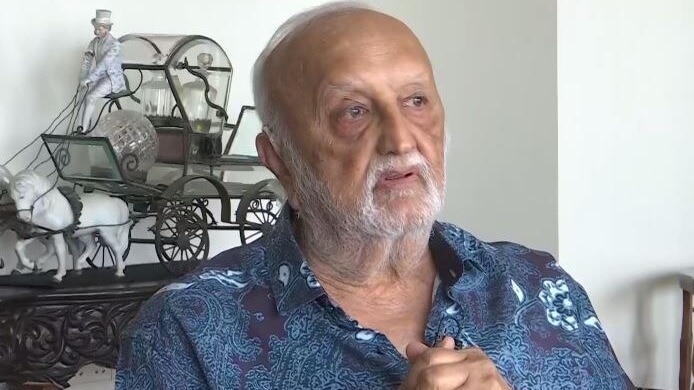
    Padma Bhushan awardee, aviation enthusiast and former chairman of the Raymond Group, Vijaypat Singhania, passed away peacefully in Mumbai on Saturday evening. He was remembered as a visionary industrialist, philanthropist and inspiring personality whose contributions spanned business, aviation and public life.  

    Singhania’s son and Raymond Group Chairman and Managing Director Gautam Singhania also shared the news on X (formerly Twitter), writing a brief tribute: “RIP. Om Shanti.”  

    Confirming the development, a spokesperson for the Raymond Group said: “Air Commodore Vijaypat Singhania, recipient of Padma Bhushan, former Chairman of Raymond Group and former Sheriff of Bombay peacefully passed away earlier this evening in Mumbai. His last rites will be performed tomorrow, March 29, 2026. All of us are deeply saddened and praying for his Sadgati.”  

    According to a family announcement, the funeral assembly will take place at 1:30 pm on Sunday, March 29, 2026, at Haveli, L D Ruparel Marg in Mumbai. The cremation will be held at Chandanwadi crematorium at 3:00 pm.  

    Family members, friends and well-wishers have been requested to attend and pay their final respects.  

    The condolence message issued by the Singhania family described him as “a visionary leader, philanthropist, and an inspiring personality whose legacy will continue to guide and inspire generations.”  

    The announcement also invoked a verse from the Bhagavad Gita: “Karmanye vadhikaraste ma phaleshu kadachana, ma karmaphalahetur bhur ma te sangostvakarmani.” The family said they pray for the departed soul to attain eternal peace.  

    Who is Vijaypat Singhania  

    Vijaypat Singhania was one of India’s most prominent industrialists and aviation pioneers. Born into the Singhania business family, he led the Raymond Group, one of India’s best-known textile and apparel companies, transforming it into a globally recognised brand in suiting fabrics and menswear.  

    During his tenure as chairman, Raymond expanded significantly in manufacturing, retail and exports, helping establish the company as a dominant player in the textile sector.  

    Singhania also served as the Sheriff of Bombay, a ceremonial civic post in Mumbai, reflecting his stature in public life.  

    Beyond business, he was widely known for his passion for aviation and adventure. A trained pilot and former Air Commodore (Honorary), he set several aviation and ballooning records and was among the most celebrated balloonists in the world.  

    In recognition of his contributions to industry and society, the Government of India honoured him with the Padma Bhushan, the country’s third-highest civilian award.

    Read More

  • FIIs sell Indian equities worth Rs 1.14 lakh crore in March; 2026 outflow balloons to Rs 1.27 lakh crore

    FIIs sell Indian equities worth Rs 1.14 lakh crore in March; 2026 outflow balloons to Rs 1.27 lakh crore


    Foreign institutional investors (FIIs) offloaded domestic equities worth Rs 1,13,810 crore in March, extending their selling trends amid the Iran-Israel war. So far, this year, they have offloaded Indian shares worth Rs 1,27,157 crore.

    This has turned out to be the worst month so far, as foreign investors continue pulling out from their Indian investments amid the Iran-Israel war.

    Commenting on the current trends, Dr. VK Vijayakumar, Chief Investment Strategist, Geojit Investments said the weakness in global equity markets following the war in West Asia, the steady depreciation of the rupee, fears of decline in remittances from the Gulf region and concerns surrounding the impact of high crude price on India’s growth and corporate earnings contributed to the sustained selling by FPIs.

    “It is important to understand that FPIs were sellers in other emerging markets, too, like Taiwan and South Korea. There is a risk-off trend in equity markets, globally after the war broke out in West Asia. The poor returns from India vis-a-vis other markets – both developed and emerging- during the last eighteen months is the principal reason for FPI’s indifference towards India. If their sustained selling strategy is to change, there should be an end to the hostilities in West Asia and decline in crude prices,” Vijayakumar said.

    On Friday, FIIs sold domestic shares at Rs 4,367.30 crore while DIIs were net buyers at Rs 3,566.15 crore.


    Indian frontline indices ended their two-session rally amid sharp cuts as a failure in the Iran-US negotiations dented the market mood. Elevated energy prices and a plunging rupee aggravated troubles for domestic investors. Amid high volatility, markets were mainly dragged by financials, auto and consumer stocks. Nifty settled at 22,819.60, falling by 486.85 points or 2.09% while the BSE Sensex closed at 73,583.22, declining 1,690.23 points or 2.25%.

    FIIs in 2026

    Foreign investors turned net buyers in February, buying shares worth Rs 22,615 crore in the domestic markets so far. In January, they sold Rs 35,962 crore worth of shares.

    In 2025, the FIIs buying trends remained patchy, but the overall trend was bearish. They took Rs 1,66,286 crore from Indian markets as trade deal delay and premium valuations weighed on the sentiments.

    (Disclaimer: Recommendations, suggestions, views and opinions given by the experts are their own. These do not represent the views of Economic Times)

    Read More