Category: Business

  • How are Asian airlines responding to fuel price surges?

    How are Asian airlines responding to fuel price surges?


    Asian airlines are responding to surging fuel prices by implementing significant ticket price hikes, increasing fuel surcharges, and developing contingency plans to ground aircraft.

    • Ticket price hikes & surcharges: Cathay Pacific and Hong Kong Airlines nearly doubled surcharges; Thai Airways raised fares by 10–15%.
    • Contingency planning: Low-cost carriers (AirAsia, Lion Air, Garuda Indonesia) may delay aircraft purchases or ground planes if fuel remains unaffordable.
    • Operational efficiency: Airlines are adopting fuel‑saving procedures, lighter loads, and deploying newer aircraft while retiring older widebodies.

    These measures come as jet fuel prices have more than doubled due to escalating conflict in the Middle East, with some carriers warning of potential bankruptcy for budget airlines if the crisis persists.

    Cathay Pacific and Hong Kong Airlines have nearly doubled their fuel surcharges, with long-haul surcharges reaching over HK$1,164. In Thailand, Thai Airways International is raising average ticket prices by 10-15% and limiting the availability of low-fare tickets through dynamic pricing to offset costs. Meanwhile, low-cost carriers in Southeast Asia, including AirAsia, Lion Air, and Garuda Indonesia, are reviewing timelines for aircraft purchases and considering grounding planes if fuel remains unaffordable.

    The regional impact is further complicated by a 60% reliance on jet fuel imports from China and Thailand, both of which have recently halted fuel exports to ensure their own energy security. This has led Vietnam to warn of widespread flight cuts and shortages starting in April. Despite these pressures, some carriers like Thai Airways may see marginal benefits on European routes as airspace closures in the Middle East tighten global supply and drive demand toward direct Asian hubs.

    Asian airlines are stepping up their response to fuel price surges, and the impact is increasingly visible across the region’s aviation and tourism landscape. For Thailand, where tourism is a major growth engine and air connectivity is critical, these cost pressures are reshaping routes, fares, and investment decisions.

    Fuel costs and Thailand’s connectivity

    Fuel remains one of the largest single expenses for airlines, often reaching a quarter or more of total operating costs, so sharp price increases quickly feed into route economics and pricing. In Thailand’s case, this matters not only for local carriers but also for the international airlines that bring tourists from key long‑haul markets. Any sustained rise in fuel prices risks higher fares, especially on long‑haul and regional routes with limited competition, and could constrain capacity growth during peak travel seasons.

    In response to the energy security concerns triggered by the war in the Middle East, China and Thailand have implemented strict jet fuel and refined oil export bans to prioritize domestic needs. These restrictions have significantly impacted neighboring countries, with Vietnam warning of flight reductions and Cambodia being forced to seek alternative fuel suppliers in Singapore and Malaysia.

    Within Thailand, the Department of Energy Business has confirmed that while national reserves remain sufficient for over 100 days, logistical bottlenecks have caused widespread shortages at local petrol stations. The crisis has hit the agricultural sector particularly hard, leaving machinery idle during the rice harvest season in provinces like Phitsanulok. Meanwhile, Thai Airways International has announced ticket price increases of 10-15% to offset jet fuel costs that have surged to as high as US$220 per barrel.

    How airlines are adjusting

    Across Asia, carriers are focusing on three main levers: efficiency, networks, and pricing. Operationally, airlines are optimizing flight planning, using fuel‑saving procedures such as continuous climb and descent, and removing unnecessary weight on board to lower fuel burn per sector. At the same time, they are deploying newer, more efficient aircraft on trunk routes and gradually retiring older widebodies that are more expensive to operate when fuel is high.

    Network decisions are becoming more selective. Marginal or highly seasonal routes are under review, with some frequencies trimmed or shifted to aircraft types that can spread fuel costs over more seats. On the revenue side, many carriers have either introduced or increased fuel surcharges on international tickets, alongside targeted fare increases where demand remains strong.

    Implications for tourism flows

    For tourism‑dependent economies like Thailand, these changes could influence both the volume and composition of visitor arrivals. Higher fuel‑driven costs tend to affect price‑sensitive segments first, potentially slowing growth in budget travel while preserving demand in premium and higher‑spend leisure categories. Airlines’ decisions to prioritize high‑yield routes may work in Thailand’s favor if key source markets in Asia, Europe, and the Middle East remain profitable under elevated fuel prices.

    However, persistent cost pressure may limit the pace at which new routes are opened to second‑tier cities or niche destinations within the country, keeping the focus on Bangkok and a few major tourist hubs. That, in turn, could slow diversification of tourism flows away from already crowded hotspots.
    Read More

  • Detroit Metropolitan Airport TSA Wait Time Remain Short Between 2 and 5 Minutes

    Detroit Metropolitan Airport TSA Wait Time Remain Short Between 2 and 5 Minutes


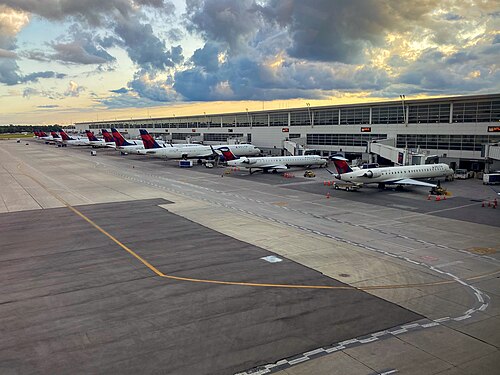
    Travelers at Detroit Metropolitan Wayne County Airport faced minimal delays at security checkpoints Thursday, with wait times hovering between 2 and 5 minutes across its two main terminals, providing welcome relief amid broader national worries about TSA staffing shortages and spring travel surges.

    Detroit Metropolitan Airport
    Detroit Metropolitan Airport

    The Wayne County Airport Authority reported real-time security wait times of just 2 minutes at the Evans Terminal and 5 minutes at the McNamara Terminal on its official website as of early Thursday morning. Those figures align with consistent reports from recent days, where lines rarely exceeded 7 minutes even during moderate traffic periods.

    Detroit Metro, or DTW as it is commonly known, serves as Michigan’s busiest airport and a major hub for Delta Air Lines. It handled more than 40 million passengers in recent years, yet its security operations have remained notably efficient compared to many larger U.S. hubs where lines have stretched for hours this week.

    Airport officials and local news outlets noted that despite a partial government shutdown affecting some federal operations, DTW has avoided the long queues seen elsewhere. As of Tuesday afternoon, waits stood at 6 minutes in Evans and 7 minutes in McNamara, according to multiple reports. By Wednesday and into Thursday, those numbers dipped even lower in off-peak hours.

    “DTW continues to move passengers through security smoothly,” a Wayne County Airport Authority spokesperson said. “We encourage travelers to check our website for the latest updates before heading to the airport.”

    The airport’s homepage features a prominent security wait time display that refreshes regularly, showing separate estimates for each terminal. Evans Terminal, which primarily serves non-Delta carriers, and the larger McNamara Terminal, home to Delta’s operations, both benefit from multiple checkpoints and expedited lanes.

    Typical TSA wait times at DTW average between 10 and 20 minutes throughout the day, with peaks during early morning Delta banks around 5 a.m. to 8 a.m. and afternoon rushes from 3 p.m. to 7 p.m. Historical data shows waits climbing to 20-25 minutes during those busy windows, but rarely beyond 30-35 minutes even on heavier travel days.

    Travelers can further shorten their experience through TSA PreCheck, CLEAR biometric screening, and Global Entry. PreCheck lanes often clear in under 5 minutes, while standard lines move steadily thanks to adequate staffing levels at DTW compared to airports reporting agent call-outs elsewhere.

    Airport authorities recommend arriving 90 minutes before domestic flights and 120 minutes before international departures to account for parking, ticketing and potential bag checks. “Give yourself plenty of time for parking, baggage check, and TSA wait lines,” the official guidance states.

    This week, while some East Coast and Southern airports saw waits balloon to 2-3 hours due to spring break crowds and staffing issues tied to the partial shutdown, DTW stood out as an exception. Local media highlighted passenger reports of breezing through security in minutes, contrasting sharply with chaos at hubs like Atlanta, Houston and Charlotte.

    One traveler departing Wednesday afternoon described the process as “shockingly quick.” “I was through McNamara security in about four minutes with PreCheck,” the passenger said. “I’ve had longer waits at much smaller airports.”

    DTW offers multiple security checkpoints. In the McNamara Terminal, options include the main north and south checkpoints, with additional lanes during peak times. The Evans Terminal features checkpoints in the main lobby area. Signs direct passengers to the appropriate lines based on their boarding pass and trusted traveler status.

    TSA PreCheck enrollment remains popular at DTW. The on-site enrollment center, located in the McNamara Terminal’s domestic baggage claim, allows eligible travelers to apply and often receive conditional approval on the spot. Members keep shoes and light jackets on and leave laptops and liquids in bags, speeding the process considerably.

    CLEAR, the biometric identity platform, is also available at DTW and pairs well with PreCheck for even faster entry. Frequent flyers report combined use reducing total security time to 2-3 minutes on average.

    Beyond expedited programs, the airport maintains efficient operations through technology and staffing strategies. Advanced imaging systems and automated tray returns help keep lines flowing. During busier periods, additional TSA officers are deployed to open more lanes.

    For those without PreCheck, standard screening still moves relatively quickly at DTW. Passengers must follow the familiar 3-1-1 liquids rule — containers of 3.4 ounces or less in a single quart-sized bag — and remove electronics larger than a cellphone. The MyTSA app from the Transportation Security Administration provides historical wait estimates and real-time crowd reports submitted by fellow travelers.

    DTW’s two-terminal layout helps distribute passenger flow. McNamara handles the bulk of traffic with its iconic architecture, including the dramatic light tunnel connecting concourses. Evans serves as a more compact alternative for other airlines. Both terminals offer ample dining and shopping options post-security, allowing passengers to relax once cleared.

    Current alerts on the airport website include three active notices, primarily related to construction or parking updates, but none impacting security operations directly. Flight status remains largely on time, with no widespread delays attributed to security bottlenecks.

    Travel experts advise checking wait times immediately before departure. The official metroairport.com site provides the most accurate real-time data, updated frequently. Third-party sites and the MyTSA app offer helpful supplements based on historical patterns and user reports.

    Peak travel seasons, including summer vacations and holidays, typically see higher averages, but even then DTW rarely ranks among the worst for delays. Its central Midwest location and strong local TSA workforce contribute to reliability.

    As spring break continues nationwide, DTW officials urge passengers to monitor both the airport site and their airline apps. Weather in the Detroit area remains mild for late March, with no major storms forecast that could exacerbate ground delays.

    For international travelers, global entry and mobile passport control can further expedite entry upon return, though departure security follows the same domestic protocols.

    Parents traveling with children or those needing assistance can request expedited screening or use family lanes where available. The airport also provides wheelchair and mobility services through airlines or third-party providers.

    Business travelers appreciate DTW’s efficiency, often citing it as one of the smoother large-airport experiences in the country. With Delta’s extensive network, many connect through the hub without long security re-checks thanks to efficient design.

    Looking ahead, the Wayne County Airport Authority continues investing in infrastructure. Future enhancements may include additional automated screening lanes and expanded PreCheck capacity to handle growing passenger volumes.

    In the meantime, Thursday’s sub-5-minute waits underscore DTW’s reputation for traveler-friendly operations even when federal challenges arise elsewhere.

    Passengers planning trips through Detroit Metro this week can breathe easier. While national headlines highlight TSA strains, local reality at DTW points to short lines and smooth sailing — a reassuring note for anyone flying soon.

    To stay informed, bookmark metroairport.com or download the MyTSA app. A few minutes of preparation can turn potential stress into a stress-free start to any journey.

    Read More

  • Marcos says Philippine oil supply secure beyond 45 days

    Marcos says Philippine oil supply secure beyond 45 days


    Marcos says Philippine oil supply secure beyond 45 days

    By Erika Mae P. Sinaking, Reporter

    PRESIDENT Ferdinand R. Marcos, Jr. said the Philippines has secured enough fuel supply to last beyond 45 days despite disruptions caused by war in the Middle East, as the government scrambles to line up alternative sources and ensure existing contracts are fulfilled.

    Speaking on Wednesday, Mr. Marcos said authorities moved quickly to make sure deliveries under previously signed contracts continued to reach the country, even as uncertainty initially froze communications with oil suppliers.

    “In the beginning, our suppliers could not even tell us what was happening, and they couldn’t give us prices,” he told a livestreamed briefing in Filipino from the presidential palace. “But through constant engagement and by putting new systems in place, supply has continued to come in.”

    Global oil markets have been jolted by escalating tensions in the Middle East, a key supply region, raising concerns over shortages and higher prices for fuel-importing countries such as the Philippines. The country relies almost entirely on imported petroleum products.

    Mr. Marcos said the government is not relying solely on traditional suppliers in the region. Officials have been reaching out to alternative sources unaffected by the conflict, though he cautioned that it is still too early to say whether new contracts have been finalized.

    “It would be premature to say that everything has been perfected. But things are beginning to open up,” he said. “I’m very confident in saying that we have sufficient supply.”

    The Department of Energy (DoE) on Tuesday said the Philippines has an average fuel inventory equivalent to about 45 days of supply, though levels vary by product.

    Mr. Marcos expressed confidence that additional shipments would arrive before stocks run low, ensuring a steady flow rather than isolated deliveries.

    “We can be fairly confident that after the 45 days, we will already have oil arriving here in the Philippines,” he said. “Not just one delivery, not just two deliveries, but a flow of petroleum and petroleum-related products.”

    Mr. Marcos credited the country’s diplomatic ties for helping secure continued access to fuel, noting that good relations with partner countries have played a key role in keeping supply lines open.

    Authorities, he said, would continue to explore new sourcing arrangements while monitoring global developments, as energy prices remain vulnerable to further geopolitical shocks.

    He and Energy Secretary Sharon S. Garin earlier said the country is talking to China, Russia, the US, South American countries, Brunei, South Korea, Japan and India, among others, for oil supply, noting the discussions yield positive results.

    As a net oil importer, the Philippines is particularly vulnerable to disruptions in global oil supply and volatility in prices. It imports nearly all of its crude oil from the Middle East, with Saudi Arabia as its top supplier.

    At the same time, the Department of Budget and Management (DBM) has approved the release of P20 billion to the DoE to secure fuel supply for the country.

    The funds were released on March 24 through a Special Allotment Release Order (SARO) and Notice of Cash Allocation (NCA), which was sourced from the Malampaya Gas Fund under the Special Account in the General Fund (SAGF), the DBM said in a statement.

    The P20 billion will fund the “strategic procurement of fuel products — including diesel, gasoline, and liquefied petroleum gas (LPG) — to boost national fuel inventory, stabilize pump prices, and ensure uninterrupted operations across transport, logistics, agriculture, emergency response, and other critical sectors.”

    It will be implemented by the Philippine National Oil Company-Exploration Corporation, which has already started procurement.

    ‘DO NOT PANIC’
    On Tuesday evening, Mr. Marcos placed the country under a national state of energy emergency under Executive Order (EO) No. 110, noting the ongoing war’s imminent threat to the country’s energy supply. The order will be in effect for a year.

    The President on Wednesday clarified that the declaration was only a “precautionary tool” and that only the energy sector was covered by the state of emergency.

    “I want to assure everyone that this does not mean that we should panic. It means that we are doing everything that we can to assess and to alleviate the situation,” Mr. Marcos said.

    Under the EO, the President created the Unified Package for Livelihoods, Industry, Food, and Transport (UPLIFT) committee for a coordinated response in stabilizing fuel supply, sustaining economic activity and protecting sectors most exposed to rising energy costs.

    The EO also allows authorities to focus interventions on ensuring adequate energy supply and mitigating price spikes while mobilizing government resources more efficiently.

    “The source of the problem is the supply and the price of energy, and that is what we need to address directly… The reason that I declared an energy emergency is to provide government with more options should the need arise,” Mr. Marcos said.

    Transport workers are planning a two-day strike starting Thursday to protest surging oil prices and demand a fare hike, a move Mr. Marcos rejected last week.

    They also want him to cut or halt excise taxes on petroleum products to lessen oil prices.

    Mr. Marcos on Wednesday signed into law Republic Act No. 12316, a measure granting him the power to temporarily suspend or reduce excise taxes on petroleum products to mitigate the impact of rising global oil prices.

    Asked if the government will take control of the oil industry, the President said he hopes the situation won’t call for the move.

    “We don’t want to get into that discussion,” Mr. Marcos told reporters and refused to take follow-up questions.

    Jay M. Layug, a former energy undersecretary and executive board member of the Philippine Energy Research and Policy Institute, echoed the President’s remarks.

    “No need to take control of oil companies,” he said in a Viber message.

    “What government needs to do is implement multiple measures to manage demand for petroleum and conserve energy use. Example, coding system expansion, carpooling, expanded WFH (work-from-home) program, expanded EV (electric vehicle) program, etc.”

    The government had already mandated a four-day workweek for government offices to lessen energy use.

    Fuel prices climbed again this week, extending one of the longest runs of increases in recent years.

    Noel M. Baga, co-convenor of the Center for Energy Research and Policy think tank, said the declaration is overdue, noting that the legal tools were already in place and that recent price hikes and suspended public utility operations highlighted the urgency of stronger action.

    “Every power generation project in the pipeline must be fast-tracked,” Mr. Baga said. “The emergency declaration signals that the government is finally treating this as the crisis it is. The next measure of seriousness is whether price ceilings follow.”

    INFRA SPENDING
    Meanwhile, the DBM said it has also released P16.5 billion to the Department of Public Works and Highways (DPWH) in a bid to accelerate infrastructure spending and support economic growth.

    The funds will be released via the issuance of an NCA to the DPWH Central Office and will be used to cover the settlement of the department’s due and demandable accounts payable.

    “Upon the order of the President, we are accelerating infrastructure spending to keep projects moving and the economy growing. This P16.5 billion release ensures that obligations are paid on time,” Budget Secretary Rolando U. Toledo said in a statement.

    Read More

  • MediPharm Labs Sets Date to Report Full Year and Fourth Quarter 2025 Financial Results


    This news release contains “forward-looking information” and “forward-looking statements” (collectively, “forward-looking statements”) within the meaning of the applicable Canadian securities legislation. All statements, other than statements of historical fact, are forward-looking statements and are based on expectations, estimates and projections as at the date of this news release. Any statement that involves discussions with respect to predictions, expectations, beliefs, plans, projections, objectives, assumptions, future events or performance (often but not always using phrases such as “expects”, or “does not expect”, “is expected”, “anticipates” or “does not anticipate”, “plans”, “budget”, “scheduled”, “forecasts”, “estimates”, “believes” or “intends” or variations of such words and phrases or stating that certain actions, events or results “may” or “could”, “would”, “might” or “will” be taken to occur or be achieved) are not statements of historical fact and may be forward-looking statements. In this news release, forward-looking statements relate to, among other things, statements regarding the release of MediPharm’s financial results and the future of MediPharm’s foreign drug manufacturing site registration. Forward-looking statements are necessarily based upon a number of estimates and assumptions that, while considered reasonable, are subject to known and unknown risks, uncertainties, and other factors which may cause the actual results and future events to differ materially from those expressed or implied by such forward-looking statements. Such factors include, but are not limited to: general business, economic, competitive, political and social uncertainties; the inability of MediPharm to obtain adequate financing; the delay or failure to receive regulatory approvals; and other factors discussed in MediPharm’s filings, available on the SEDAR+ website at www.sedarplus.ca. There can be no assurance that such statements will prove to be accurate, as actual results and future events could differ materially from those anticipated in such statements. Accordingly, readers should not place undue reliance on the forward-looking statements and information contained in this news release. Except as required by law, MediPharm assumes no obligation to update the forward-looking statements of beliefs, opinions, projections, or other factors, should they change.

    Read More

  • Assam 2026: Himanta Vs Gogoi Race Tightens With NDA Holding Slight Edge — Key Factors At Play


    Vote Vibe’s "State Vibe" survey said that since one in five voters in Assam is still undecided, the contest remains highly fluid.

    Read More

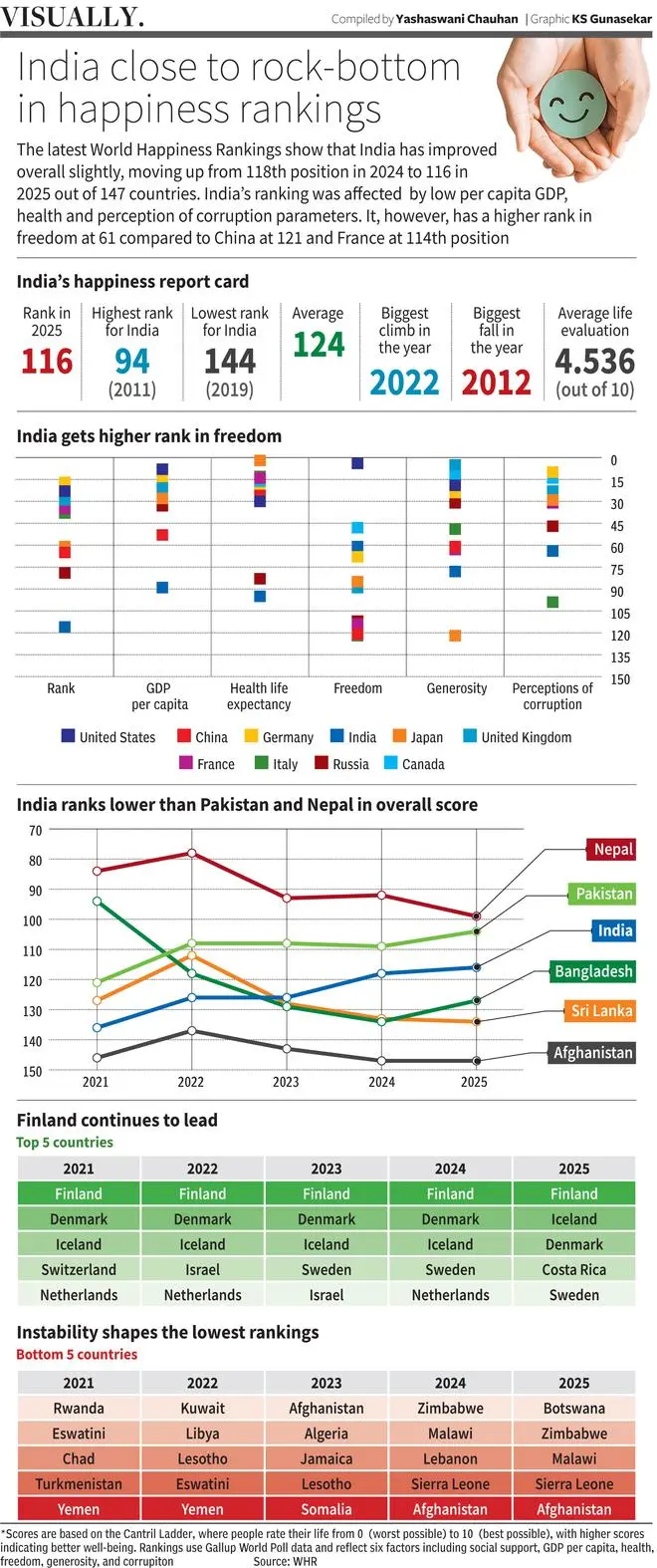
  • India close to rock-bottom in happiness rankings

    India close to rock-bottom in happiness rankings


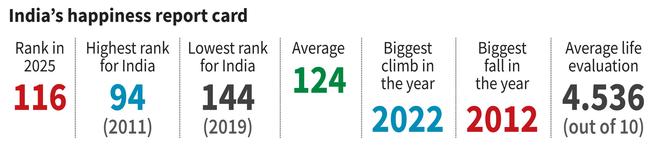
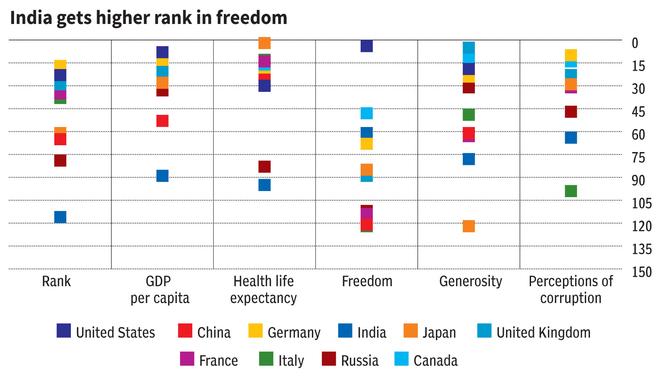
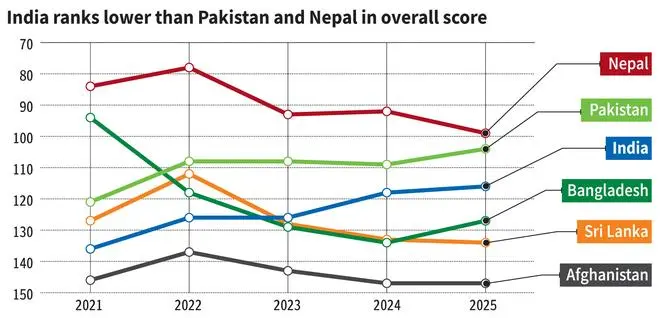
    The latest World Happiness Rankings show that India has improved overall slightly, moving up from 118th position in 2024 to 116 in 2025 out of 147 countries. India’s ranking was affected by low per capita GDP, health and perception of corruption parameters. It, however, has a higher rank in freedom at 61 compared to China at 121 and France at 114th position

    Published on March 25, 2026

    Read More

  • Govt retains inflation target at 4% with 2–6% band for next five years

    Govt retains inflation target at 4% with 2–6% band for next five years


    The central government has retained India’s retail inflation target at 4%, with a tolerance band of 2% to 6%, for the next five years, according to an official notification issued on Wednesday. The revised mandate will remain in force for the period from April 1, 2026 to March 31, 2031, continuing the inflation-targeting framework followed since 2016.

    In the notification issued under Section 45ZA of the Reserve Bank of India Act, 1934, the government, in consultation with the Reserve Bank of India (RBI), confirmed that the inflation target will remain at 4%, with an upper tolerance limit of 6% and a lower limit of 2%. The decision effectively keeps the existing framework unchanged, giving the central bank continuity in monetary policy.

    The Centre has adopted formal inflation targeting in 2016, assigning the RBI the responsibility of maintaining consumer price inflation within the band set by the government. The framework was last reviewed in 2021. The RBI’s Monetary Policy Committee (MPC), which includes three RBI officials and three government-appointed members, is responsible for setting interest rates to keep inflation within the target range.

    Economists said retaining the current band provides policy stability at a time when global uncertainties remain high. Retail inflation has eased in recent months, with consumer price inflation at 2.75% in February, but risks remain due to rising global oil prices and supply disruptions linked to tensions in West Asia. Higher fuel costs could push inflation closer to or above the 4% target in the coming financial year.

    Analysts noted that the existing ±2% tolerance band gives the RBI flexibility to deal with temporary supply shocks without reacting too aggressively on interest rates. The current geopolitical situation, including the West Asia conflict, poses both downside risks to growth and upside risks to inflation, making policy flexibility important.

    There had been calls in recent years to review the inflation-targeting framework, particularly because food prices often cause sharp but temporary spikes in inflation. Some policymakers had suggested focusing more on core inflation, which excludes food and energy, since interest rate changes have limited impact on food prices.

    However, recent changes in the consumer price index, including a lower weight for food items, are expected to reduce volatility. The RBI has also indicated support for continuing the current framework, saying it has helped anchor inflation expectations over the past decade.

    With the target unchanged, the RBI is expected to continue balancing growth and inflation risks as it prepares for its next policy decision.

    (With agency inputs)

    Read More

  • Bulk deals: Mukul Agrawal sells stake in microcap laggard; Societe General buys Rs 76 crore stake in Sammaan Capital

    Bulk deals: Mukul Agrawal sells stake in microcap laggard; Societe General buys Rs 76 crore stake in Sammaan Capital


    Smallcap counter Sammaan Capital – which was in news today after the Reserve Bank of India (RBI) cleared decks for Abu Dhabi-based International Holding Company (IHC) to acquire a controlling stake – witnessed a bulk deal where French multinational bank Societe Generale bought shares worth Rs 76 crore. In another major deal, ace investor Mukul Agrawal sold shares worth Rs 8 crore in a microcap Siyaram Recycling Industries, which had fallen 72%.

    Sammaan Capital

    Societe Generale bought 50.6 lakh shares in Sammaan Capital at a price of Rs 149.92 per share. It was a premium of 8% over the Tuesday closing price of Rs 138.51 on the NSE. Today, its shares settled nearly 6% higher at Rs 146.30.

    The stock has been a market outperformer with 23% returns over a 1-year period and is currently trading above its 50-day and 200-day simple moving averages (SMAs) of Rs 145 and Rs 144, respectively, according to Trendlyne data.

    The acquisition of a 66.65% controlling stake will be made via Avenir Investment RSC, which is owned and controlled by IHC.

    Avenir Investment RSC proposed to invest nearly Rs 8,850 crore by the way of preferential issue. This is one of the largest investments by a Middle Eastern entity in India’s financial services sector.


    After the completion of the preferential issue, Avenir Investment will hold nearly a 41.23% stake in the company, while the rest will be acquired through an open offer, Sammaan Capital, formerly called Indiabulls Housing Finance, said in an exchange filing.

    Siyaram Recycling Industries

    Mukul Agrawal sold 21 lakh shares via a separate bulk deal where the buyer was Param Value Investments. The shares were purchased at a price of Rs 38.20 apiece, a 4.3% premium over the Tuesday closing price of Rs 36.64.Today, its shares settled at Rs 38.28, up by Rs 1.64 or 4.5% over the last closing price.

    Agrawal held 22 lakh shares representing 10.10% stake in the company according the September shareholding data on the BSE.

    The stock price has seen a 72% erosion in the past year.

    (Disclaimer: The recommendations, suggestions, views, and opinions given by the experts are their own. These do not represent the views of The Economic Times.)

    Read More

  • US Supreme Court sides with Cox Communications in landmark music piracy case brought by record labels

    US Supreme Court sides with Cox Communications in landmark music piracy case brought by record labels


    The US Supreme Court has ruled that internet service provider Cox Communications cannot be held responsible for music piracy committed by its subscribers, ending a landmark copyright case in which the major record companies had won a $1 billion jury verdict.

    The unanimous decision was handed down today (March 25).

    Justice Clarence Thomas, writing for the Court, said that Cox “neither induced its users’ infringement nor provided a service tailored to infringement.”

    He added: “Cox provided internet service to its subscribers, but it did not intend for that service to be used to commit copyright infringement. Holding Cox liable merely for failing to terminate internet service to infringing accounts would expand secondary copyright liability beyond our precedents.”

    Commenting on the decision, Mitch Glazier, RIAA Chairman and CEO, said: “We are disappointed in the Court’s decision vacating a jury’s determination that Cox Communications contributed to mass scale copyright infringement, based on overwhelming evidence that the company knowingly facilitated theft.

    “To be effective, copyright law must protect creators and markets from harmful infringement and policymakers should look closely at the impact of this ruling. The Court’s decision is narrow, applying only to ‘contributory infringement’ cases involving defendants like Cox that do not themselves copy, host, distribute, or publish infringing material or control or induce such activity.”

    The ruling, which you can see here, means that simply knowing some subscribers are pirating music, and continuing to provide them with internet access, is not enough to make an ISP liable for copyright infringement.

    Under the standard set by today’s decision, rightsholders must prove either that a provider actively encouraged infringement, or that its service was designed for piracy with no real lawful use. Internet access, the Court said, clearly has many lawful purposes.

     “We are disappointed in the Court’s decision vacating a jury’s determination that Cox Communications contributed to mass scale copyright infringement, based on overwhelming evidence that the company knowingly facilitated theft.”

    Mitch Glazier, RIAA 

    The case dates back to 2018, when Sony Music, Universal Music Group, Warner Music Group and dozens of other rightsholders sued Cox, arguing the company ignored over 163,000 infringement notices about subscribers illegally downloading more than 10,000 copyrighted songs.

    The labels pointed to evidence that a Cox manager overseeing piracy compliance told his team to “F the DMCA.”

    A jury sided with the labels in 2019, awarding $1 billion. The Fourth Circuit Court of Appeals partially overturned that verdict in 2024, throwing out the vicarious liability finding but keeping the contributory infringement ruling and ordering a retrial on damages that could have reached $1.5 billion.

    The Supreme Court took up the case last June, heard oral arguments in December, and has now reversed the remaining contributory liability finding entirely.

    The Thomas opinion laid out two — and only two — paths to contributory copyright liability. The first is inducement, where a provider actively promotes its service as a tool for piracy, as in the landmark 2005 MGM v. Grokster ruling involving file-sharing software. The second is where a service is specifically tailored to infringement and has no real commercial use beyond piracy.

    Cox, the Court found, met neither test. The company had contractually prohibited subscribers from using its service to infringe copyrights, sent warnings, suspended services and terminated accounts.

    The opinion stated: “This Court has repeatedly made clear that mere knowledge that a service will be used to infringe is insufficient to establish the required intent to infringe.”

    Elsewhere in the opinion, Thomas wrote: “Based on this theory of infringement, respondents, Sony Music Entertainment and other major copyright owners, secured a billion-dollar verdict against Cox. The United States Court of Appeals for the Fourth Circuit agreed that because Cox provided Internet service to known infringers, it was a willful infringer itself.

    “Under our precedents, a company is not liable as a copyright infringer for merely providing a service to the general public with knowledge that it will be used by some to infringe copyrights. Accordingly, we reverse.”

    “This Court has repeatedly made clear that mere knowledge that a service will be used to infringe is insufficient to establish the required intent to infringe.”

    Supreme court Ruling filed on March 25, 2026

    It also found that the Fourth Circuit had gone wrong by creating a broader form of liability, holding that “supplying a product with knowledge that the recipient will use it to infringe copyrights” was enough. The Supreme Court said this conflicted with decades of its own case law.

    Justice Sonia Sotomayor, joined by Justice Ketanji Brown Jackson, agreed Cox should not be liable in this case but warned that the majority’s ruling goes too far.

    Sotomayor argued that it strips ISPs of any real reason to deal with piracy on their networks, making the DMCA’s safe harbor rules pointless. Those rules require ISPs to cut off repeat infringers in exchange for legal protection.

    She wrote that the majority’s decision “completely upends” the balance Congress created and “consigns the safe harbor provision to obsolescence,” adding that “ISPs no longer face any realistic probability of secondary liability for copyright infringement, regardless of whether they take steps to address infringement on their networks.”

     Music Business Worldwide

    Read More

  • Williams Trading cuts On Holding stock price target on CEO transition

    Williams Trading cuts On Holding stock price target on CEO transition


    Williams Trading cuts On Holding stock price target on CEO transition
    Williams Trading cuts On Holding stock price target on CEO transition

    Read More