
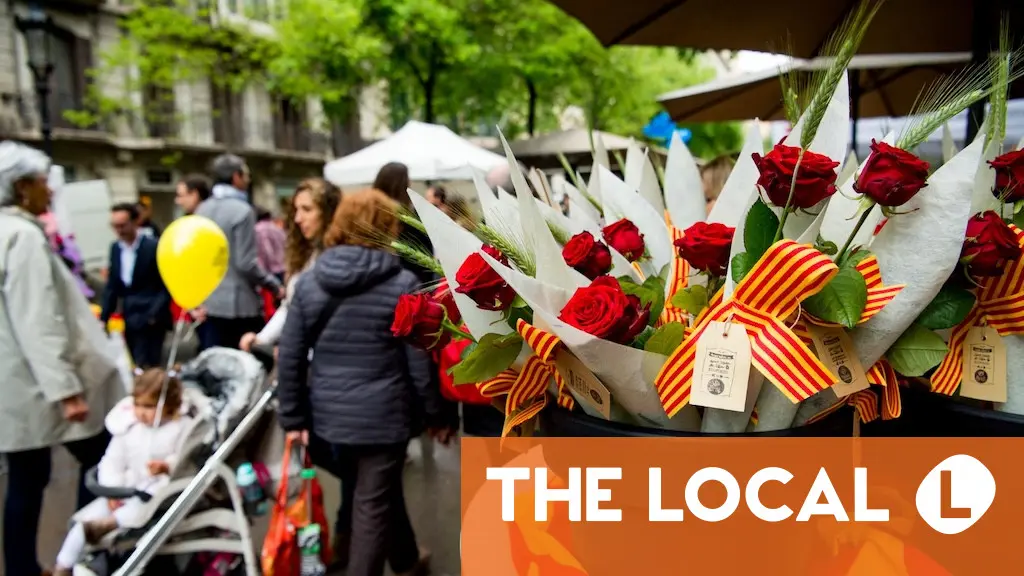
Catalonia prepares for its annual Sant Jordi celebrations tomorrow, April 23rd, when roses and books stalls flood the streets, particularly in the capital of Barcelona.
Every April 23rd, Catalans celebrate the Día de Sant Jordi or St. George’s Day with books, roses and dragons, in honour of their patron saint, love and culture.
Catalonia adopted St. George as its patron saint in the 15th century, yes the same one who is patron saint of England, Georgia, Genoa in Italy, and many other places around the world.
Originally, to mark the occasion, men would give their love a rose, while she would give him a book in return. Today, thankfully this tradition has evolved and women also receive books, while men can also be gifted roses. Flowers are also given to parents, children, friends and even co-workers, not just lovers.
Why roses?
The tradition of the roses stems from the legend of Saint George and the Dragon. The story goes that there was once a kingdom who was terrorised by a dragon. To appease the dragon, the people decided they would sacrifice someone every day. One day the king’s daughter was selected to be sacrificed and was sent to the dragon’s lair.
But, just before the dragon could eat her, a noble knight (Saint George) came to save the day and slayed the dragon with his sword, whisking the princess away on his trusty steed.
It is said that where the dragon’s blood spilled, a beautiful rose bush grew in its place, which would bloom every year in April.
This gave rise to the medieval tradition of gifting roses, which has survived in Catalonia ever since.
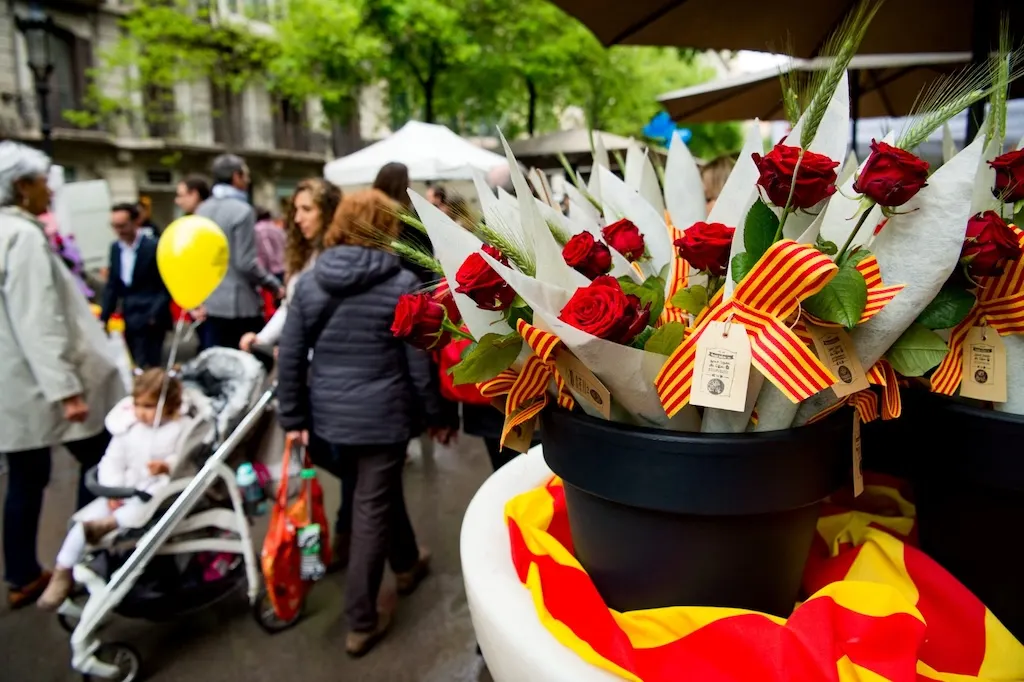
Today, hundreds of rose stalls are set up in cities and towns across Catalonia. They’re typically sold wrapped in yellow and red paper, to represent the Senyera (Catalan flag) and paired with a sheaf of wheat. Sometimes hearts or small dragon figurines are also attached.
READ ALSO: Ten books that tell you everything you need to know about Spain
Advertisement
Why books?
April 23rd also coincides with UNESCO’s World Book Day, as it celebrates the anniversary of the deaths of William Shakespeare and famed Spanish author of Don Quixote, Miguel de Cervantes (although the latter actually died on April 22nd).
Books have become an integral part of Saint Jordi Day in Catalonia and as well as rose, stalls, hundreds of book stalls stand alongside them. These are often set up by bookstores, who bring their wares out onto the streets.
In fact, buying books on this day has become so popular that on average retailers sell around two million books in just one day in the region, which is home to 7.5 million people.
Catalan booksellers make between 5-8 percent of their annual sales on the day of Sant Jordi and one in every three books bought in Catalonia is sold on this day, according to the Catalan booksellers association. The majority of the books sold are in the Catalan language.
There are also special talks with writers, author signings and huge queues outside bookstores for the latest releases.
Since 1931, a book fair has been held in Barcelona on April 23rd. The tradition of offering books and roses in Catalonia even thrived, during the 1939-74 dictatorship of General Francisco Franco when the open sale of books in the Catalan language was banned.
READ ALSO: The 14 best books about the Spanish Civil War
Advertisement
What else happens on Sant Jordi Day?
Saint George’s Day is not a public holiday so schools, businesses and shops remain open. Children celebrate by going to school dressed either as knights, princesses or indeed, dragons, while there’s usually a lot of activity on the streets during breaks, lunchtime and afterwork.
In Barcelona, the city allows free entrance to certain museums and buildings not usually open to the public such as the City Hall, the National Library, Palau Güell, the Recinte Modernista de Sant Pau, the Museum of History of Catalonia and more. Be aware, some places require advanced registration to get your free spot, while there will be long queues for others.
The Sagrada Familia also allows free entrance to anyone named Jordi, Jordina, Jorge or Jorgina. Other forms of the name in other languages also work, like George and Georgina. You must register in advance on the official website, however, and can’t just simply turn up.
While entrance to Gaudí’s Casa Batlló is not free on April 23rd, it’s worth a visit to see its spectacular display of roses, which cover its entire facade.
Bakeries also celebrate this day by baking special pa de Sant Jordi (red and yellow striped bread) and colourful tarts decorated with roses. Musicians sometimes perform in the streets and generally it’s a day of fun and culture.
