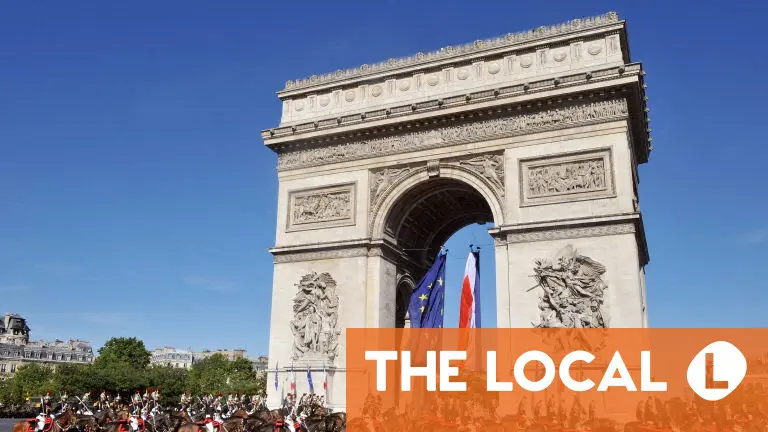
It’s the original and – we dare to say – will always remain the best, so here’s a few things you might not know about the Arc de Triomphe in Paris.
We hear that across the Atlantic there are plans for an American ‘triumphal arch’, inspired by the Paris monument.
So let’s take a look at the 50m high (and 45m wide) arch that has inspired so many people since its construction in the 19th century.
Birthday gift – The Arc de Triomphe was commissioned by Napoleon in 1806 to mark his victory at the 1805 Battle of Austerlitz. Construction began on his birthday (August 15th) the same year, as a kind of gift to himself.
Project delays – It took 30 years to build. That’s not because the French builders were especially slow – construction was halted when Napoleon abdicated in 1814. Work on the half-finished arch resumed on the orders of King Louis XVIII in 1823, following a successful French invasion of Spain. Work was completed in 1836, during the reign of King Louis-Philippe, who opened it officially on July 29th that year.
That’s the problem with commissioning huge monuments to your own ego – you may not be around to see them finished.
Temporary measure – But designer Jean-François Chalgrin, who died in 1811, still got to see how it would look in situ, as a full-size replica of the completed design, created from wood and painted canvas, was erected at the site in 1810 for the arrival in Paris of Austrian archduchess Marie-Louise, the future wife of Napoleon.
Based on what he saw, and being a designer, Chalgrin took the chance to make a few changes
Roman roots – His design is far from original. It is Neoclassical, and inspired in part by the Arch of Titus in the Roman Forum.
No topping – In contrast to the Brandenburg Gate in Berlin – which is topped with a huge sculpture of a goddess driving a chariot pulled by four horses – the top of the Arc de Triomphe is quite plain.
In fact a quadriga (sculpture to go on top) was created between 1882 and 1886 by Alexandre Falguière. Entitled Triomphe de la Révolution, the sculpture was of a chariot drawn by four horses advancing ‘to crush Anarchy and Despotism’.
However, it failed the public opinion test and was removed a few years later. It’s perhaps unsurprising that Parisians hated it, they have famously hated landmarks including the Eiffel Tower, Sacre Coeur and the Louvre pyramid.
Remembrance – The Arc acquired a solemn new focal point in the 1920s. The Tomb of the Unknown Soldier underneath the arch was added in 1921, and the flame of remembrance in 1923.
The Tomb of the Unknown Soldier forms the focal point of Armistice Day ceremonies in Paris and the flame is rekindled every day at 6.30pm.
Military history – the arch was commissioned to mark a battle and remains an important military symbol.
It has been the focal point of multiple historic victory parades in Paris — by Germany in 1871 and 1940, and by the Allies to mark the end of World War I, the liberation of Paris in 1944, and the end of World War II in 1945.
On August 7th 1919, three weeks after the Paris victory parade marking the end of hostilities in World War I, Charles Godefroy flew a Nieuport biplane under the arch’s primary vault, which is just over 29m high.
The story goes that he didn’t get official clearance for his incredibly dangerous stunt. Happily it all worked out fine, since a fatal crash and a badly damaged national monument might have taken the edge off victory celebrations.
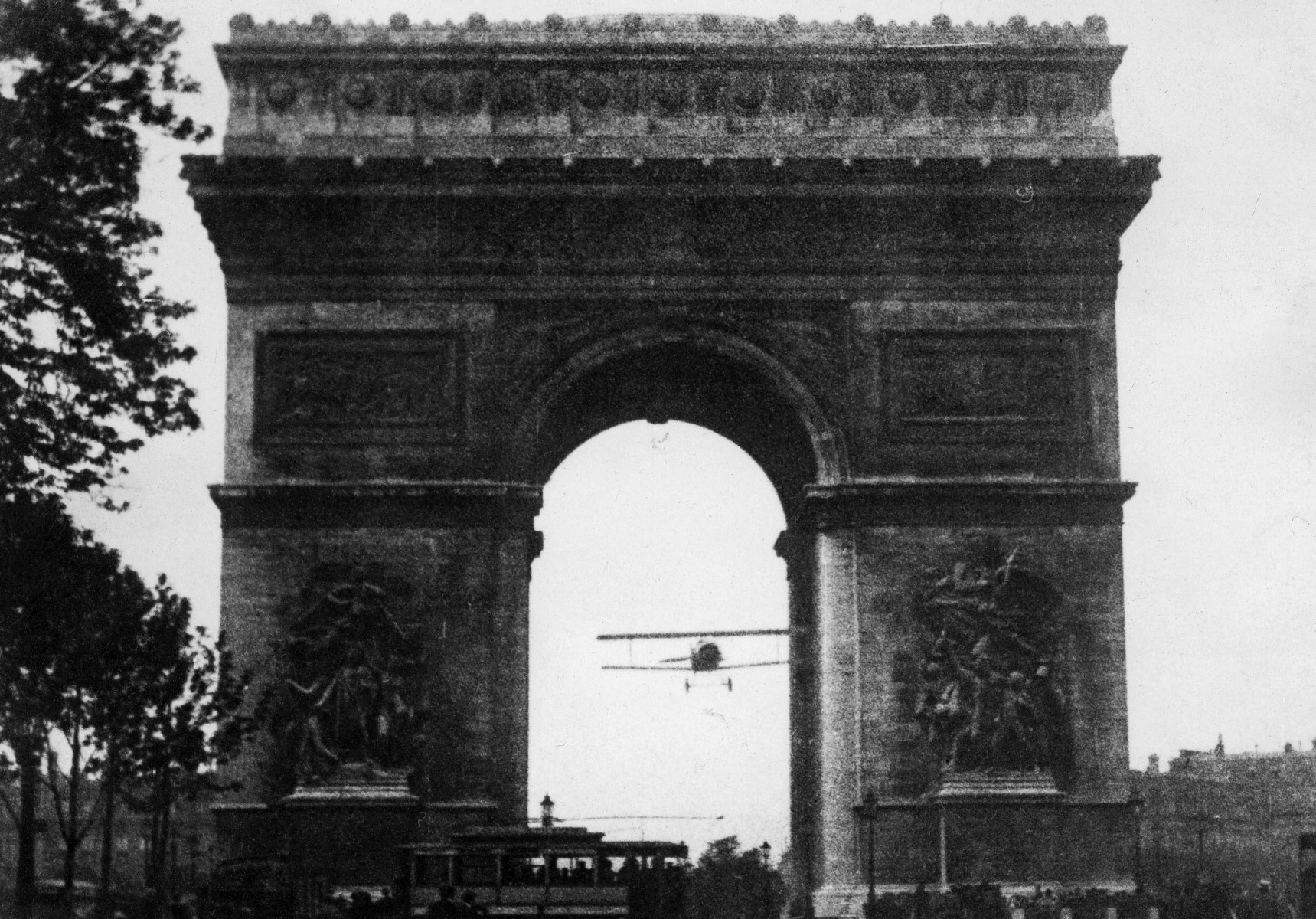
This photograph taken on August 7, 1919 and released by the Musee de l’Air et de l’Espace shows French aviator Charles Godefroy flying through the Arc de Triomphe in Paris with his Nieuport 27 aeroplane. Photo by Jacques MORTANE / Musée de l’Air et de l’Espace – Le Bourget / Agence Prieur-Branger / AFP
Mirror arch – the Arc de Triomphe is not the only large arch in Paris – there is also the widely-hated Grande Arche at La Défense, which is a much loftier 110m tall.
The modernist structure was commissioned in 1985 to serve as a focal point for the Paris business district – it’s designed to line up with the Arc de Triomphe so that you can gaze down the straight road in between them and see both at the same time.
Visit – Although the Arc de Triomphe is used for some ceremonies and official events, most people will probably experience it as a tourist attraction.
Visitors can climb the 284 steps to the top of the monument, to enjoy aerial views of the city’s traffic. A lift goes partway to the top, but access to the observation deck means going up the stairs.
Star power – The Arc sits at the top of the Champs-Élysées in the circular Place Charles de Gaulle (formerly known as Place de l’Étoile), from which 12 Parisian grand avenues radiate in a star-like pattern.
It is sometimes known as the Arc de Triomphe de l’Étoile, while the nearest Metro station is Charles de Gaulle-Etoile.
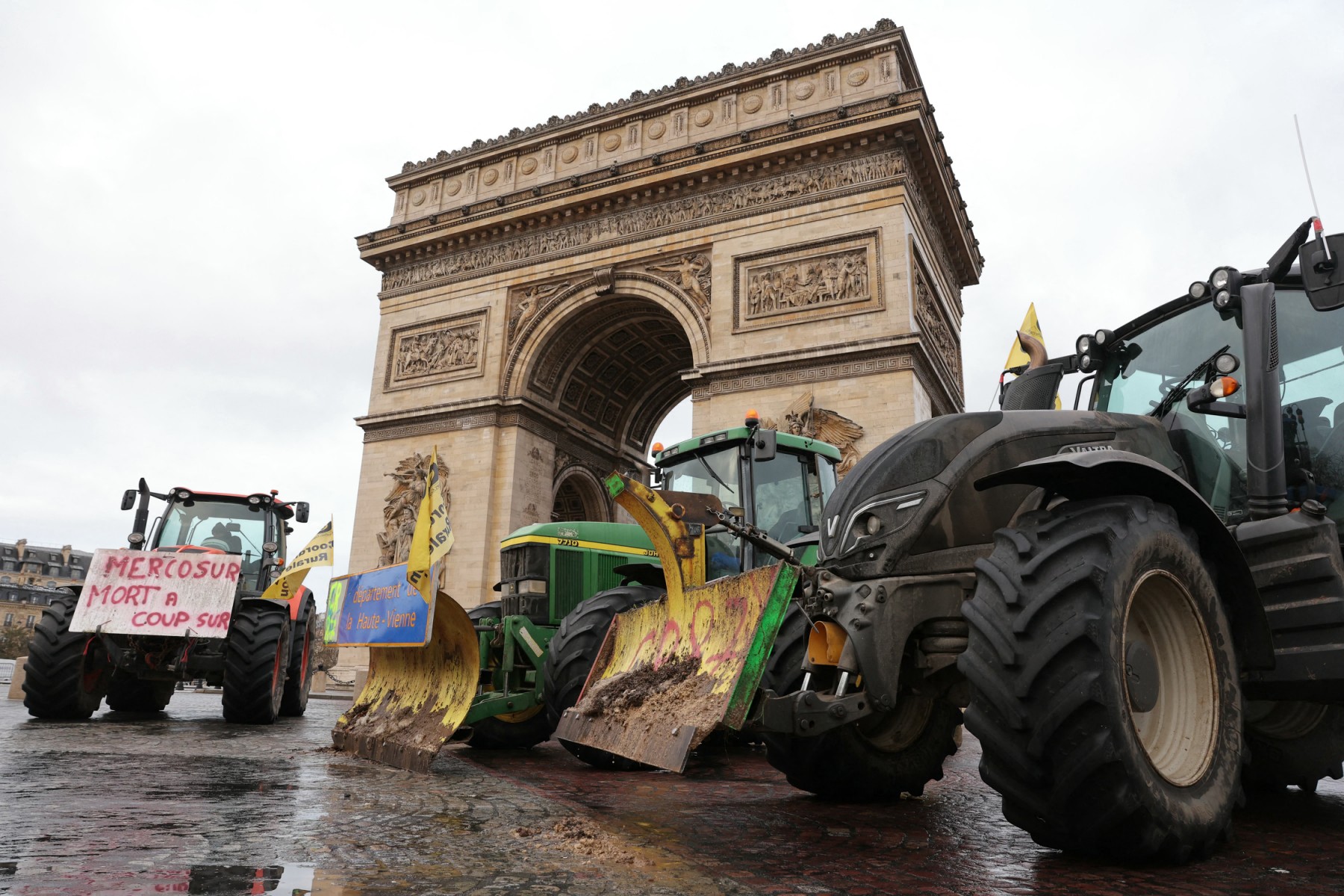
Tractors are seen parked in front of the Arc de Triomphe during farmer protests in January 2026. Photo by Thomas SAMSON / AFP
Protests and parties – away from the official ceremonies, these days the Arc’s main function is as a backdrop for protests and parties.
Numerous protesters – from the ‘yellow vests’ to farmers – have ended their actions in front of the Arc to get that all-important news photo. Some of these demos are authorised, others are not.
The Arc’s other function is as a focal point for parties and again, some of these are official while others are not. New Year’s Eve in Paris involves crowds of people cramming onto the Champs-Elysées so they can watch the fireworks while the city often celebrates big events by projecting messages onto the Arc itself, for example the start of the Paris Olympics.
The Champs-Elysées and Arc de Triomphe is also the unofficial location for football celebrations and if French teams (or teams that are supported by a lot of people living in France such as Algeria or Morocco) win a big tournament, fans pour onto the avenue to party.