
You’ve done everything right; sent in the application to renew your French residency permit in good time, supplied all the required documents, waited patiently for the préfecture to deal with your request. And then your card expires while you’re still waiting – what should you do?
Non-EU citizens living in France will need the French residency permit known as the carte de séjour, and these need to be regularly renewed.
It is your responsibility to keep track of the expiry date and apply for the permit to be renewed within the stated time (usually between two and four months before the expiry date, depending on the type of card).
But waiting times at préfectures can be long, so what happens if your card expires while you’re still waiting for the new one?
Don’t panic
It’s easy to assume the worst, but in fact, this is a very common scenario. In a recent survey of readers of The Local, 90 percent of respondents said that this had happened to them at least once.
Waiting times at préfectures can be very long – the national average is 117 days (just under four months), but this hides wide regional variations. One third of préfectures have average waiting times of more than 120 days, according to official figures.
Despite this, you can only apply for a renewal once your card approaches its expiry date (the exact times vary depending on the type of card – the Article 50 TUE ‘Brexit’ cards specify two months before the expiry date, others are either three or four months). Applications made before the specified time can be rejected.
It’s important to note that you do not become irrégulier (undocumented, also commonly referred to as sans papiers) when your card expires – provided you have applied for a renewal before its expiry date.
Documentation
Because this is such a common situation, there is a procedure; the récépissé. This is basically a receipt, which shows that you have applied in time and you are awaiting a response from the préfecture.
This is a legal document that proves your right to continued legal residency in France – depending on your status, it also extends your right to work in France and should be accepted by all official bodies, including employers.
Sadly people unfamiliar with the immigration system don’t always realise that these documents have legal status, but anyone in an official position; police, préfecture staff, border control, etc., should recognise it.
READ ALSO: Récépissé: Your questions answered on France’s temporary residency permit✎
How to get a récépissé
The actual process of getting one varies slightly – if you are using the online ANEF platform for your renewal, you should be automatically issued with one once you make your application. It’s normally in the form of a download which you can print out and show to anyone who needs it.
The recent memo from Interior Minister Laurent Nunez instructs that the ANEF site should automatically issue a 12-month one to anyone applying for a renewal. The documents have slight variations in the name, the one issued by ANEF is usually called an attestation de prolongation d’instruction.
The ANEF site can only be used for the renewal of certain types of card (and cannot be used for the post-Brexit cards known as the Article 50 TUE/WARP cards), but all renewals are gradually moving online.
For those who cannot use ANEF and make their application directly to the préfecture, the process varies. Some préfectures automatically issue a récépissé, in others, you have to request one.
Most préfectures allow this to be done online – head to your préfecture’s website and look for Prolongation droit au séjour or similar. The duration of the récépissé also varies according to the préfecture – between three months and six months is common. If your récépissé expires and you are still waiting (again – not uncommon), you can get a renewal.
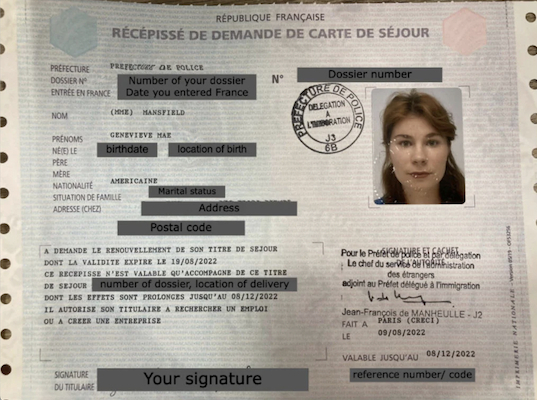
Likewise, the actual document itself varies – some préfectures send a link for you to download the récépissé and print it out, others issue a paper document. Regardless of the format, it remains a legal document.
Below is an example of a paper version, issued by the Paris police préfecture – the exact format varies according to the préfecture but they mostly follow a similar format, not the description in the bottom left that includes the authorisation to work.
What about travel?
The récépissé can be used for travel if you are renewing a carte de séjour (if you are applying for your first carte de séjour and you come from a country that is not covered by the 90-day rule, you may need to check if you can travel).
When travelling, you should take; your expired carte de séjour; your récépissé; your valid passport.
This scenario is common enough that you shouldn’t encounter problems if you are arriving in France via a crossing point that is regularly used by non-EU travellers (e.g., large French airports or the Eurostar or ferry terminals from the UK).
If you are arriving at a smaller airport – or you are landing in an EU country other than France – you may need to be prepared to explain the situation. But remember; your récépissé is a legal document issued by the French state.