
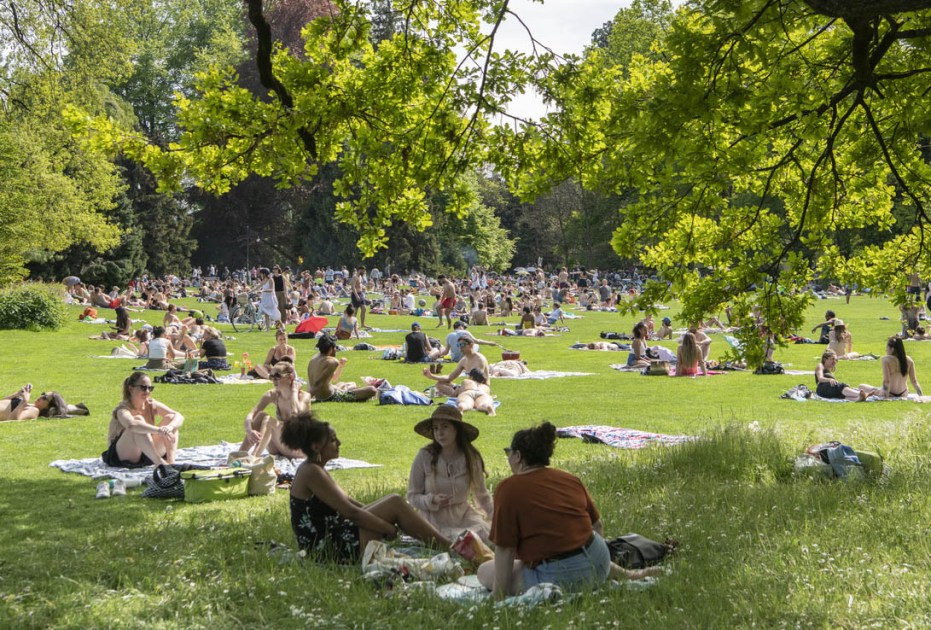

Overcrowded? Summer lakeside in Zurich.
Keystone / Ennio Leanza
On June 14, Swiss voters will head to the polls to decide on the “No to ten million” initiative, which seeks to cap immigration. What impact would such a restriction have on the country?
How did this initiative come about?
The right-wing Swiss People’s Party launched the “No to ten million” immigration initiative, arguing that immigration had increased in an uncontrolled manner since 2007 and that the population could soon exceed the ten-million mark (it is currently 9.1 million). Now, it says, it is time for Switzerland to pull the emergency brake.
After previous immigration initiatives in 2014 and 2020, this is the third time Switzerland’s largest party has put forward a proposal with a similar aim. Voters narrowly backed the mass immigration initiative in 2014, but the People’s Party argues that it has not been properly implemented.
What’s the goal of the initiative?
With the “No to ten million” immigration initiative, the People’s Party aims to force the government to ensure that the permanent resident population does not exceed ten million before 2050. If the population reaches 9.5 million before then, the government and parliament would already be required to step in.
In the asylum sector, this would mean that provisionally admitted people would no longer be granted permanent residence permits. Family reunification would also be restricted.
As for regular immigration, Switzerland would in a second stage have to renegotiate international agreements that contribute to population growth. If that proved insufficient, it would ultimately have to terminate its free movement of people agreement with the European Union.
What are the supporters’ arguments?
The People’s Party believes that immigration is putting a strain on Switzerland, referring to it as “pressure from population density”. It points to overcrowded trains, congested roads, a tight housing market, rising crime, high social security costs and other negative trends which it attributes to immigration.

Commuter traffic at Stadelhofen station in Zurich.
Keystone / Ennio Leanza
Hence it is calling for “sustainable population development”, which is why it also refers to the proposal as the “sustainability initiative”. “We have lost control. Many people increasingly feel like strangers in their own country,” says co-initiator and People’s Party parliamentarian Thomas Matter.
The party’s key argument is the so-called immigration spiral. It claims that population growth driven by immigration requires even more immigration to meet the people’s needs. This vicious cycle must be broken, it says.
The initiative distinguishes between asylum and regular migration. It emphasises that “too many and the wrong people” were immigrating to Switzerland. Based on this, it proposes initial measures in the asylum sector which would still allow up to 40,000 skilled workers or other individuals to enter the country each year.
What are the opponents’ arguments?
Opponents warn that the proposal could jeopardise Switzerland’s prosperity. They have dubbed it the “termination initiative”, saying it would ultimately lead to the termination of Switzerland’s agreements with the EU. It is also labelled the “chaos initiative” for the uncertainty it would create.
The government and parliament reject the initiative, arguing that it would undermine the bilateral approach with the EU and that Switzerland was dependent on immigration. This, they say, is not only because of a shortage of skilled workers in the economy, but also because of demographic developments in the resident population. They stress that the social security system, based on a pay-as-you-go model, depends on continued contribution from the working population.
They also claim that, so far, Switzerland has absorbed immigration well and that there was no “pressure from population density”. Integration and growth, they say, are part of Switzerland’s success model.
The left is particularly critical of regulating the asylum sector, which accounts for only a small part of immigration. Meanwhile, centre-right parties warn that chaos could descend on the asylum system especially if, in a worst-case scenario, the Schengen and Dublin agreements governing this sector were to be terminated.
Supporters of the initiative:
– Swiss People’s Party
Opponents of the initiative
– Social Democratic Party, the Green Party, the Centre Party, the Radical-Liberal Party, the Federal Democratic Union, the Protestant Party
– Government and parliament
– Trade unions, trade associations
What does the initiative mean for the Swiss Abroad?
How the initiative would affect the Swiss Abroad remains unclear as the federal and cantonal authorities still need to work out the measures. The proposal defines the permanent resident population in a way that excludes the 830,000 Swiss Abroad.
The Council of the Swiss Abroad warns that, if accepted, the initiative could jeopardise the free movement of people and therefore recommends rejecting it. It argues that the approximately 475,000 Swiss Abroad living in the EU/EFTA area have a strong interest in preserving free movement.
We asked Justice Minister Beat Jans about the consequences for the Swiss Abroad. Here is his answer:
What are the economic implications?
“The Swiss economy has always relied on foreign workers,” the Swiss People’s Party writes at the outset of its proposal. While it argues that immigration is largely to blame for the shortage of skilled workers, opponents point to the existing shortage of skilled labour.
Opponents argue that many sectors depend on foreign labour, including healthcare, construction, hospitality, agriculture and tourism. “Switzerland is growing and growing and growing,” says People’s Party’s president Marcel Dettling. Yet the benefits of this growth do not reach the population and that immigration does not address the shortage of skilled labour, he says.
The Swiss business federation economiesuisse warns of uncertainty, bureaucracy and a worsening shortage of labour, if the initiative is accepted.
What are the implications for the relationship between Bern and Brussels?
If accepted, the initiative would put the free movement of people at risk in the long term and create new uncertainties in the relationship between Bern and Brussels as a population cap contradicts the fundamental principle of free movement.
In the worst case, Switzerland would have to renegotiate the free movement of people, or at least secure a safeguard clause. However, the safeguard clause negotiated in the new agreements with the EU would not be compatible with the initiative’s objectives. If Switzerland were to terminate the free movement of people agreement because of the initiative, the existing bilateral agreements with the EU would also be null and void.
Edited by Samuel Jaberg. Adapted from German by Billi Bierling/ts
