Forget the left bank and the right bank, Paris’ real divide – economically, socially and politically – is between the east and the west of the city. Here’s why.
You might have heard talk of the rive gauche and rive droite, but maps tracking property prices, average income, social deprivation and political leanings in Paris all show the same thing.
You can listen to the team at Talking France discussing Paris’ east-west divide in the latest episode of Talking France – download here or listen below
Politics
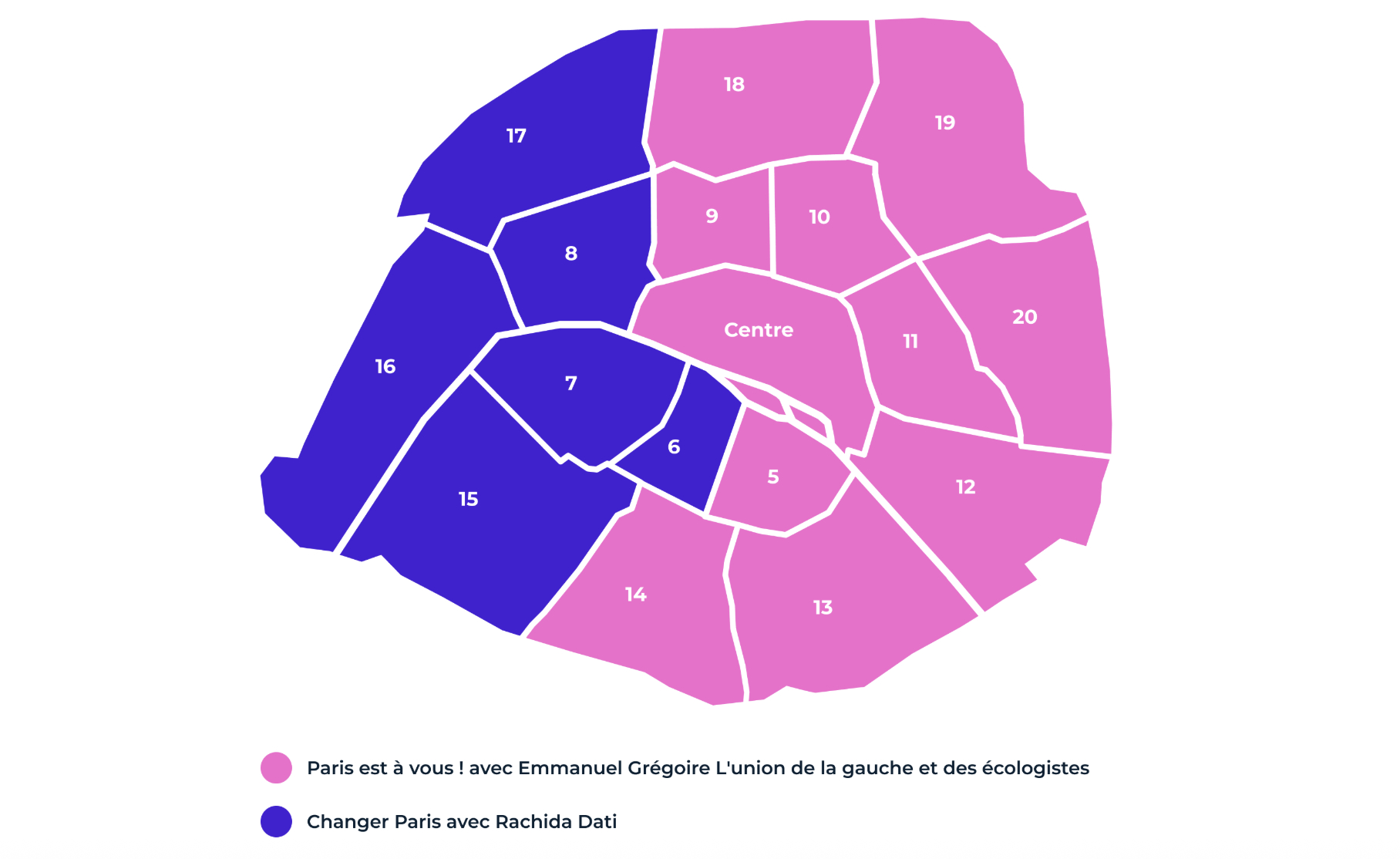
During France’s latest local elections 35,000 communes – including Paris – went to the polls to choose a new mayor. In Paris, the second round was dominated by the centre-left candidate Emmanuel Grégoire and the centre-right’s Rachida Dati, with Grégoire eventually winning a comfortable victory.
The blow map shows the vote share per arrondissement, with Grégoire in pink, and reveals the clear east-west divide in left-wing voters versus right-wing voters.
 (Photo: Ville de Paris)
And it doesn’t stop there – in the first round of the same election the far-right candidate Sarah Knafo drew her votes almost exclusively from the west of the city
Le vote Knafo, le vote du vrai peuple qui souffre
— Vincent Tiberj (@vtiberj.bsky.social) March 19, 2026 at 11:24 AM
And this is far from a recent phenomenon, both presidential and parliamentary elections stretching back decades revealing the same overall trend of a stronger leftist vote in the east, and a more right-wing west.
Financial divide
The political divide in Paris strongly tracks the financial divide, in which the west of the city is generally wealthier.
Among the historical reasons for this is a surprising one – the wind.
In Paris, the wind blows mainly from west to east. As a result, the western neighbourhoods were less exposed to domestic and industrial smoke, smog and pollution – which was plentiful, from factories to tanneries, and smoky chimneys. From 1915 to 1974, the French automobile company Citroën’s factories were located on the banks of the Seine, known today as the Quai André Citroën.
Over in the poorer east, inhabitants had no choice but to ensure the smoke and pollution.
The factories and the smoke may be largely gone, but the wealth disparity remains.
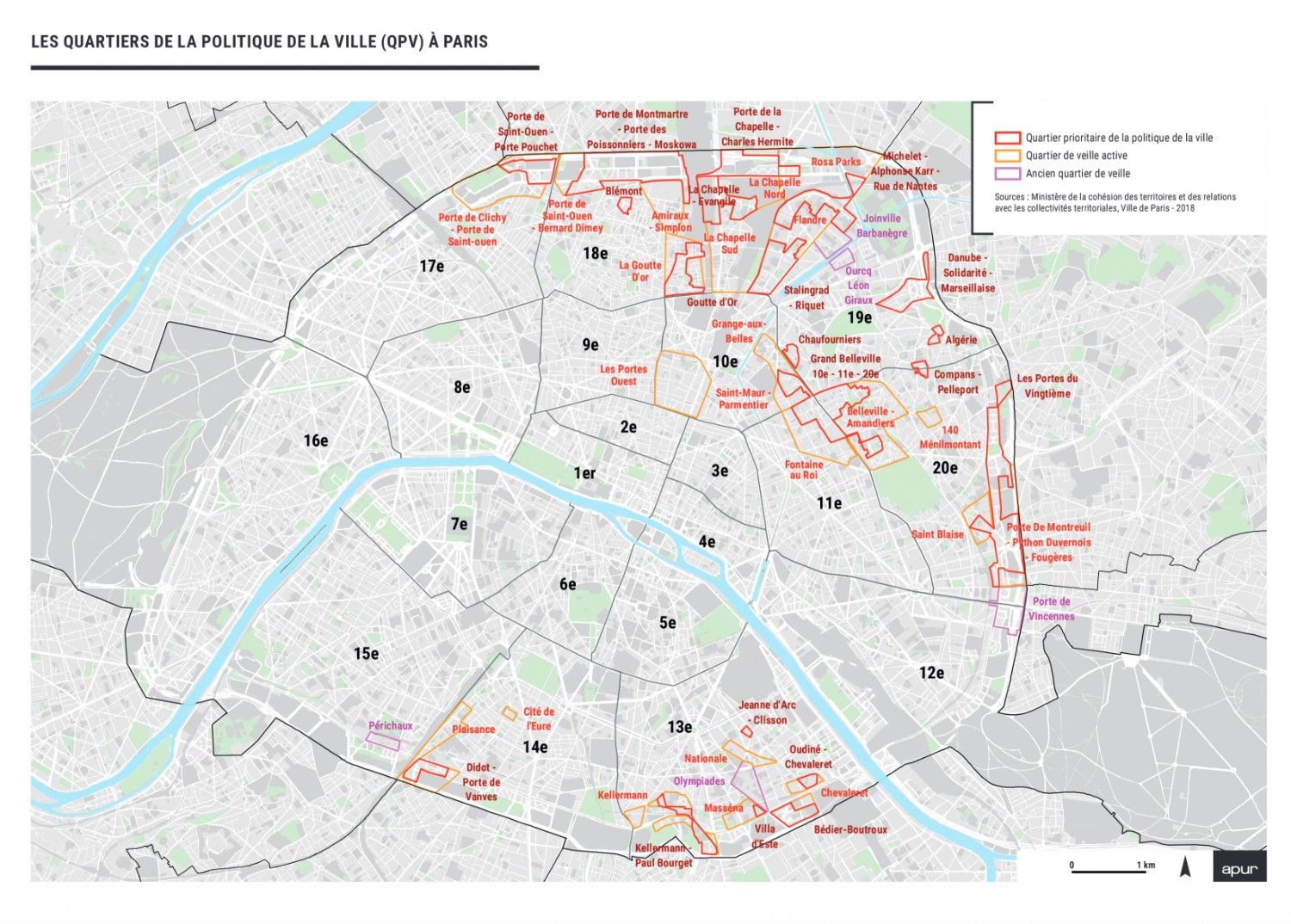
Apur, the Parisian urban planning agency created the map below, which shows the places in Paris that struggle the most financially.
The red lines show the quartier prioritaire de la politique de la ville (QPV) – priority urban areas – which are given the designation based on income disparity between the neighbourhood’s population and that of the metropolitan area in which the neighbourhood is located. In short, they are the poorest areas of a city, and as the map shows are heavily clustered in the east side of Paris.
 (Photo: Apur)
In yellow, we can see quartier de veille active (QVA) – socially disadvantaged neighbourhoods, but where the challenges are considered less severe than in the QPV, while in purple, you can see the former QVA’s.
Average income
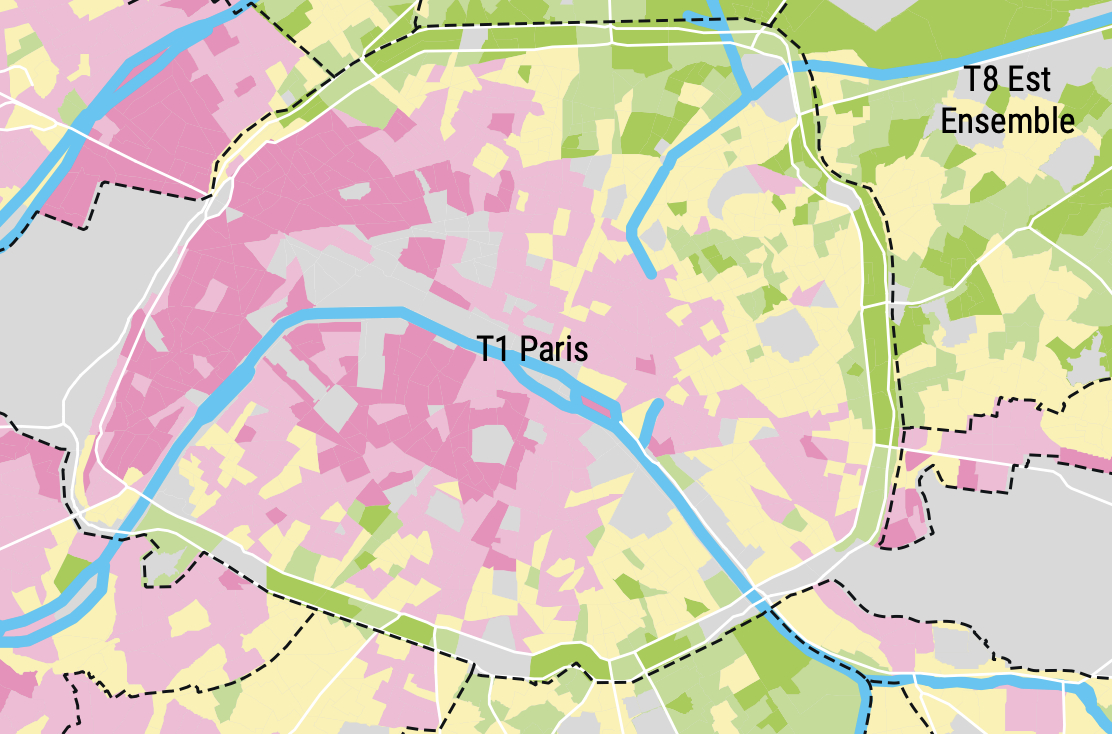
Closely linked to areas of deprivation is income. The below map shows the average household income in each neighbourhood (before taxes and benefits) – with pink the highest incomes and green the lowest.
House prices
As you would expect, the wealthier half of the city has more expensive housing.
Although gentrification is pushing up prices sharply across the whole city, leading to a steady population flight as families and young people are priced out of the market, west Paris remains the most expensive.
The historically wealthier west also has a larger share of large apartments, luxury buildings and houses than the traditionally poorer east – and the divide is consistent across both rental and purchase prices.
The below map shows property price changes, but it also lists the average price for square metre for each arondissement.
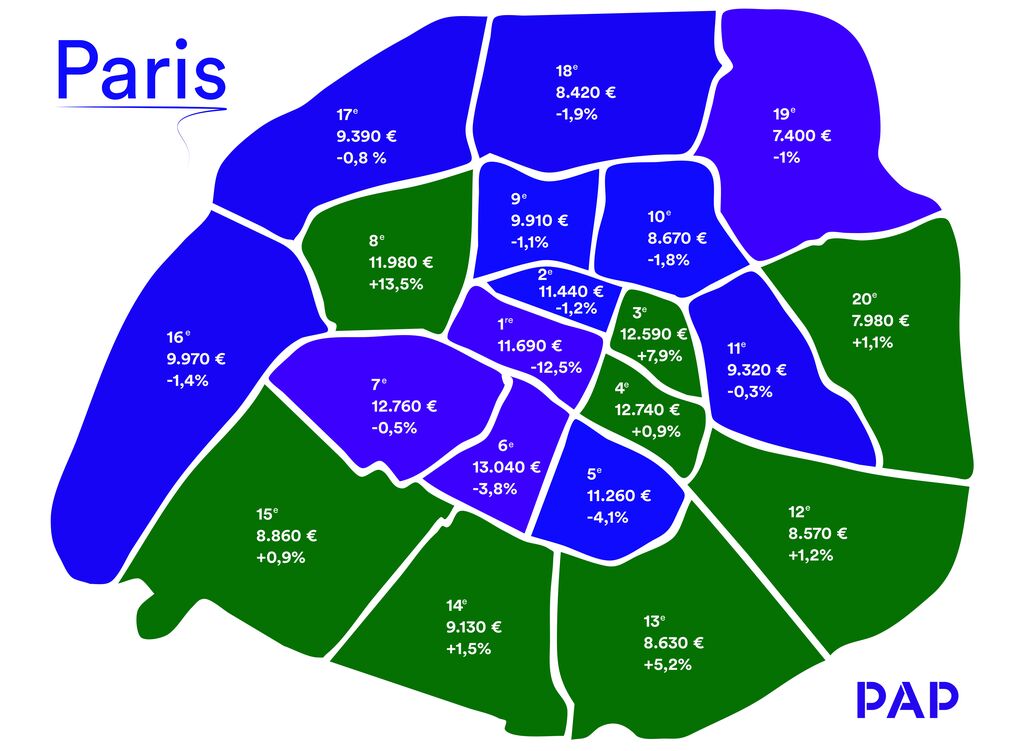 A 2025 map of prices per square metre in Paris based on arrondissements. (Photo: PAP)
The ‘cheaper’ arrondissements is of course a relative term – the average price per square metre in Paris is €9,827 – against a national average of €3,100 – but as you can see on the map, that depends on the location.
But the real estate market never sleeps and Paris is seeing some significant changes – according to an article in French media Les Echos, after a strong rise in prices between 2015 and 2020, the housing market then declined, with average property values dropping around 15 percent since 2020 due to higher interest rates and reduced purchasing power.
While all arrondissements have been affected, the turnout has been uneven. Some previously trendy neighbourhoods saw sharp corrections, whereas central areas and certain high-end locations held up better.
The below video tracks the changes in recent years.
🏡 CARTE. Avez-vous fait une bonne ou une mauvaise affaire en achetant à Paris ? ➡️ https://t.co/0jI9feKnzf
💸 Après une flambée qui a vu son apogée en 2021, la capitale a subi une sévère correction… mais tous les quartiers ne sont pas logés à la même enseigne. pic.twitter.com/qZdZRxYpF1
— Les Echos (@LesEchos) February 22, 2025
Gentrification
The gradual gentrification of Paris means that even the traditionally cheaper areas are no longer available for many.
In Paris, this has been especially visible in eastern and northern arrondissements such as the 10th, 11th, 18th, 19th, and 20th, where former industrial or modest areas became trendy over the past two decades.
During the boom between 2015 and 2020, gentrifying neighbourhoods experienced some of the fastest price increases, driven by demand for more affordable alternatives to central Paris – as the below map shows.
Une #carte de la #gentrification de #Paris au cours des 30 dernières années. #Intéressant. Non? ^^ #mixite #sociale pic.twitter.com/R4WSTbo1qk
— Sébastien Poulet-Goffard (@SebPoGo) January 10, 2016
Gentrification is not a new process, but the gradual rise in prices in the east of the city does not seem to have affected the political landscape, so the east still leans leftwards.
This may be due to the characterisation of gentrification, or ‘boboisation‘ – where new arrivals in traditionally poorer areas tend to be younger, more diverse and working in creative or media-based industries.