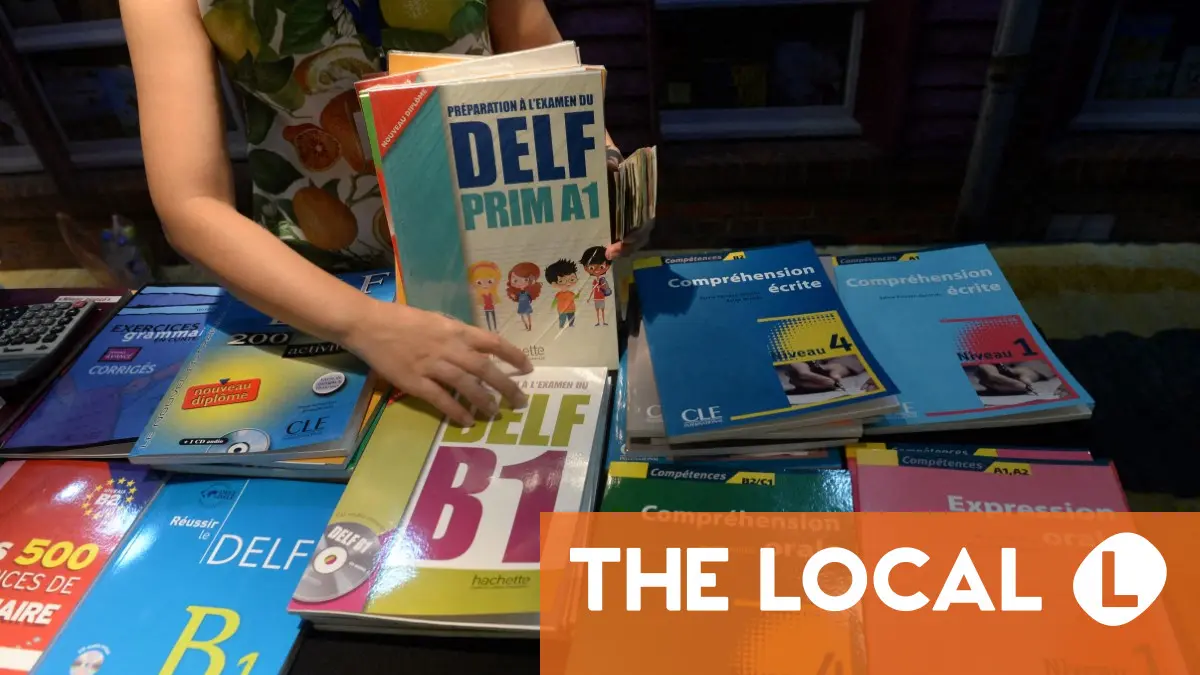

The Local France’s Emma Pearson insists she get no pleasure from other people’s misfortune, but here she confesses to a secret enjoyment at watching her bilingual colleague Emma Albright struggle with the more technical aspects of French grammar.
I like to think that I’m not the type of person who enjoys the pain of others (apart from people who watch videos on trains without headphones) and I should stress that this is nothing personal against Emma, an excellent journalist and a delightful colleague who brings croissants to the office.
No, it’s because the fact that even she – raised by a French mother and an American father and fully bilingual – is sometimes uncertain about the complexities of French grammar.
Starting a recent article on the use of the French verbs se souviens and se rappeler (different ways of saying remember) she began by breezily saying “Sure, I’ll get that done this afternoon”. Three hours later, she burst out “this is the hardest thing I’ve ever had to write”.
As someone who has been wrestling with the byzantine complexity of French grammar for the last six years, I find this enormously heartening.
It’s not just me! Everyone finds this hard, even people born to it.
Spending enough time in the company of the French subjunctive, reflexive, COD et al is enough to make anyone feel like a halfwit, a simpleton who cannot grasp the most basic concept, a hapless stumbling fool who should not be allowed out unaccompanied.
OK this isn’t quite what a series of French teachers have said to me, but the subtext was clearly there.
The knowledge that even native speakers of French struggle with grammar, and that there are very common mistakes for native French speakers, gives me hope to continue.
The thing is, I know that this is true in English too – plenty of native anglophones litter their language with spelling and grammar errors.
I wouldn’t dream of judging someone on their grammar because you never know what someone’s level of education is, whether they have dyslexia or other issues. And I would certainly never judge someone for errors made when they’re speaking English as a second language.
So why do I assume that all French people are judging me?
Is it that common habit of ‘helpful’ corrections (which I genuinely think are mostly intended to be helpful, even if it doesn’t always come over that way)? Is it the, er, shall we say ‘robust’ teaching style that many French teachers employ? Or do I just need to have a word with myself and shut up?
Either way, I find it immensely comforting to know that everyone struggles with this and I am, perhaps, not the intellectual equivalent of a flatworm.
Emma’s series of French Grammar Tips are very helpful in explaining complicated aspects of French grammar in a simple way – but you maybe you too will find helpful the knowledge that she did a little bit of tearing her hair out while writing them.
Emma Albright’s response:
I was convinced I’d left painful grammar lessons behind in primary school – or at least that, as a native French speaker, I’d find it easy to explain the ins and outs of the language. That hasn’t quite been the case…
I spent the first years of my education in a French school, where classes were exactly as you might imagine: the board completely covered with the day’s grammar lesson, and the teacher, pointer in hand, guiding us as we recited everything until it was ingrained in our brains.
Both of my parents were teachers and deeply involved in my education. I later attended the American School of Paris for most of my primary and secondary schooling. Although we had French classes that followed a curriculum similar to that of French schools, all my other subjects were taught in English. My mother’s biggest concern was that my French writing might fall behind.
So, on top of school, we worked on French at home, especially on weekends. I still remember the notebooks she made – a red one for grammar and a green one for verb conjugations (can you tell I’m still traumatised?). I have to admit though, I admire her dedication.
We would sit together, learning and relearning the rules and tricky spellings of the French language, followed by exercises to make sure I had properly absorbed each lesson.
She also had me do dictées where she would read passages aloud while I wrote them down, always including the grammar points or conjugations we had been working on. This wasn’t limited to weekends, during school holidays, and even summer mornings, I had to keep practising.
Even today, I sometimes forget a complex rule or mis-conjugate a verb – and as you can see, it’s certainly not for lack of effort. French is simply a very complex language, where words are rarely spelt the way they sound.
At the time, I often resented those study sessions – especially when my friends were outside playing while I was indoors struggling with the subjunctive. But my mother would always say, “You’ll thank me one day.” And she was right. If I’m able to explain these grammar rules today, it’s largely thanks to her.