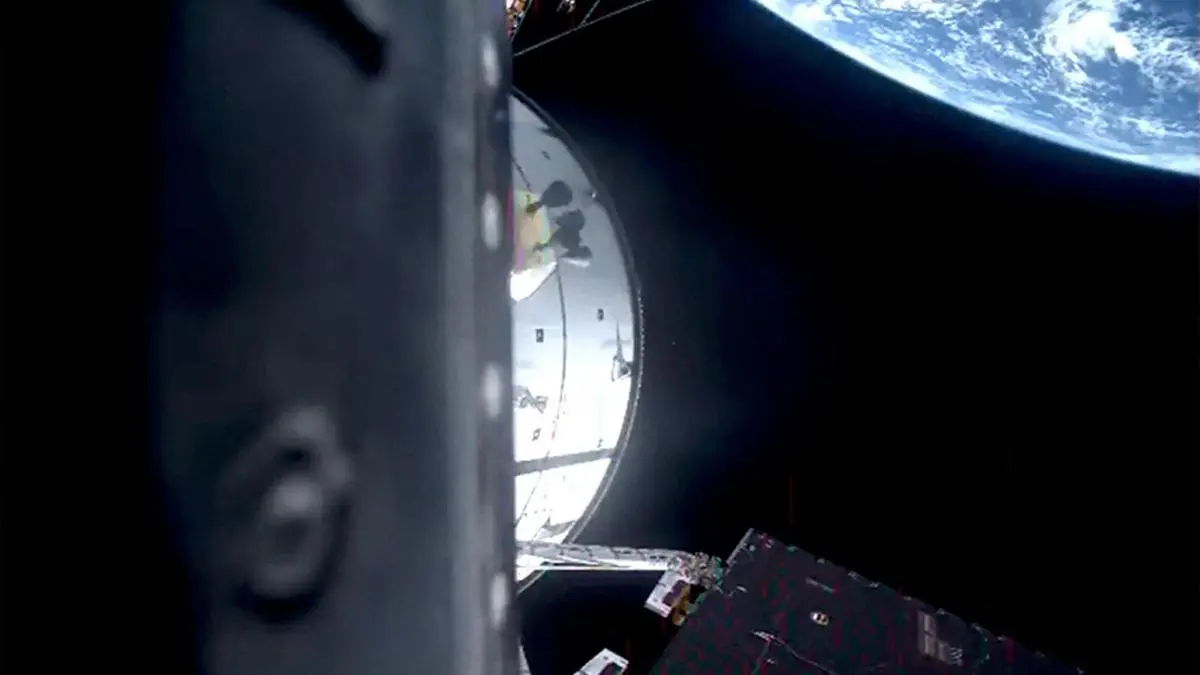
The Artemis II mission’s Orion capsule leaves Earth on its way to fly by the moon, after launching from the Kennedy Space Centre in Cape Canaveral, Florida, U.S., April 1, 2026 in a still image from video.
| Photo Credit:
NASA TV
NASA’s Artemis II mission is shaping
up to be more than just the next step in returning humans to the
moon — it is a key test of whether the agency’s traditional
contractor-built systems can remain viable in a rapidly shifting
space industry.
The mission, set to launch on Wednesday evening from the Kennedy
Space Center in Florida, will send astronauts around the moon
for the first time in over 50 years. It will be the first crewed
flight of Boeing and Northrop Grumman’s Space
Launch System (SLS) rocket and Lockheed Martin’s Orion
capsule.
While both systems have undergone years of development and
uncrewed testing, with the rocket’s more than $24 billion
development beginning in 2010, Artemis II marks the moment when
their reliability will be judged under the highest possible
stakes: human flight.
The outcome of Artemis II could reshape the political
narrative around Orion as well as SLS, the world’s most powerful
active rocket, which has faced persistent criticism over delays,
ballooning costs and a relatively slow launch rate.
“The stakes are extremely high whenever there are astronauts
on board,” said Michael Leshock, equity research analyst at
KeyBanc Capital Markets, adding that Artemis II represents “a
critical validation moment” as NASA evaluates proven commercial
options.
COMMERCIAL RIVALS CHALLENGE SLS DOMINANCE
A new wave of private rockets inspired by SpaceX’s reusable
Falcon 9 has challenged NASA’s thinking with the expendable SLS,
a reincarnation of decades-old, Shuttle-era tech as the industry
has focused on reusability in more recent years.
Commercial players like Elon Musk’s SpaceX and Jeff Bezos’ Blue
Origin are already waiting in the wings. NASA chief Jared
Isaacman announced last week that the agency intends to open the
SLS mission – launching Artemis astronauts and cargo off Earth –
to competitive bids from other companies for missions after
Artemis V.
That was one of many changes Isaacman has made to the Artemis
program in recent weeks. He also cancelled plans to upgrade SLS
with a more powerful upper stage meant for later Artemis
missions, instead tapping United Launch Alliance – the joint
rocket venture of Boeing and Lockheed – to use its less powerful
Centaur upper stage.
“If they (NASA) do include SpaceX or Blue Origin, it would
give the U.S. more flexibility in who they partner with in the
future, as SpaceX and Blue Origin are already part of Artemis;
it’s just how much larger a part they can play,” said Andrew
Chanin, CEO of ProcureAM, the issuer of the Procure Space
exchange-traded fund.
HIGH COSTS THREATEN SLS FUTURE
Analysts say the SLS program is costly and is unlikely to be
a viable long-term option for NASA to return to the moon on a
regular, cost-effective cadence.
That makes the high-profile Artemis II mission a critical
validation point for the contractors behind the program, as
newer, lower-cost rockets try to prove their own reliability.
Each SLS launch is estimated to cost between $2 billion and $4
billion. By contrast, SpaceX’s Starship and Blue Origin’s New
Glenn are far cheaper, though pricing could fluctuate by tens of
millions of dollars depending on the mission complexity. NASA
paid $18 million for an initial New Glenn flight in 2025,
according to contracting data. Space station company Voyager
paid $90 million for its planned Starship launch, according to a
recent earnings report.
NASA tried to impose SLS cost-reduction strategies in 2023, to
little avail. Boeing and Northrop set up a joint venture at the
time through which NASA would hand its ownership of the rocket
to the companies, encouraging them to sell the rocket
commercially.
NASA has already begun incorporating commercial systems into
its Artemis architecture, awarding SpaceX and Blue Origin
central roles for each to develop lunar landers. Future missions
could expand that reliance, raising questions about how long SLS
will remain a cornerstone of the program.
LEGACY PLAYERS HAVE POLITICAL BACKING
Still, not everyone is ready to write off the legacy
systems, with some analysts pointing to political staying power
and a track record that commercial rivals have yet to match.
“SLS still has a lot of congressional support, which makes
it difficult to kill the program,” said Austin Moeller, director
of equity research at Canaccord Genuity.
Starship has test-launched 11 times since 2023, but has not
yet deployed payloads into orbit. SLS and Orion achieved a
successful uncrewed test flight in 2022 around the moon and
back.
Supporters of SpaceX and the commercial-focused contracting
culture it prefers have argued for SLS cancellation for years,
with some attempts to do so failing.
The Trump administration’s budget proposal last year sought
to end SLS after Artemis III, but Senate Appropriations
Committee Chairman Ted Cruz, whose home state of Texas includes
Boeing employees and SLS suppliers, swiftly countered with a
bill that cemented the rocket’s role in the program through
Artemis V.
“It could not have been a faster repudiation,” said Casey
Dreier, chief of space policy at the Planetary Society, a space
policy nonprofit co-founded by famed astronomer Carl Sagan.
While privately owned rockets have shown lower costs and
greater innovation, he said, “the need to stick with SLS is
political.”
Published on April 2, 2026