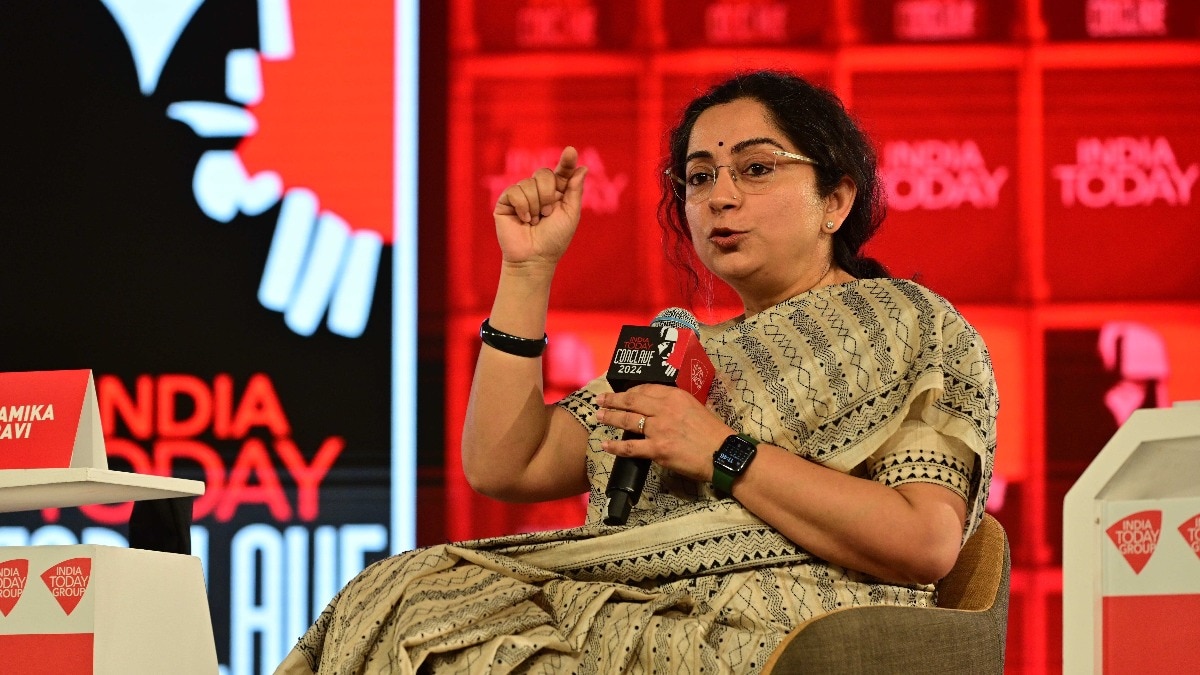
Economist Dr Shamika Ravi on Sunday defended welfare schemes often dismissed as “freebies”, arguing that targeted government programmes have helped eradicate women’s poverty over the past 12 years, reduced extreme deprivation, and supported long-term economic growth.
Ravi, a member of the Prime Minister’s Economic Advisory Council, said not all freebies are the same, contending that while some may be wasteful, others are “hugely beneficial” and play a critical role in improving living standards.
“Why ‘freebies’? Because India has eradicated women’s poverty through targeted programs in the last 12 years. Because economic growth in democracies is not sustainable at very high levels of poverty (~30% in 2011/12). Because not all ‘freebies’ are alike. Some are distortionary, wasteful & some are hugely beneficial,” she wrote on X.
Don’t Miss: ‘Gold is a dead asset’: PM-EAC member Shamika Ravi explains Modi’s appeal
This comes just days after Ravi, during a podcast with ANI’s Smita Prakash, had said she was surprised by the amount of attention the freebies debate receives.
“I’m a bit surprised at the amount of commentary we are having on freebies because (with freebies) what you’re eventually doing is you are targeting the bottom 40%, and you are ensuring or assuring a certain basic quality of life,” she said when asked why the government was still giving free rations.
Ravi argued that concerns over welfare spending pale in comparison to a much bigger economic challenge – channeling surplus funds in the banking system and corporate sector into productive investments.
“It pales in comparison to, let’s say, the other bigger concern we ought to have right now, which is that the banks are flushed with funds. Most of our corporations are flushed with funds. How do we drive that into investments?” she said.
She pointed out that priority sector lending alone involves far larger sums of money than the combined welfare spending of states and the Centre. “There is a lot of money which is in the system which is much much larger than the freebie bill of states and Center put together,” she said.
According to Ravi, the criticism of welfare programmes is driven more by politics than economics.
“It makes for a political conversation, which I think in India people are particularly interested in. But when it comes from the economic point of view, I think it’s not leading to inefficiencies of the kind people are talking about,” she said.
Instead, she argued that programmes providing electricity, housing and water could boost productivity and contribute to long-term economic growth. “In fact, if anything, having access to electricity and housing and water and so on is hopefully feeding into the productivity and long-term sort of economic growth of the country,” Ravi said.
Ravi also rejected the argument that free food grain distribution undermines claims that poverty has declined in India. She noted that countries use different welfare models and said food support programmes should not automatically be viewed as evidence of economic weakness.
“Countries give welfare in different ways. America gives food stamps. Though it’s not really the epitome of a welfare state, so we don’t want to be emulating the US,” she said, adding that welfare systems in Scandinavian countries also include extensive benefits and allowances.
Ravi said India’s food grain programme has helped address a long-standing distribution challenge. “So in India, we do have a lot of food grains. Until 10 years back, you saw everyday reports of food grains rotting. Today you just give it away to people,” she said.
She added that data suggest households are using savings from lower food expenses for other forms of consumption rather than becoming dependent on welfare.
“Our analysis of the consumption expenditure is also showing that the savings that households get from food grain expenses coming down are getting diverted into other kinds of consumption. So people are not sitting idle eating rice and wheat because the government is giving them rice and wheat.”