

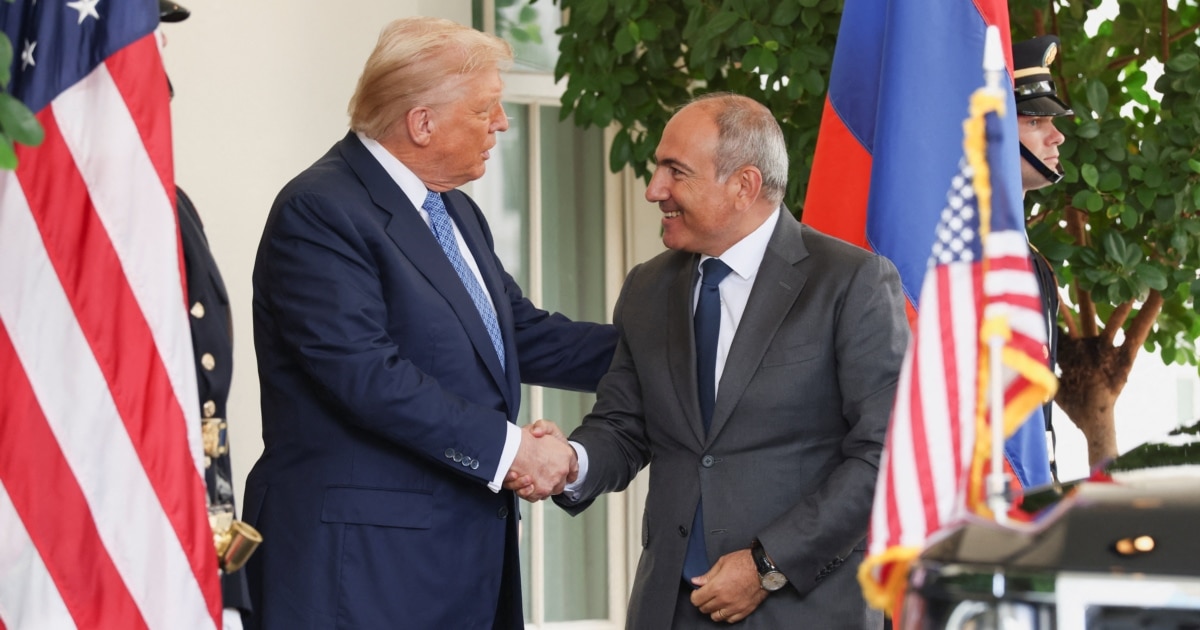
WASHINGTON — The United States has reaffirmed its support for Armenia’s sovereignty and democratic institutions amid growing concerns over what Western officials describe as an intensifying Russian campaign to weaken Prime Minister Nikol Pashinian ahead of the country’s upcoming elections.
Responding to questions from RFE/RL regarding reports of foreign interference and warnings from US lawmakers, a State Department spokesperson stressed that Armenia’s political future should be determined by its citizens alone, starting with the vote this weekend that is widely viewed as a referendum on Armenia’s geopolitical trajectory.
Pashinian’s Civil Contract party has a comfortable lead in opinion polls and is expected to win the June 7 election.
“We are aware of media reports of foreign interference in Armenia’s political processes,” the spokesperson said on June 3. “The people of Armenia have the right to determine their own leadership and chart their own future.”
The comments come at a moment of rapidly expanding ties between Washington and Yerevan, highlighted by the formal signing this week of the Framework Agreement on Strategic Cooperation Concerning the Trump Route for International Peace and Prosperity (TRIPP).
Armenian Foreign Minister Ararat Mirzoyan announced on June 4 that he had signed the Armenia-US framework agreement on the Trump Route for International Peace and Prosperity (TRIPP), completing the bilateral signing process after Secretary of State Marco Rubio signed the document after it was initialed during a visit to Yerevan last week.
The State Department told RFE/RL it sees the initiative as “a crucial and enduring part of bringing peace and prosperity to Armenia and the South Caucasus.”
Concern Over Russian Interference
Since coming to power in the 2018 Velvet Revolution, Pashinian has steadily moved Armenia away from exclusive reliance on Moscow.
His government subsequently froze participation in the Russian-led Collective Security Treaty Organization, deepened cooperation with Western partners, and reached a US-brokered peace agreement with Azerbaijan.
For Moscow, Western officials increasingly believe those developments threaten to diminish Russia’s traditional influence in a region it has long considered part of its sphere of influence.
Last week President Vladimir Putin made a thinly veiled threat about Yerevan’s westward aspirations, saying Armenia could face a “Ukrainian scenario” due to its European integration aims.
The Trump administration’s concern about Russian activities in Armenia was underscored this week by Rubio during testimony before the Senate Foreign Relations Committee.
“I think this is pretty well understood in the open-source reporting: The Russians are less than happy about our engagement there,” Rubio told lawmakers on June 3. “I think there’s evidence that they would like the current prime minister to lose his election as a result of this growing relationship with the US.”
Rubio emphasized that Washington’s objective is not to pull Armenia away from other partners but to support its ability to pursue an independent foreign policy.
“To be clear, we’re not there to infringe on Armenian sovereignty. We’re not asking them not to be friends with other countries. We just want to be able to have a relationship with them,” he said.
The secretary portrayed TRIPP as a transformative project capable of reshaping Armenia’s role in regional commerce. “It really has an opportunity to revolutionize Armenia’s strategic location and become a central hub for trade in the region,” Rubio said. “It has the ability to transform the Armenian economy in a very powerful way.”
Rubio also argued that the initiative has revitalized relations between Washington and Yerevan after years of limited engagement.
“For a long period of time, our relations with Armenia were quite stagnant and, in many cases, I would argue almost nonexistent,” he said. “It has also reinvigorated that relationship between our two countries and allows us to explore opportunities in all sorts of other fields.”
The secretary said implementation will now be critical, expressing hope that US companies will participate in infrastructure, transportation, and development projects associated with the corridor.
Russian Pressure Campaign
Rubio’s remarks came amid reports that Western intelligence and government officials have detected an intensifying Russian effort to prevent Pashinian from securing another term in office.
According to a Reuters investigation published in late May, Moscow fears a Pashinian victory could cement Armenia’s gradual realignment toward the United States and Europe, further eroding Russian influence in the South Caucasus.
Reuters, citing five Western intelligence officials and documents it reviewed, reported that Russian efforts have included disinformation campaigns promoting pro-Kremlin candidates, covert influence operations targeting Armenian voters, and discussions about transporting large numbers of Russia-based Armenians to Armenia to vote for Pashinian’s opponents.
Reuters reported that Kremlin-linked influence operations have employed disinformation networks and fake media initiatives aimed at undermining support for the Armenian government and promoting narratives favoring closer alignment with Russia.
In recent months, Russia has publicly warned Armenia that it could lose access to discounted natural gas while also restricting imports of Armenian products, including fruit, vegetables, flowers, and brandy.
Several Western officials said Moscow’s preferred candidate is billionaire businessman Samvel Karapetian, an Armenian-Russian entrepreneur who is currently on trial in Armenia on charges related to alleged calls for overthrowing the government. Karapetyan denies the allegations.
The investigation also cited serious and ongoing concerns among some Western officials regarding Pashinian’s personal security.
Western Drift
Analysts interviewed by RFE/RL said there is little doubt that Russia views Armenia’s deepening Western ties as a strategic challenge.
Michael Hikari Cecire, a defense and security researcher at RAND, said there is extensive evidence of Russian information operations targeting Armenian politics.
“There is extensive documented evidence in the open source domain that Russian disinformation actors and outlets are extremely active on the Armenian elections, and the risk is legitimate,” he said.
However, Cecire cautioned that influence operations often have limited impact unless they reinforce existing public attitudes.
“In Armenia, recent and regular polling indicates continued trust in the current government’s conflict settlement efforts and continued skepticism towards Russia itself,” he said. “That indicates a population that is less receptive towards Russian-aligned information operations.”
As a result, he argued, Russian campaigns may affect political dynamics at the margins but are unlikely to fundamentally alter the election outcome.
Cecire said Moscow’s broader objective appears to be preventing Armenia’s continued integration with Western institutions.
“Russia is certainly seeking to keep Armenia within its so-called privileged sphere of influence, particularly to torpedo Armenia’s European alignments,” he said.
He said the most compelling US response would be to finalize the Armenia-Azerbaijan peace settlement and implement the TRIPP framework as quickly and comprehensively as possible, while working with European partners to expand investment and financing mechanisms that could help Armenia’s transition toward deeper integration with Europe.
Andrew D’Anieri, associate director of the Atlantic Council’s Eurasia Center, offered a similar assessment.
“I don’t have a good way of assessing the effectiveness of Russia’s interference tactics at the moment,” D’Anieri told RFE/RL. “But it is absolutely true that Moscow wants Pashinian to lose and is attempting all kinds of coercion against Armenia — economic, information, diplomatic, you name it.”