

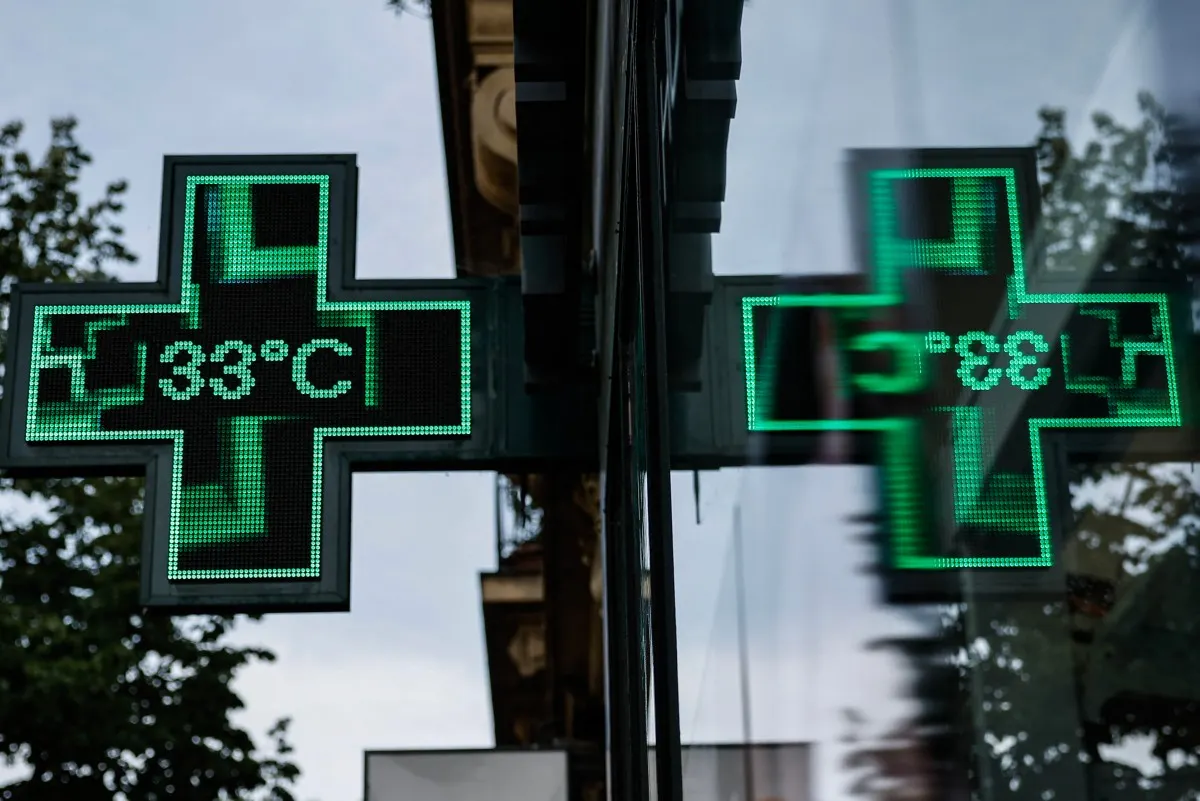
France broke temperature records and reached 37C before the month of May was out – so does this mean we’re in for a scorching summer?
May 2026 was a record-breaker in France, and several of its neighbours, as an unusually early and intense heatwave hit Europe.
Temperatures in the final week of May hit 37C in the south and 33C in Paris – temperatures that wouldn’t be abnormal in the height of summer but have never before been recorded in May.
In total 406 French towns and cities recorded their highest ever May temperatures, while the French weather agency Météo France imposed heatwave alerts for the first time ever in May.
The temperatures have now dropped back down to seasonal norms – but does this herald a scorching summer?
Heatwaves
When looking at summer scorchers the highest temperatures are always recorded during periods of heatwave – defined by Météo France as three or more days when temperatures are significantly above seasonal averages for the region.
Météo France has also consistently warned that the effects of climate change mean that summer heatwaves are becoming more frequent, more intense and are starting earlier in the year.
READ ALSO: In numbers: Yes, summers in France are getting hotter✎
The agency states: “Unusually hot spells have occurred in the past, such as in May 1947, 1953, 1992, 2005, 2017, and 2022, but temperatures had never reached the levels seen in May 2026.”
But having one heatwave in May doesn’t necessarily mean that the summer will see more heatwaves than usual, or that they will be more intense than usual.
Here’s Météo France again: “It is not possible to predict the weather on a week-by-week basis for the next three months.
“However, in connection with climate change, we have observed an increase in record-breaking high temperatures in recent years. In recent years, in line with the global trend of climate change, summers have more frequently been warmer than seasonal norms, but heatwaves and heat spells vary in intensity, timing, and location from one summer to the next.
“Periods of cooler weather are never ruled out either, as was the case in the middle of summer 2023.
“With climate change, we expect to see such heatwaves with increasing frequency. They will occur earlier and earlier and become more and more intense. They require greater caution and knowledge of the right steps to take to protect yourself.”
READ ALSO: Eat well and close shutters: The French government advice for surviving a heatwave✎
Heatwaves generally cannot be forecast with any accuracy more than a fortnight ahead.
Long-range forecasts
Forecasters can, however, predict more general trends – Météo France’s June-August 2026 long-range forecast predicts that the most likely scenario is a summer warmer than average.
They say: “The scenario of warmer-than-normal temperatures is the most likely for France, with higher probabilities in eastern France and Corsica.
“However, there may be occasional periods of cooler-than-normal temperatures during the three-month period.”
They again stress that specific weather conditions, including heatwaves, cannot be predicted more than a week or so in advance.
It is also likely that rainfall will be lighter than normal, making drought conditions extremely likely – indeed some parts of France have already been placed under water restrictions.
Average temperatures
So what are these ‘average temperatures’ for France in the summer?
Naturally, it depends where you are – the south of the country, especially the south east along the Mediterranean coast, is usually the hottest while people hoping to escape the heat traditionally flee to Brittany or the higher points of the Alps.
Most of the south of France will see temperatures of 30C or higher in the summer, rising to 35C on the hottest days. At the peak of a heatwave, the temperatures can rise to near 40C, and the highest temperature ever recorded in France (in 2019) was in the southern département of Hérault – 48C.
The north is generally cooler, although it’s not unusual to reach 30C in Paris in the summer, up to 35C on the hottest days of a heatwave. Paris’ all-time temperature record (also in 2019) was 42.6C.
At higher altitudes, or in Brittany, summer temperatures usually trend towards 25C-29C.
But what do they know anyway?
Perhaps sensitive to the eye-rolling that often accompanies weather forecasts, Météo France dedicates a significant part of its long-range forecast to caveats about what can and cannot be predicted.
“Every month, Météo-France issues a bulletin outlining major climate trends for the coming three months. These are not weather forecasts intended to provide information on what the weather will be like in France on a specific day, but rather to identify probabilistic trends on a European scale.
“These are probabilistic forecasts of average climate conditions for the next three months, particularly in terms of temperatures and precipitation. For large regions of the globe (at least 1,000 km by 1,000 km), they indicate the most likely scenario among the following three: near, below, or above normal. This results in “warm,” “normal,” or “cold” scenarios for temperature and “wet,” “normal,” or “dry” scenarios for precipitation.
“This bulletin does not provide detailed day-by-day or even week-by-week forecasts for the coming months. It merely attempts to determine the expected average trends for the period.
“While temperature trends can be assessed broadly over the season, specific events lasting from a few days to a few weeks can only be anticipated a few days in advance using conventional weather forecasting.”
With that in mind, the previous five summers in France have all had at least one heatwave, so the chance of at least a few days of uncomfortably high temperatures seems quite high.
