


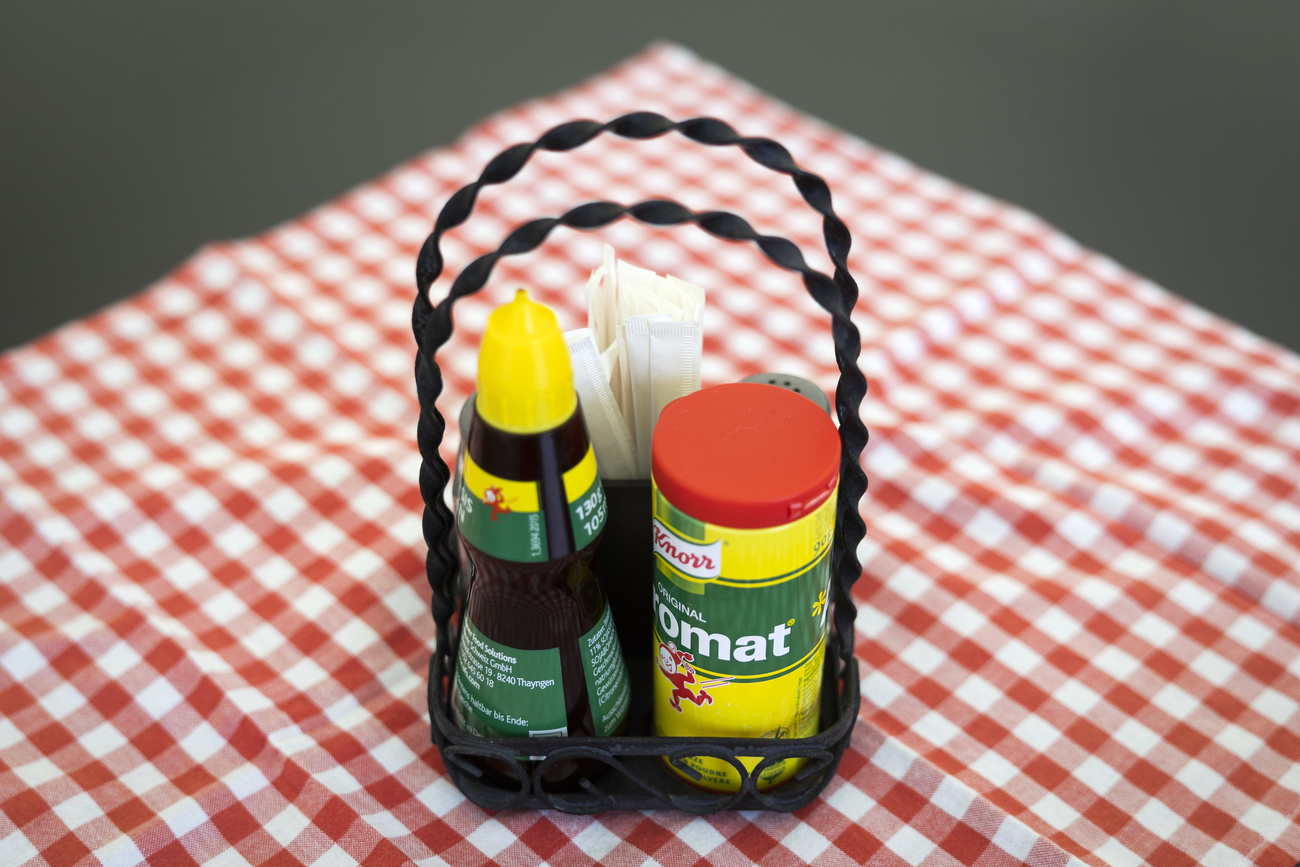
The chef at a restaurant in Langa seasons her dishes with Aromat.
Michael Heger
Aromat’s future is hanging by a thread in Switzerland. At the southern tip of the African continent, however, the spice has added a zing to all kinds of dishes for more than 70 years.
The air is filled with the smell of barbecued meat and roasted corn on the cob. Charcoal smoke is mixing with the dust whirled up by the minibus taxis along Washington Street. It’s lunchtime in Langa, Cape Town’s oldest township.
At Jordan Ways of Cooking, the thin walls tremble to the sounds of Amapiano music, and in the kitchen, a yellow plastic bucket filled with a kilogramme of Aromat sits among pans, knives and ladles.
Ntlalo Jordan, the 35-year-old head chef and owner of the restaurant, says he does not really need the spice. He worked in five-star hotels in Dubai, Liberia and Sudan before fulfilling his lifelong dream of opening his own place. Fresh herbs are his thing, and he makes his own marinades. “But the guests ask for Aromat, and that’s why we serve it.”
More
More
Aromat: on (almost) every Swiss table for 70 years
A hundred metres farther on, a corrugated-iron shack turned snack bar serves sausages and burgers from a grill that has been sizzling since the early hours of the morning. The counter is protected by bars with a small opening just wide enough to pass food and money through. At its centre stands a yellow shaker of Aromat prominently placed next to a carton of eggs. The label reads “Original Seasoning”, but the brand name Knorrli is nowhere to be found. Instead, the small print reveals that the product is made in South Africa.
Nine-thousand kilometres north of this corrugated-iron shack, this yellow spice has become a political issue. At the end of March, Aromat’s British parent company Unilever announced plans to spin off its food division and merge it with the US spice producer McCormick. In Switzerland, the announcement sparked a debate about identity.
The media described it as a Swiss national spiceExternal link that must not fall into “American handsExternal link”. A petition titled “Aromat belongs to SwitzerlandExternal link” gathered almost 10,000 signatures within one week.
More

More
Petition defends Swiss roots at iconic brand Aromat
To this day, around 3,000 tonnes of the spice mix are produced annually in Thayngen, a quiet village in canton Schaffhausen where experimental chef Walter Obrist developed the recipe in 1952. Among other things, the initiators of this petition are calling for the protection of 180 jobs as well as the original Aromat recipe.
Although the yellow seasoning has never actually belonged to a Swiss company, it is as much a staple in Switzerland as fondue, cervelat sausages or the Matterhorn. Alongside Maggi, salt and pepper, Aromat has graced Swiss tables for decades. It seasons salad dressings and scrambled eggs, evokes memories of military service and childhood tastes and serves as a symbol of home and comfort in a yellow shaker.
But what most people who signed the petition probably do not know is that Aromat has taken on a life of its own in South Africa over the past 70 years.
Street food instead of restaurant tables
“How come eggs now cost four rand? Just recently, they were three!” The customer at the small kiosk at Cape Town’s minibus taxi station is obviously irritated. Jibril Mengesha tries to calm her down by blaming the price hike on inflation. Reluctantly, she gives him a few coins, takes an egg from the glass bowl, peels it and sprinkles it with the spice mix from one of the four yellow spice shakers lined up in front of her..

Jibril Mengesha with his display of eggs and spices.
Michael Heger
Mengesha, 28, is from Kenya and looks after his sister’s shop. He complains about the fierce competition from hawkers carrying egg cartons in one hand and Aromat shakers in the other.
He says he had never heard that Aromat comes from Switzerland, but he knows how popular it is with his South African customers. By 10am, he has already sold 26 boiled eggs, which along with soft drinks and a wide variety of snacks are a staple of the shop.
Most of his customers come from the townships on the outskirts of the city. On their way to work in minibus taxis to the city centre, they stop for a quick snack.
Aromat is omnipresent in kasi cuisine, the food of the townships. It seasons braai (grilled meat), corn on the cob, kota (a township sandwich made from hollowed-out bread filled with chips), sausages, chakalaka (a vegetable relish) and sauce. Or it goes into pap, a maize porridge that is a staple across southern Africa.
Across all social classes
Reducing Aromat to its presence in the townships would not do it justice. It reached the Cape as early as 1953, just a year after it was invented in Switzerland. Today, it is a fixture in many households across all social classes.
In Grassy Park, half an hour east of the city centre where the Cape Flats stretch towards False Bay, Stella Urion is busy in her kitchen. The retired teacher and proud grandmother belongs to an Afrikaans-speaking coloured community. She sprinkles Aromat on chicken legs and lamb chops. “But my favourite,” she says with a smirk as if sharing a family secret, “is seasoning popcorn with it.”
Even though the dusty roads of Langa, Cape Town’s central business district and the middle-class kitchens of Grassy Park are only half-an-hour’s drive apart, the boundaries set under the apartheid regime through the Group Areas Act still echo today. The yellow shaker, however, has gone beyond these borders.
“The spice is popular across all social classes, whether in wealthy Camps Bay, the middle-class Southern Suburbs or Langa,” explains Lwandile Dubazane, junior brand manager at Unilever South Africa. He estimates that half of South African households stock Aromat in their kitchen.
Marketing the South African way
Aromat is close to Dubazane’s heart. “When we were children, we used to recite the TV slogans from the 1990s.” What belongs on restaurant tables in Switzerland is street culture in South Africa. Aromat commercials in South Africa speak a language that nobody would understand in Thayngen, its Swiss town of origin. “Mogodu MondaysExternal link”, “7 Colour SundaysExternal link”, “Ichicken DustExternal link”. One advert shows Aromat inside a minibus taxi, another links the brand to the kota festival.
External Content
Dubazane believes the television commercials hit the mark when it comes to South African culture and its sense of humour. “Aromat feels South African, but only because the marketing team has made it so.” They organise comedy series and community events in the townships. “Chips are stupid without Aromat,” has become everyday street talk.
South African Aromat is produced at the 22,000-square-metre Indonsa factory in Durban. With a capacity of 65,000 to 100,000 tonnes per yearExternal link, it is Unilever’s largest dry foods manufacturing site in the world.
Unilever South Africa declines to say how much Aromat is produced in the country, not even Dubazane is allowed to mention any figures. But the scale speaks for itself: a country of 62 million people is supplied by a plant that is several times larger than the one in Thayngen.
Heritage or appropriation?
Is this cultural appropriation? A product that has been taken and made one’s own? Or are these traces of colonial consumption patterns? A European industrial product that has displaced local seasoning traditions.
“Well, it’s both, isn’t it?” says Marcelyn Oostendorp, associate professor in the Department of General Linguistics at Stellenbosch University. Her research project, Politics of the Belly, studies the link between language, food and South African identity. Oostendorp recalls a debate between the Kenyan writer Ngũgĩ wa Thiong’o and Nigerian novelist Chinua Achebe about the English language. Ngũgĩ stopped writing in English, arguing that the language of the colonisers could not be his own. Achebe disagreed, explaining that the English he wrote was a new Nigerian English, one that could be used to undermine the colonial narrative.
“Of course, this product dates back to colonial times and has likely replaced local ways of seasoning dishes,” says Oostendorp. “But at the same time, we have made it our own and integrated it into our food culture.”
Adapted from German by Billi Bierling/ts
