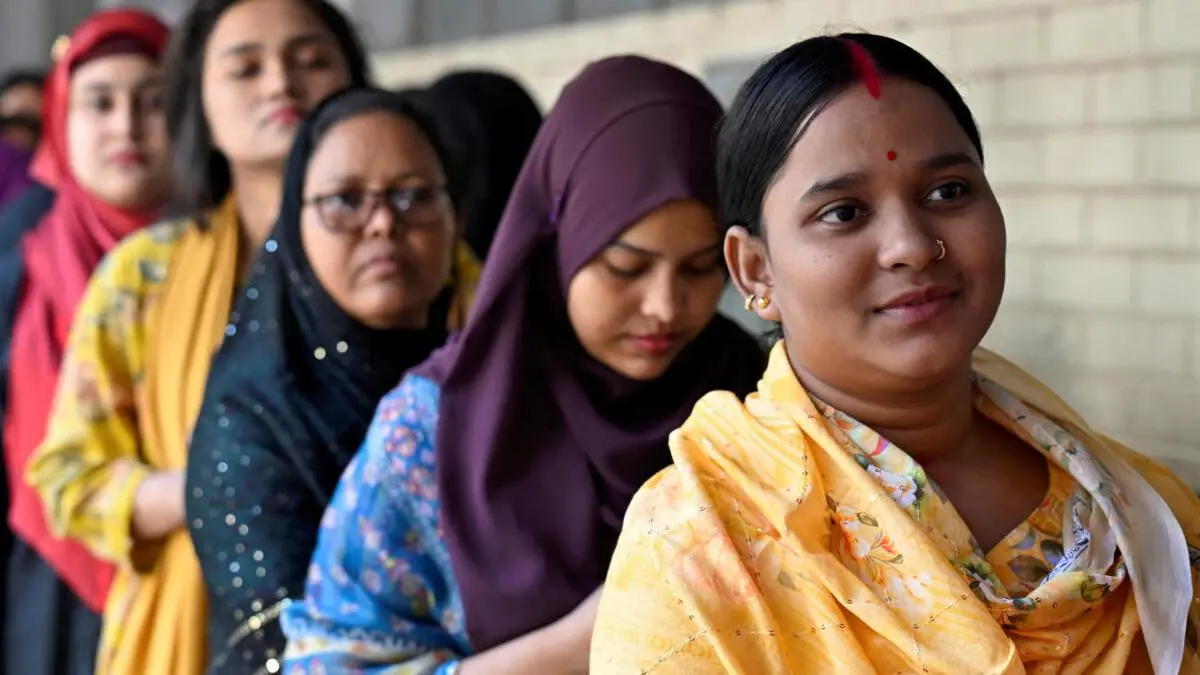
What is irrefutable is women voters are increasingly the determining factor across States
With the Election Commission of India announcing Assembly election schedules for Kerala, Assam, Tamil Nadu and West Bengal on March 16, a significant number of commentators, pundits and analysts have already started harping about how the welfare measures (especially the women-specific ones) could influence voter sentiment.
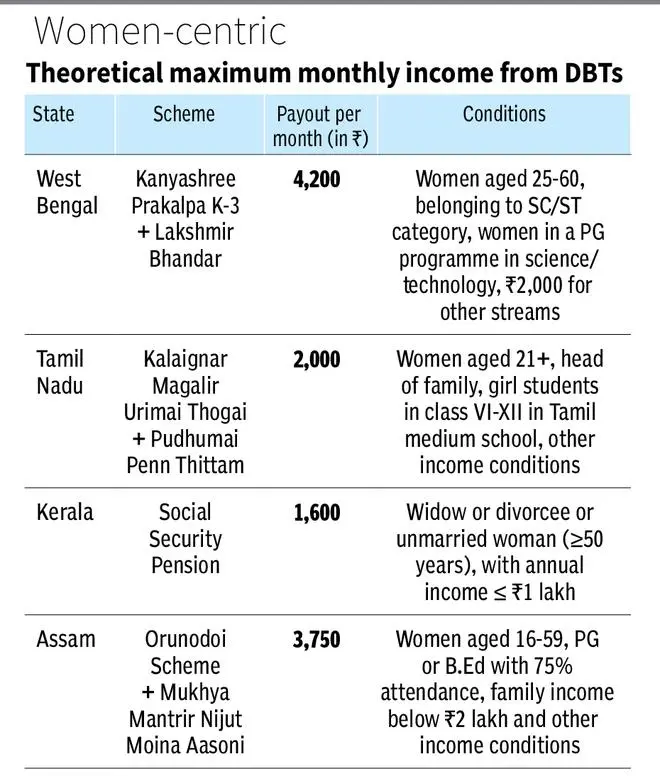
At businessline, however, we want our readers to know just how much can a qualifying woman or household from each of these States “earn” per month from a possible combination of the direct benefit transfer (DBT) schemes active in their States.
State-wise
In West Bengal, a combination of luck and choice can net you up to ₹4,200 per month. Under the Kanyashree Prakalpa (K-3) girls pursuing post-graduation in science and technology are given ₹2,500 per month while Lakshmir Bhandar currently gives ₹1,700 per month to women belonging to the SC/ST communities. Given that the Lakshmir Bhandar scheme is a non-competing scheme, in the sense that all permanent residents of West Bengal aged 25–60 years and not a government employee or pensioner, can avail the benefits irrespective of other DBT schemes, and there is no upper age-limit for availing K-3, a woman aged above 25 pursuing a PG degree, from the SC/ST community, can receive ₹4,200 per month.
In Tamil Nadu, a household can net a maximum of ₹2,000 monthly through the combination of Kalaignar Magalir Urimai Thogai (KMUT) and Pudhumai Penn Thittam. However, the qualifying conditions are extremely stringent. Apart from several income related categories, the woman must be aged more than 21 years and be recognised as the head of family in the ration card to avail the ₹1,000 DBT provided under KMUT, presently. To get the other ₹1,000 under Padhumai Penn Thittam the claimant must also have a girl or transgender child who is currently pursuing UG/ITI/Diploma/other courses recognised by the Tamil Nadu government and has previously also studied in a Tamil-medium institution from Class VI to Class XII.
Kerala’s Social Security Pension schemes, which incidentally were also some of the earliest such schemes offered in the country, provides for a maximum of ₹1,600 per month. However, the qualifying conditions are quite dismal as women need to be either widows, divorcees, or never-married by the age of 50 with their annual incomes below ₹1 lakh.
In Assam, a potential ₹3,750 monthly payout via the Orunodoi Scheme and Mukhya Mantrir Nijut Moina Aasoni is possible. However, this maximum is only receivable for 10 months in a year, and only to PG and B.Ed. students where ₹2,500 is paid under the Mukhya Mantrir Nijut Moina Aasoni, which can be supplemented by ₹1,250 per month from the Orunodoi Scheme by those who also qualify under the various income criteria of the Orunodoi Scheme.
The DBT welfare debate
These schemes provide a steady financial cushion, improving household stability and enabling access to education and basic needs. They also empower women economically, often positioning them as key financial decision-makers within families. However, concerns about fiscal sustainability and whether such schemes create long-term economic mobility or feed short-term dependency, remain.
Women voters, the decisive factor
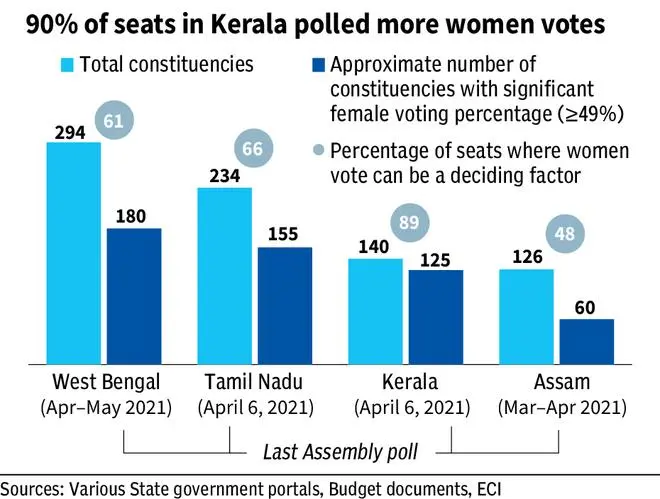
What is irrefutable though is that the women voters are increasingly the determining factor across these states. Voter data from the last Assembly elections in these states, show that in Kerala, approximately 89 per cent of constituencies have half of their polled votes from women, followed by Tamil Nadu at 66 per cent, West Bengal at 61 per cent, and Assam at 48 per cent. In absolute terms, this translates to 125 constituencies in Kerala, 155 in Tamil Nadu, 180 in West Bengal, and 60 in Assam where women could swing outcomes. As elections approach, the various DBT schemes are not just welfare tools but strategic instruments in shaping electoral outcomes.
Published on March 18, 2026