
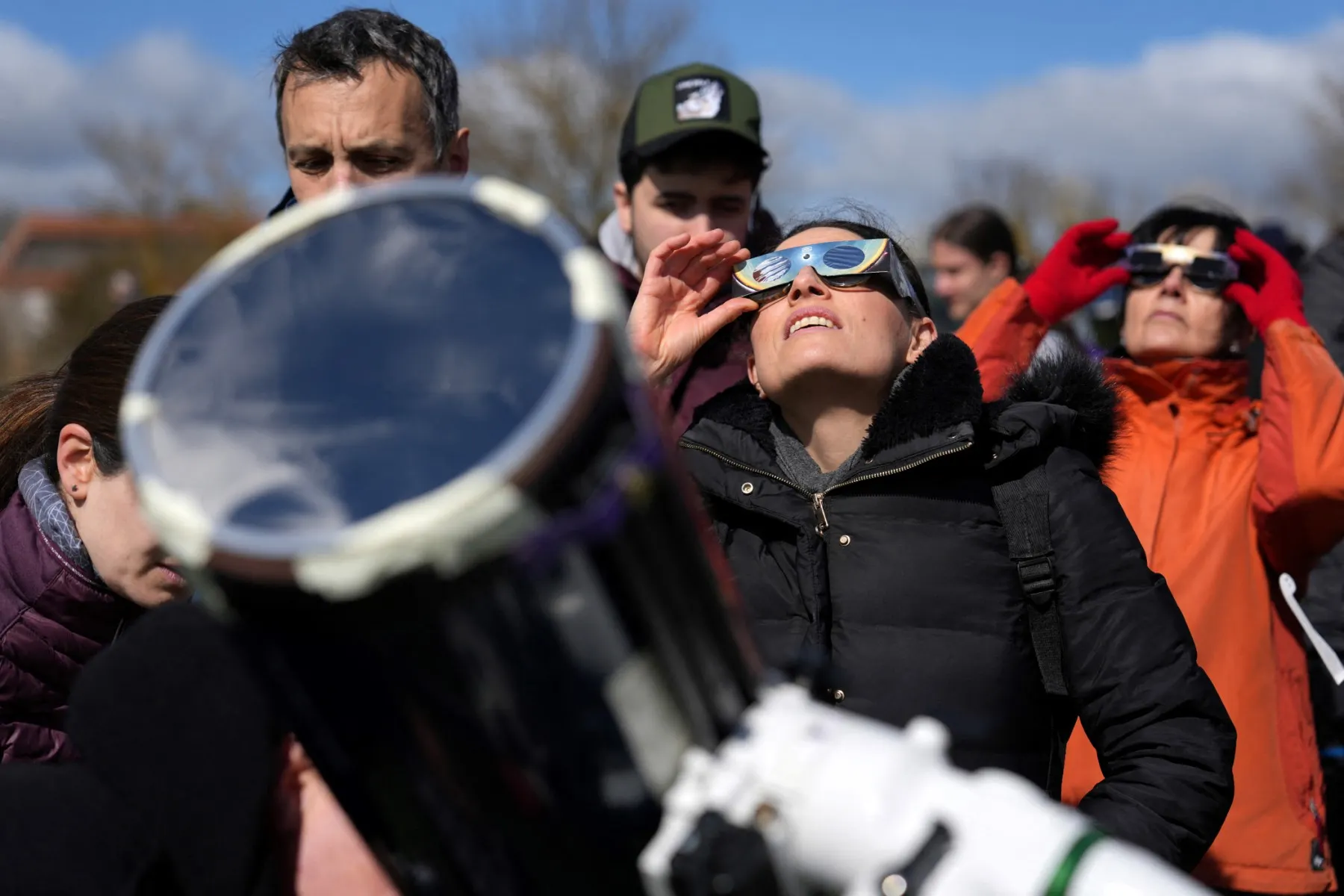
Aside from Spain, the next total solar eclipse will also be visible in Greenland, Iceland, Russia and a small portion of Portugal, with a partial eclipse in other parts of Europe and western Africa.
The Spanish government said in a statement on Thursday that the Iberian Peninsula “will be the only populated place in the world where the total solar eclipse of August 12th can be fully enjoyed, the first of its kind visible in our country in more than 100 years”.
At its peak, when the moon completely covers the sun, darkening the sky in the middle of the day, the eclipse will last just over two minutes in Spain.
The government said Thursday it has selected the Yebes Observatory in the central province of Guadalajara — a key node in global radio astronomy networks — as the official monitoring centre for the eclipse.
READ ALSO: Where to travel in Spain to see the solar eclipse this summer
It will be the first of three major eclipses Spain will experience between 2026 and 2028.
On August 2nd 2027, a second total solar eclipse with an unusually long duration of six minutes will cross southern Spain, while an annular eclipse — in which the moon does not fully cover the sun, leaving a bright ring — is expected in January 2028.
Accommodation prices have already surged in areas where the total solar eclipse will be visible but which are not typically popular summer tourism destinations.
A search for lodging on Thursday in the northeastern city of Teruel for the night of August 12 showed prices ranging from about 300 euros ($351) for a modest hostel to €1,400 for a privately rented apartment.
In Burgos, no accommodation was available for less than €600, while a 60-square-metre (645-square-foot) apartment was listed at €5,000.
Teruel’s tourism office has promoted the city as an ideal location to observe the eclipse, citing its open landscapes, clear skies and low levels of light pollution.