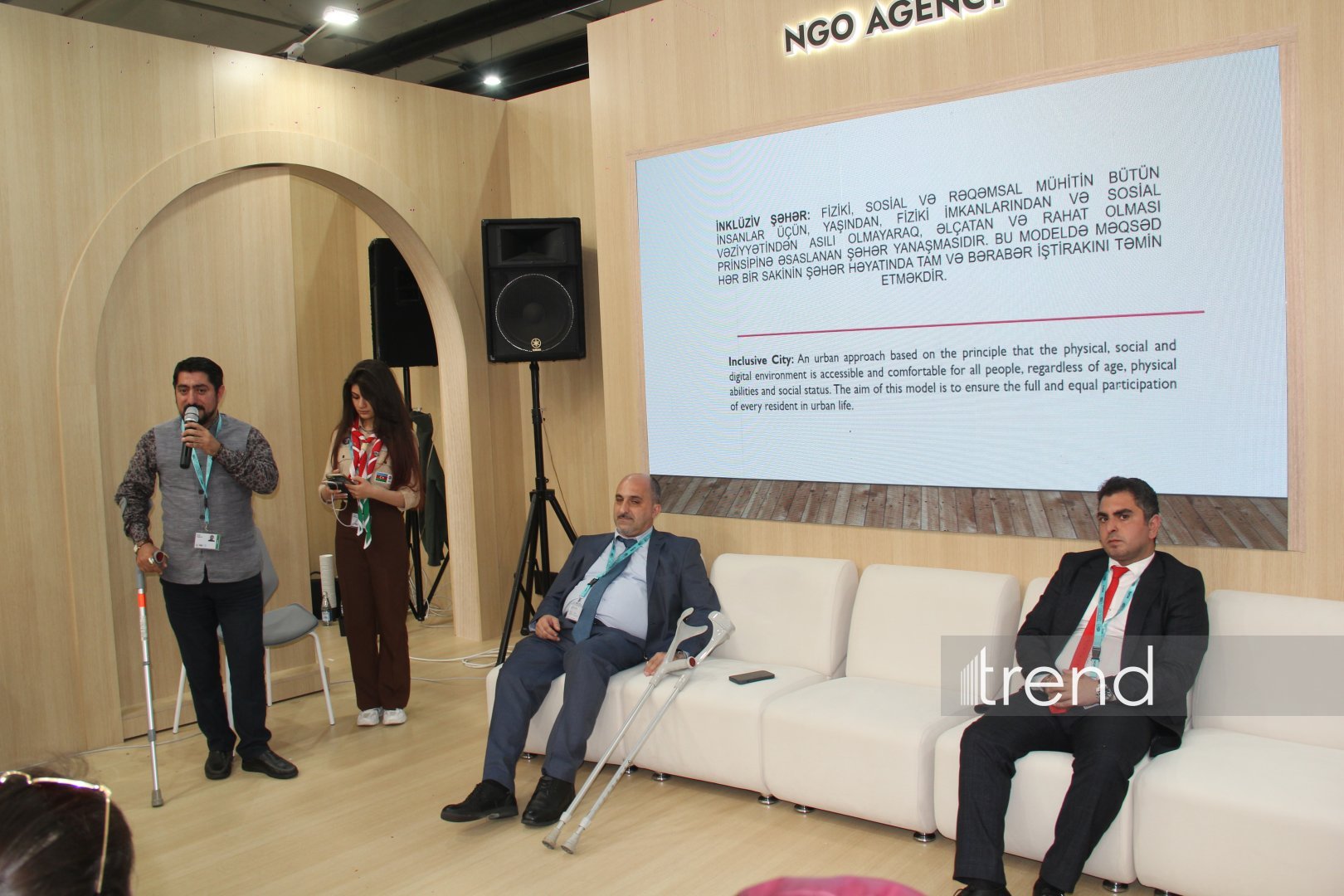
BAKU, Azerbaijan, May 21. At the World Urban
Forum in Baku, the Blood Donors Association organized an event
titled “Inclusive City: Creating an Accessible Urban Environment
for All” at the pavilion of Azerbaijan’s State Agency for Support
of NGOs, Trend
reports.
The guest of the meeting was Aydin Khalilov, chairman of the
Center for Independent Living for Persons with Disabilities, an
expert on the implementation of ESG standards and inclusive
business processes, and a consultant on social inclusion and
universal design with over 20 years of experience.
During the discussion, participants addressed contemporary
approaches to building inclusive cities, the physical and social
barriers people with disabilities face daily, as well as issues of
accessibility in public spaces, transportation, and the digital
environment.
Particular attention was paid to the principles of universal
design and a human-centered approach in urban planning.
Participants noted that a modern city must be comfortable and safe
for all segments of the population, regardless of age, physical
abilities, or social status.
In an interview with Trend, Aydin Khalilov noted that the
concept of an inclusive city is much broader than simply creating
basic infrastructure.
“An inclusive city is not just about ramps and elevators. It is
an environment in which every person can live safely,
independently, and with dignity, move about freely, receive an
education, work, and fully participate in public life,” he
said.
According to him, when designing the urban environment, it is
important to consider not only architectural accessibility but also
the participation of people with disabilities themselves in the
decision-making process.
“It is very important that people with disabilities are not
merely recipients of services, but full participants in urban
planning and development processes. Only then can we create a truly
effective inclusive system,” noted Aydin Khalilov.
The discussions also highlighted the role of ESG standards in
the activities of government agencies and businesses. Experts
discussed the development of inclusive business models, expanding
employment opportunities for people with disabilities, and
fostering corporate social responsibility.
Participants paid special attention to digital accessibility and
modern technological solutions capable of increasing social
engagement.
During the event, examples of international experience and
innovative practices were shared, which could potentially be
applied in Azerbaijan to create a more accessible and inclusive
urban environment.
Participants noted that holding such discussions at WUF13
demonstrates Baku’s commitment to developing modern approaches to
urban planning, where the focus is on people and their right to
full participation in city life.
WUF13 is taking place in Baku from May 17 through 22 as part of
a collaboration between the United Nations Human Settlements
Program (UN-Habitat) and the Azerbaijan government. WUF13 features
121 pavilions, including 41 national pavilions, with over 40,000
participants registered from 182 countries. The forum is dedicated
to the theme “Housing the world: Safe and resilient cities and
communities,” and addresses such important issues as the global
housing crisis, sustainable urbanization, urban resilience, the
impact of climate change on cities, and modern urban
governance.