
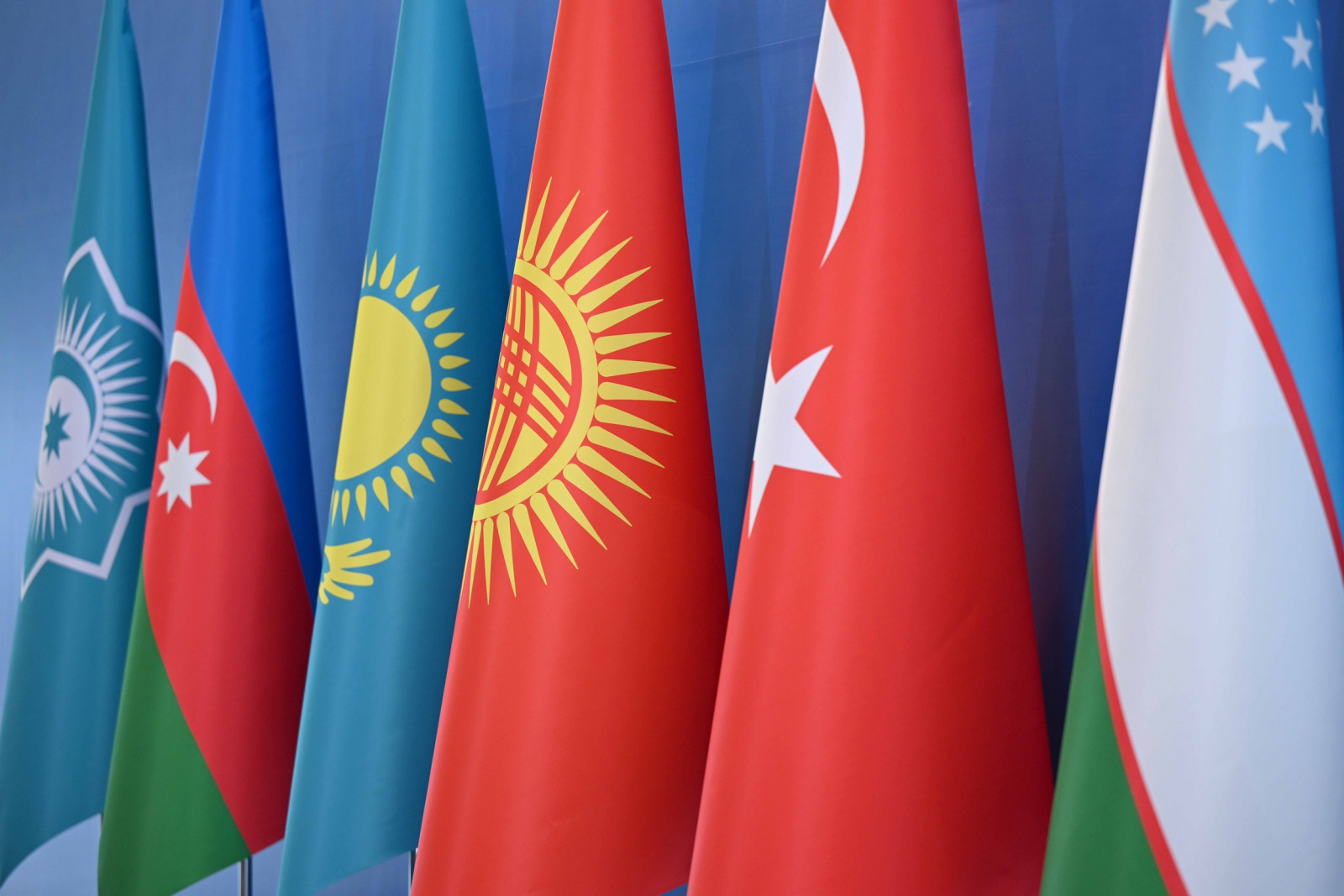
BAKU, Azerbaijan, May 18. The informal summit
of the Organization of Turkic States in Turkestan, held on 15 May,
once again demonstrated that technological integration is playing
an increasingly important role in the modern world.
The main topics of the meeting were digital development and
artificial intelligence. This is directly linked to the future
competitiveness of the region in the context of global
technological transformation. For Kazakhstan, this agenda is of
strategic importance, as the country seeks to reduce its dependence
on a resource-based economy and develop new sources of growth.
Notably, 2026 has been declared the Year of Digitalization and
Artificial Intelligence.
Today, the country’s economy still largely relies on the export
of oil, gas, and metals; however, the authorities openly
acknowledge that in the coming decades, the state’s sustainability
will depend on its ability to integrate into the digital economy.
It is noteworthy that Kazakhstan’s IT services exports exceeded $1
billion last year, and the digital sector is gradually becoming one
of the fastest-growing areas of the economy.
In his speech, President Kassym-Jomart Tokayev stated that
technological progress has become a factor of stability and
security in all countries of the world. He emphasized that states
that timely adoption of digital technologies will not be left “on
the sidelines of progress.”
In this context, Kazakhstan is seeking to position itself as a
regional digital hub in Central Asia. The international center
Alem.ai has already been opened in Astana, two supercomputers have
been launched, and the next stage is expected to be the creation of
a “Data Center Valley.” This project is being developed in
Ekibastuz in the Pavlodar region, where land plots have already
been allocated, a 215 MW substation has been acquired, and basic
infrastructure has been established. Kazakhstan is also holding
talks with more than 20 hyperscale companies from the United
States, China, and India operating in cloud computing, big data,
and digital services. The total potential of the project is
estimated at up to 1 GW.
In essence, this refers to the creation of the largest regional
data storage and processing center, which is expected to attract
international digital capital and global technology companies.
At the same time, digitalization for Kazakhstan also means the
modernization of the traditional economy. In the oil and gas and
mining sectors, technologies enable predictive maintenance of
equipment, optimization of logistics for mining machinery, and
improved industrial safety. In agriculture, satellite imagery
analysis will help forecast yields and use water resources more
efficiently, which is especially important for the southern regions
of the country.
Particular attention is being paid to the development of the
Trans-Caspian International Transport Route, whose digitalization
is expected to reduce cargo processing times at customs checkpoints
and increase Kazakhstan’s transit attractiveness as a link between
China, Central Asian countries, and Europe.
Another important direction is the development of human capital.
The country is preparing to launch an Artificial Intelligence
University. Tokayev announced readiness to provide special grants
for citizens of Turkic states, while migration procedures for
qualified specialists are being simplified.
Tokayev also highlighted the introduction of a “golden visa” for
foreign entrepreneurs and investors, which grants access to state
and financial services on equal terms with Kazakhstan’s citizens.
At the same time, the authorities are seeking to strengthen the
country’s technological sovereignty. This includes the development
of domestic language models and digital solutions adapted to the
Kazakh language, legislation, and cultural context. This is viewed
as a tool for data protection and reducing dependence on foreign
platforms in education, healthcare, public administration, and the
financial sector.
The summit also demonstrated the Organization of Turkic States’
aspiration to create a unified digital space. Secretary General of
the OTS Kubanychbek Omuraliev stated that digitalization is
becoming the main factor of economic growth and regional
resilience. He recalled the “Turkic ID” project, which already
allows citizens of several countries to use national identity cards
instead of passports when crossing borders. President Recep Tayyip
Erdoğan, in turn, emphasized that cooperation in the technological
sphere must be elevated to the “highest possible level,” and that
digital development should become a strategic vision for the common
future of the Turkic world.
At the same time, Kazakhstan deliberately emphasizes that the
Organization of Turkic States is not a military or geopolitical
bloc. Tokayev explicitly rejected attempts to portray the OTS as a
military alliance and stated that the organization is primarily
being developed as a platform for trade, economic, technological,
and humanitarian cooperation.
This demonstrates Astana’s intention to use Turkic integration
primarily as a tool for economic development, investment
attraction, and strengthening regional competitiveness. The
Turkestan summit effectively presented a new development model for
the OTS, in which digital infrastructure, logistics, education, and
technology are expected to gradually become an alternative to the
resource-based economy and the foundation of long-term economic
growth.
