Every year, 800,000 people aged between 16 and 25 take part in a Defence and Citizenship Day in France – a requirement for all young French citizens. Emma Albright explains what to expect on the day.
When I turned 16 years old, I was excited for two things: getting my own carte vitale (France’s health card), and getting to skip a day of school to attend the mandatory Journée de Défense et de Citoyenneté (JDC).
It is a requirement for all young French citizens – including those recently naturalised – and is a prerequisite for sitting the baccalauréat, applying for certain public jobs, or obtaining a driving licence.
But my mother had other plans for me and under no circumstance was I to miss school. So she signed me up for a slot that was during a school holiday.
At the time, she went to our local mairie to sign me up but today it is possible to do it online. In both cases you then receive a formal letter in the mail or in person at the mairie, giving you a date and time for your course.
READ MORE: What is France’s ‘citizen service’ and who has to do it?
The programme has changed slightly from when I did it, a decade ago (hurts me to say it), but overall, the day follows the same type of schedule.
The day usually lasts seven hours, starting at 8.30 am and ending at 3.30 pm, and happens in the nearest military centre near your home.
It was quite a weird feeling for me, as a shy teenager – walking into a room full of other shy teenagers was probably my worst nightmare at the time. On the bright side, no one knew one another, so it was equally as awkward for us all.
After a brief welcome speech on how the day was going to go and singing France’s national anthem, military instructors, all dressed in uniform, showed us a video of all the different jobs that the military had to offer.
At the time, I remember thinking it felt like propaganda (we were most likely studying that particular subject in school at the time). But in reality, looking back, it was quite interesting to know about the different jobs that were possible.
When thinking about the military, I used to think only about soldiers but there are so many other jobs you can do within that field. I think this day is a good way of presenting young people the options that they can have.
We then had several group discussions about what it means to be a French citizen based on the human rights charter (charte des droits et devoirs du citoyen français), and a language test to assess basic proficiency in the French language.
I remember learning a lot and as the morning unfolded, we all started to break out of our teenage shells to engage in group discussions and even talk amongst ourselves.
By lunch time, the awkwardness had lifted. We went down to the cafeteria and had a typical French meal: starter, main dish, cheese, some sort of dessert and fruit.
In 2025, the JDC changed a little and apparently now, France’s official website Service Public, describes the lunch as “served in the form of combat rations”. I guess it helps people immerse into the military ambience even more?
READ ALSO: What’s in store if your child is doing France’s Journée de Défense et de Citoyenneté this year
We then had a class on first aid and learned what to do if someone fainted, was choking on something and which numbers to call in case of an emergency.
We also learned how to use a defibrillator and where to find them if needed. This was quite useful as I have always wondered what the green boxes found everywhere were used for. There are actually 500,000 of them across the country which can be found in hospitals, train stations, offices etc.
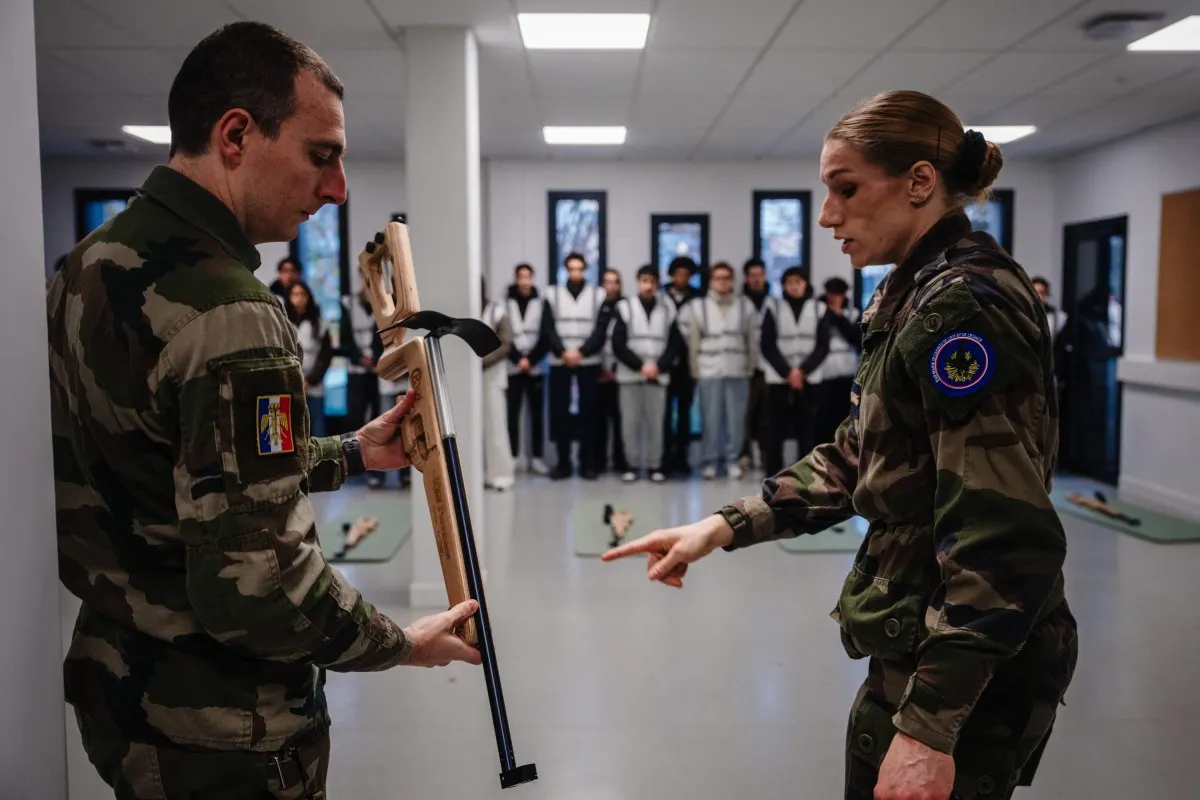
Today, it seems as though they have scrapped the first aid lesson and replaced it with a laser-target shooting simulation and a careers forum with military officials and officers from the National Gendarmerie.
The day ended with us receiving an official certificate, stating that we had fulfilled our duty as young citizens – and of course to make sure not to lose it if we wanted to pass our driving test or work in the civil service one day.