BAKU, Azerbaijan, May 2. The Baku Marathon 2026
was held in the capital of Azerbaijan at the initiative of the
Heydar Aliyev Foundation, Trend reports.
It went far beyond a sporting event and became a large-scale
city festival.
From early morning, State Flag Square became a vibrant,
pulsating hub, with thousands of runners, media personalities,
diplomats, and representatives of culture and science flocking
there. The atmosphere felt more like the start of a grand festival,
where sport and entertainment merged, rather than the start of a
race.
While in previous years Baku hosted a 21-kilometer half
marathon, this year the city hosted the full 42-kilometer distance
for the first time. The route began at the square and ended at Sea
Breeze, covering the capital’s key thoroughfares and turning the
city itself into a backdrop for this dynamic event.
Eduard Mamedov, Vice President of the Azerbaijan Kickboxing
Federation and 30-time world champion, noted the importance of the
Baku Marathon in an interview with Trend.
“Every year, it attracts more and more people, attracting the
attention of both amateurs and renowned athletes. Such competitions
not only popularize sports but also foster a healthy lifestyle
culture and play an important role in educating young people,” he
said.
Holding the full marathon in Baku takes this event to a new
level, Olympic champion, multiple world and European champion, and
vice president of the Azerbaijan National Olympic Committee Zemfira
Meftakhetdinova told Trend in an interview.
“There’s an incredible atmosphere here: professional athletes,
amateurs, and even Olympic champions are all at the start and along
the course. This motivates and inspires everyone to move forward,
regardless of their level of training. The marathon brings together
people – those who love sports, support it and simply want to be
part of this great movement,” she noted.
The fan zone at the start lasted until late in the evening:
music, applause, an open stage, and an atmosphere that could be
summed up in one phrase: even if you’re not running, you’re still
part of the event. The concert program became a special attraction:
Tunzala Agayeva, Nigar Jamal, Samira Efendi, Eldar Gasimov, and
many other performers took the stage, creating a true musical
palette for the country.
At the finish line, the marathon reached an emotional climax.
Participants were greeted by music, volunteers, photo booths, and
applause. Here, fatigue gave way to joy, and each runner felt a
small victory.
The distance turned into a true journey across Baku: from the
Seaside Boulevard to Neftchilar Avenue, from White City to Heydar
Aliyev Avenue. Along the route, dozens of support stations
operated, providing water, medical assistance, and motivation that
literally pushed runners forward.
The geography of the marathon was extensive: participants from
the USA, Germany, the United Kingdom, China, Georgia, Kazakhstan,
Kyrgyzstan, Uzbekistan, Russia, Türkiye, Ukraine, and other
countries competed for victory. At the same time, the event
preserved its inclusivity, with people with disabilities and
participants with Down syndrome taking part.
“The Baku Marathon is not just a sporting event; it is a space
of equal opportunities and inner strength. For us, Paralympians,
participating in the marathon is not only a chance to test
ourselves but also to show society that limitations exist only
where self-belief ends. The Baku Marathon unites, inspires, and
proves that human strength lies not in physical abilities, but in
character and the determination to move forward,” said Bahlul
Aliyev, deputy chairman of the Public Association for Support and
Social Rehabilitation of People with Disabilities, first-group war
disabled veteran of the Karabakh War, multiple winner of the Baku
Marathon, and para-cyclist, in an interview with Trend.
And of course, this marathon knows no age limits.
Tapdyg Dadashov, 67, winner of a full marathon in Türkiye among
veterans, is a vivid example for the younger generation.
“Such events bring people together and provide strong
motivation. I want young people to look at such examples and
understand: it is important to take care of health, engage in
sports, and not be afraid to set new goals at any age,” the veteran
of Azerbaijani sports told Trend.
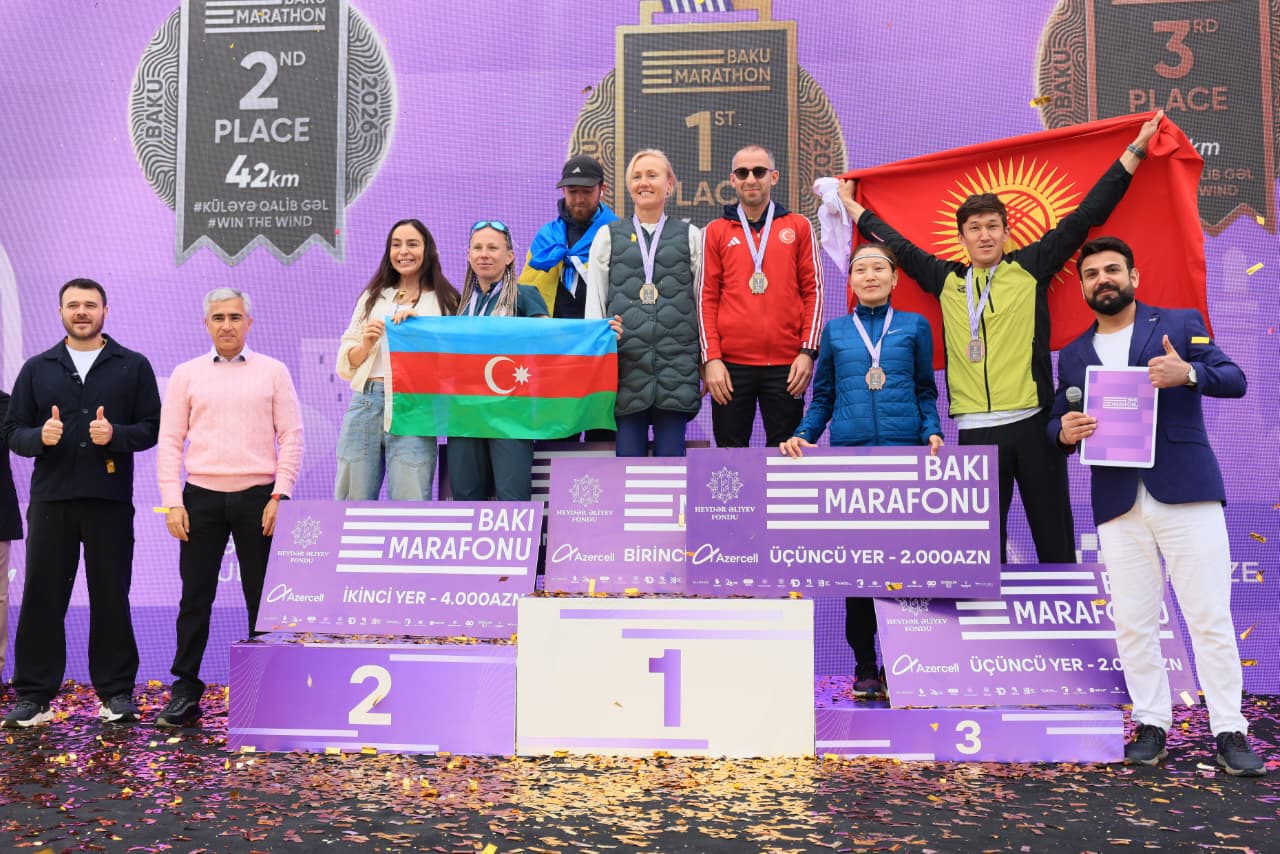
Among men, Turkish athlete Ahmed Alkanoglu was the first to
cross the finish line. Ukrainian participant Vitaliy Shafar took
second place, while Kyrgyz athlete Yrysheldi AkeroV finished
third.
For the Turkish winner, the Baku Marathon turned out to be
lucky.
“I had previously won the half marathon in Baku, and once again
here at the Baku Marathon I am very happy to have taken first
place. Today the competition was a bit tougher because we raced in
very strong wind conditions. I am happy that I raised the Turkish
flag today. I hope to achieve even better results in bigger
marathons,” the athlete said after the race.
Among women, Elena Tolstykh from Russia took first place, Anna
Yusupova from Azerbaijan came second, and Shirin Akimbay from
Kazakhstan took third place.
Interestingly, even before the start, in an interview with
Trend, the Russian participant, who had come to Azerbaijan for the
first time, expressed hope for a successful debut on the Baku
course.
“The impressions are good, the atmosphere is very warm. People
are friendly, you can feel the sporting spirit and support. From
the distance I expect an interesting race and, of course, new
emotions,” she said, turning those expectations into victory.
In the finish zone of the marathon at Sea Breeze, medals were
presented to the winners by Leyla Aliyeva, Vice President of the
Heydar Aliyev Foundation and founder and head of the IDEA Public
Union.
The ceremony was also attended by Anar Alakbarov, Assistant to
the President of the Republic of Azerbaijan and Director of the
Heydar Aliyev Center, and Emin Agalarov, President of Agalarov
Development.
The major celebration was marked by valuable prizes. First place
received 6,000 manats, second place 4,000, and third place 2,000.
In addition, all participants who completed the distance were
awarded medals. Moreover, the first 2,000 participants who were
unable to complete the full 42-kilometer distance but finished the
21-kilometer half marathon were also awarded medals, while those
who completed the 10-kilometer distance received certificates.
There were also special awards: the first finishing male and female
students, the first corporate participants (male and female), and
the oldest participants (male and female).
That day, Baku was not just hosting a marathon—it was living it.
The city became a single stage where everyone found their own
distance: some ran 42 kilometers, others experienced a single
vibrant day filled with music, movement, and a shared sense of
celebration.